Challenging Direct Mail Best Practices: A Minnesota Zoo Membership Acquisition Case Study

What We Did
- Direct Mail
The Situation
It’s a widely held belief that direct mail letters outperform postcards—especially in membership programs. While a postcard can stand out in the mailbox due to the unusual format, often larger size, as well as a reliance on appealing graphics, a letter package offers more room to tell a story, includes the traditional membership grid, and gives the recipient two ways to give: online through the use of a QR code or by mail, paying by check or credit card and returning payment in the courtesy reply envelope. Our letter also gave readers the ability to call in to charge their membership over the phone and provided the added option of bringing the letter to the Zoo to take advantage of the discount offer and pay on-site.
The Work
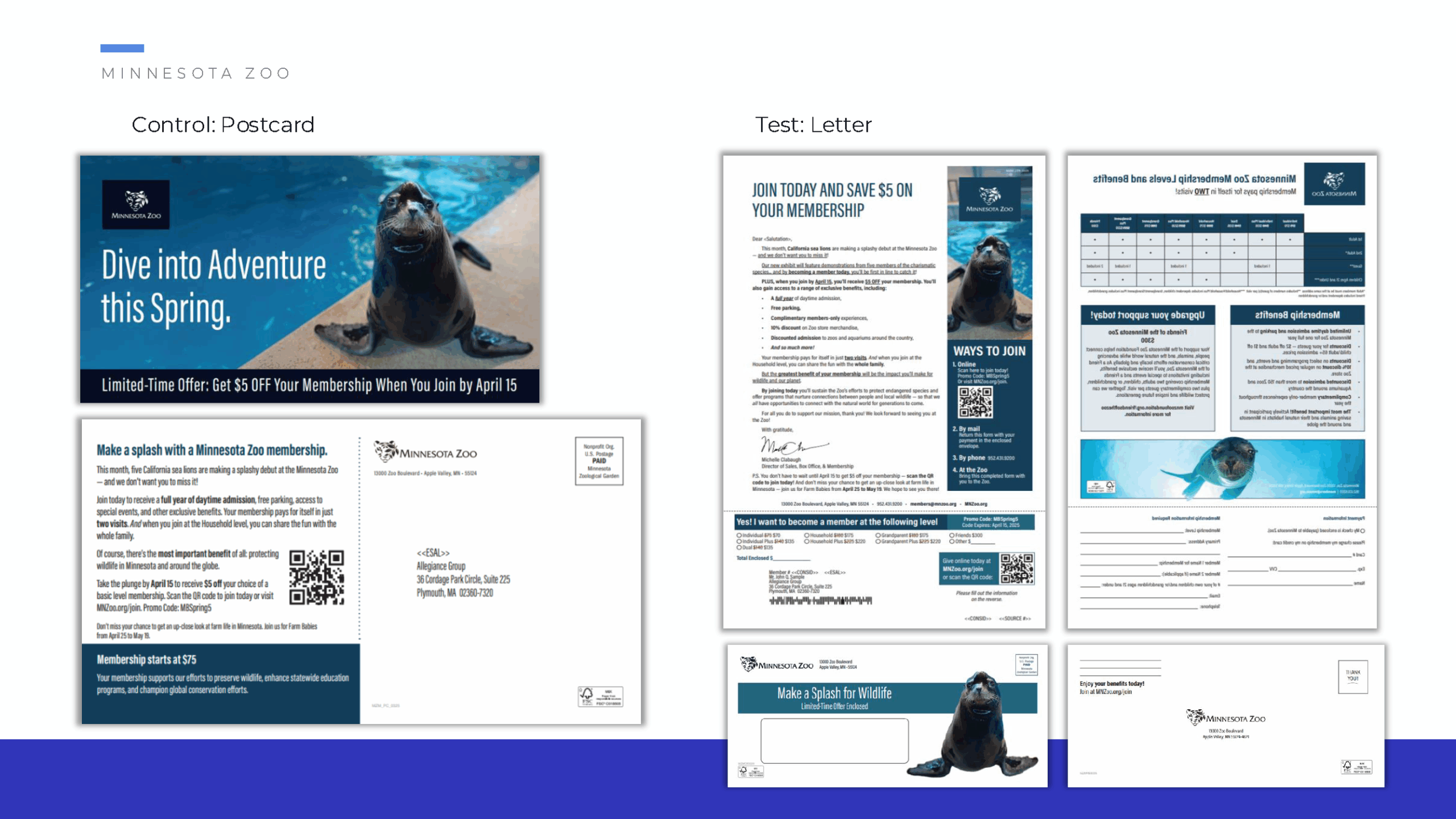
One of our earliest membership campaigns for the Minnesota Zoo was in the Spring, when we mailed a 6 ¼ x 11 ½” full-color postcard vs. a traditional #10 letter package. The postcard surprisingly lifted response by 8%. This modest lift proved not to be statistically valid based on the mail volume. Interestingly, the average gift was the same for both the test and control cells.
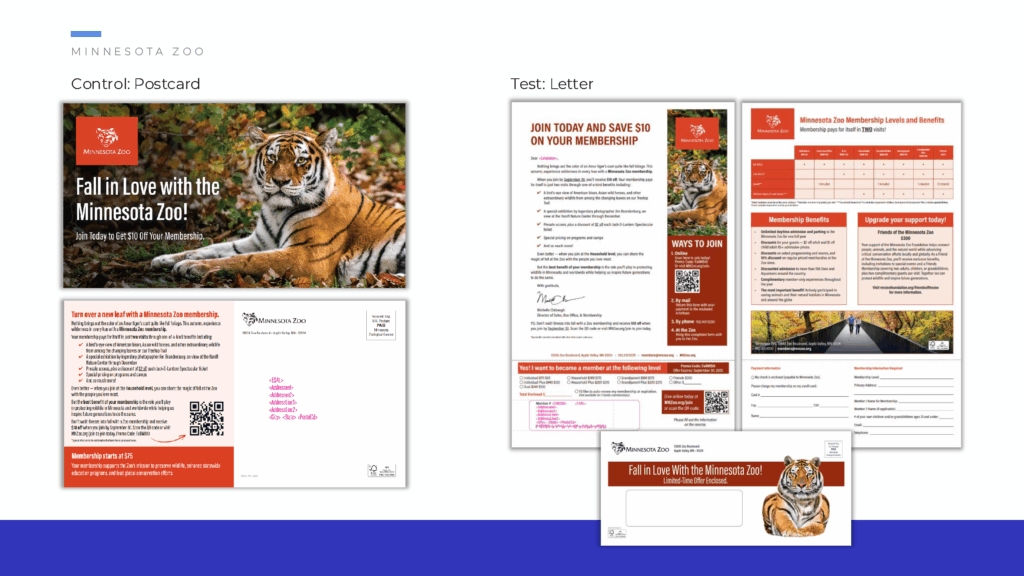
We retested this format in August with a “Fall in Love with the Minnesota Zoo” theme. The audience included cold acquisition prospects, ticket buyers, and members whose memberships had lapsed as long as two years ago. This time, the letter yielded a 15% higher response rate, which was statistically significant at the 95% confidence level. In this campaign, there was a slight variation in the average gift, with the postcard generating a modest 1% increase in the average gift.
The Results
Contrary to common practices and based on the results of our statistically valid re-test, with an ROI of $2.61 in the fall campaign, the Minnesota Zoo is instituting a postcard as its going-forward control format for membership acquisition (vs. #10 with an ROI of $2.02).
We decided to test again in the August campaign to validate the higher response rate observed with the postcard for the March campaign, but also to test based on seasonality.
Although the letter produced a slightly higher response rate for the August campaign, that lift was not significant enough to overcome the higher cost package.
Ready to craft your direct mail efforts?

Public media station crushes paid media ROI benchmarks
Nonprofits, Public Media, Digital Marketing

A Smarter Path to Acquisition: How City of Hope Elevated Response, Revenue, and Long-Term Value
Hospitals & Healthcare, Nonprofits, Direct Mail