Recurring Giving Simplified: How to Beat Fundraising Fatigue

Imagine this: you’re nearing the end of the quarter, and your team is once again scrambling to meet revenue goals. If this sounds familiar, your team is likely caught in a cycle of constant asks, unpredictable revenue, and pressure to perform—also known as fundraising fatigue. And to be honest, it’s likely your donors are feeling it, too.
Recurring giving is a strategic way to combat fundraising fatigue, deepen donor relationships, and empower your organization to plan for the future. Not only do monthly donors contribute more annually than one-time donors, but they also tend to have a much longer donor lifetime and higher retention rates. As a result, recurring giving drives more revenue and gives your team opportunities to foster relationships for less work.
This guide makes a strong case for why your nonprofit organization needs a recurring giving program, along with a few tips and best practices.
Combat fundraising fatigue and start securing reliable recurring revenue with help from our fundraising experts.
Recurring Giving FAQs
What is recurring giving?
Recurring giving, also called sustainer or monthly giving, is a fundraising model in which a supporter allows a nonprofit to automatically charge a predetermined amount to their credit card or bank account each month. For example, a recurring donor might donate $30 each month.
This strategy allows donors to conveniently give each month, shifting the process from a series of transactions to an ongoing, predictable partnership.
Why do nonprofits need recurring gifts?
Too many nonprofits find themselves stuck in a traditional, calendar-based cycle of fundraising events, emergency appeals, and reactive planning in response to challenging economic forces and funding cuts. This creates a cyclical “fundraising treadmill” that you can’t get off of:
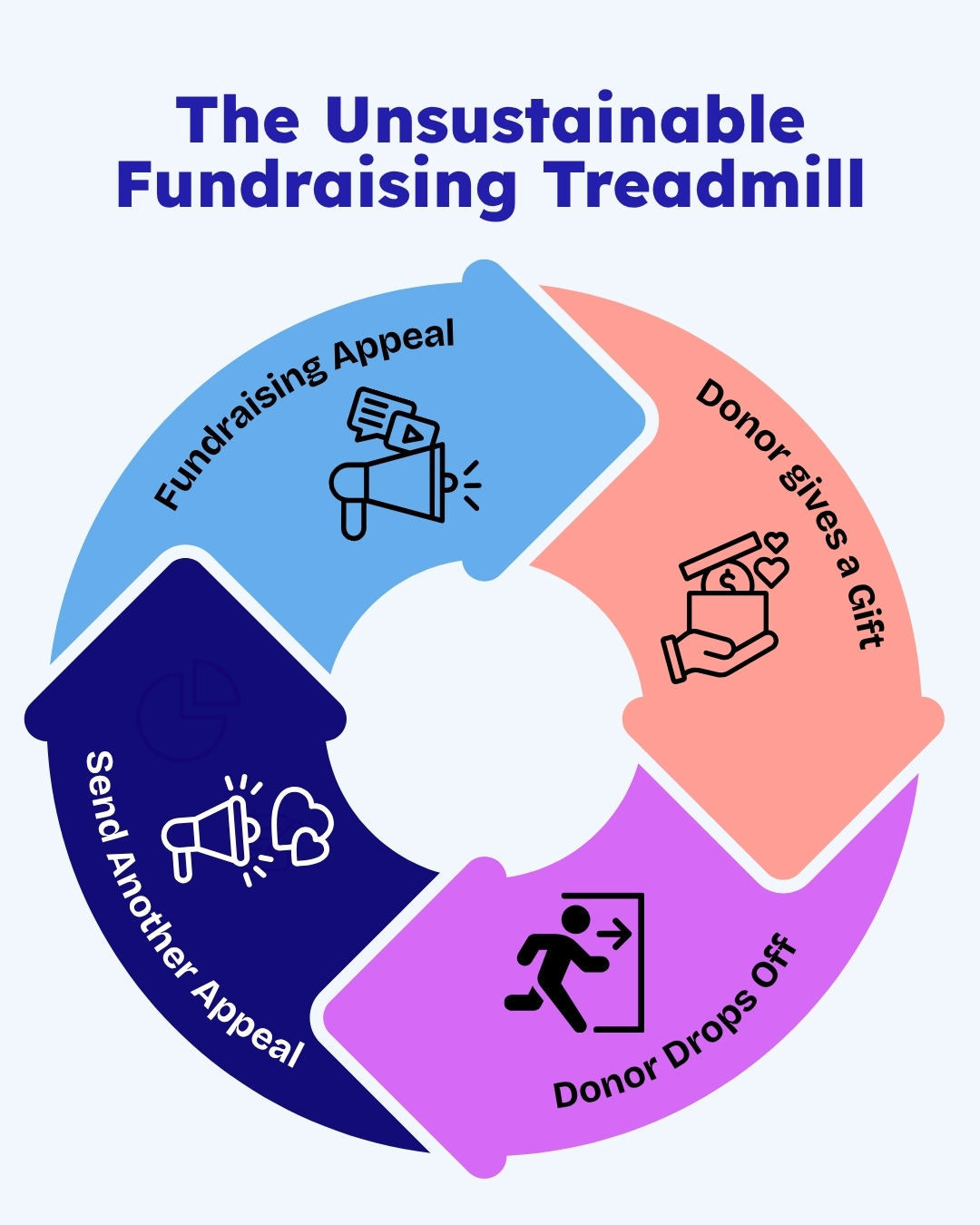
- Your team makes a fundraising appeal.
- The donor decides to give a gift.
- The donor drops off.
- You have to start from scratch, and the cycle starts over.
It can be exhausting to meet annual budget goals year after year while navigating increased competition for donor dollars, especially when there’s no time for long-term planning or strategic assessment. This constant drive for new donor acquisition, meeting revenue goals, and the high cost takes its toll.
What are the benefits of recurring gifts?
Monthly donations create a predictable revenue stream that allows organizations to plan, invest confidently, and avoid the feast-or-famine cycle that can derail critical work. Unlike major gifts or occasional appeals, recurring donations don’t rely on year-end urgency or one-off emergencies.
Rather, they accumulate quietly, consistently, and powerfully over time:
- The average monthly gift is $52, translating to $624 annually—this is significantly higher than the average one-time gift.
- The recurring donor retention rate is between 80 and 95%, compared to a sector-wide average of 46% for general donor retention.
- Most monthly donors stay engaged for 5 to 7 years.
- Monthly donors are more likely to upgrade, contribute special gifts, and convert to mid-level or planned giving over time.
In fact, monthly donors now contribute more than 30% of digital fundraising revenue. Sustainer giving provides predictable income, which allows nonprofits to:
- Forecast more accurately
- Reduce reliance on crisis campaigns
- Focus energy on cultivation, strategy, and storytelling
Are recurring donors more loyal?
Yes, on average, recurring donors tend to be more loyal to your cause than non-recurring donors. As we’ve mentioned, recurring donors typically stay engaged for five to seven years, while non-recurring supporters average at only about 18 months.
Additionally, the recurring giving model frames giving as a long-term commitment rather than a one-and-done single decision. When these donors join your program, they’ll view it as an opportunity to make a sustained impact via a convenient subscription-style program.
Case Study: The Human Impact of Recurring Giving Programs
One of our clients, a mid-size arts nonprofit, relied on the traditional calendar approach to fundraising. The nonprofit sent appeals every six to eight weeks in addition to hosting a series of fundraising events throughout the year. Staff were overworked, and donors weren’t given the attention—or giving options—they deserved.
By embracing recurring giving and focusing on the long term, staff members got off the dreaded fundraising hamster wheel. They stopped chasing big gifts and endless events, reported less stress, and were finally able to:
- Deepen donor relationships, helping donors feel seen, heard, and valued.
- Explore planned giving and mid-level strategies.
- Focus on innovation and storytelling instead of fire drills.
Donor loyalty has deepened, translating into advocacy and volunteerism. They aren’t just donors—they’re community members.
How to Build Buy-In for Recurring Giving
Despite the benefits, many sustainer programs remain under-resourced. They’re often neglected, misunderstood, or misused. Changing that mindset starts with building an internal business case.
Nonprofit leaders need to shift the perception of monthly giving from a passive donor preference to an active strategic priority.
Here’s how to make the case:
- Show the math for the cost per donor vs. lifetime value. It may cost a bit more upfront, but the donor lifetime value for recurring donors is significantly higher and more stable than that of one-time donors. Think of it this way: someone who gives $100 a month may seem like a small-gift donor, but their annual total of $1,200 puts them closer to a mid-level donor.
- Highlight staff time savings and mental energy. You can reduce burnout when staff members stop operating in emergency mode and can focus on planning and developing donor relationships.
- Tie it to mission stability. Predictably, stable income means organizations can move the needle on big-picture goals and programmatic success. Giving has lean months, just as commerce does. When you enter the slow season (April, May, and June), your monthly giving program will keep your organization running.
- Talk about long-term ROI over short-term wins. Recurring giving reduces cash flow worries and enables more reliable budgets. A recurring giving program can also guide donors toward upgraded giving levels. Even though they give monthly, ask them to contribute to a special one-time campaign.
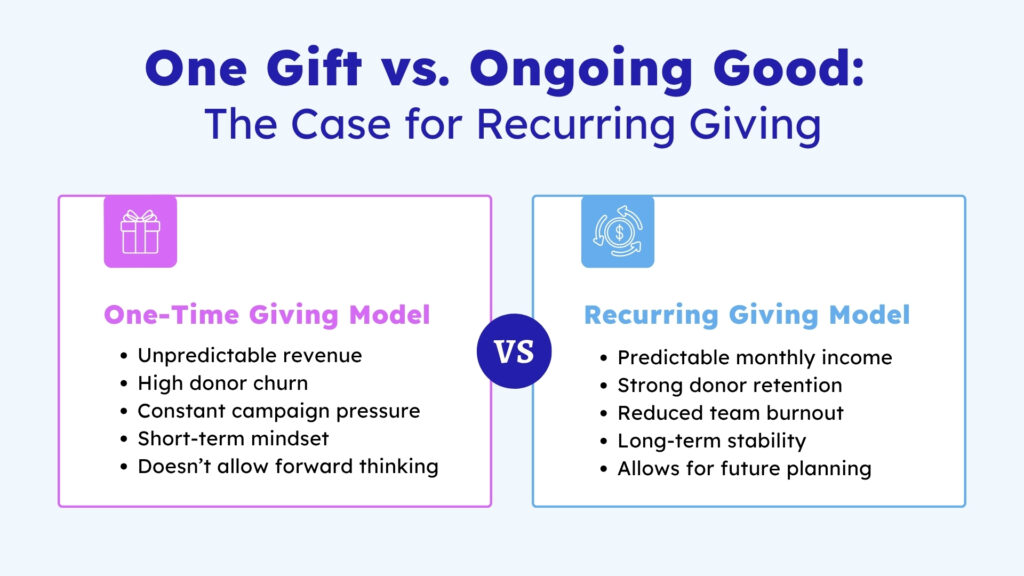
Here is a head-to-head comparison of one-time gifts and recurring giving to help you make a strong case for a recurring giving program:
- One-Time Giving Model
- Unpredictable revenue
- High donor churn
- Constant campaign pressure
- Short-term mindset
- Doesn’t allow forward thinking
- Recurring Giving Model
- Predictable monthly income
- Strong donor retention
- Reduced team burnout
- Long-term stability
- Allows for future planning
4 Simple Steps for Getting Started
Starting your recurring giving program doesn’t have to take months or thousands of dollars. The goal is to prove the model’s value quickly by focusing on your most loyal supporters. Think of this as an exclusive membership circle rather than just another donation option.
These steps can help you drive results and high retention rates:
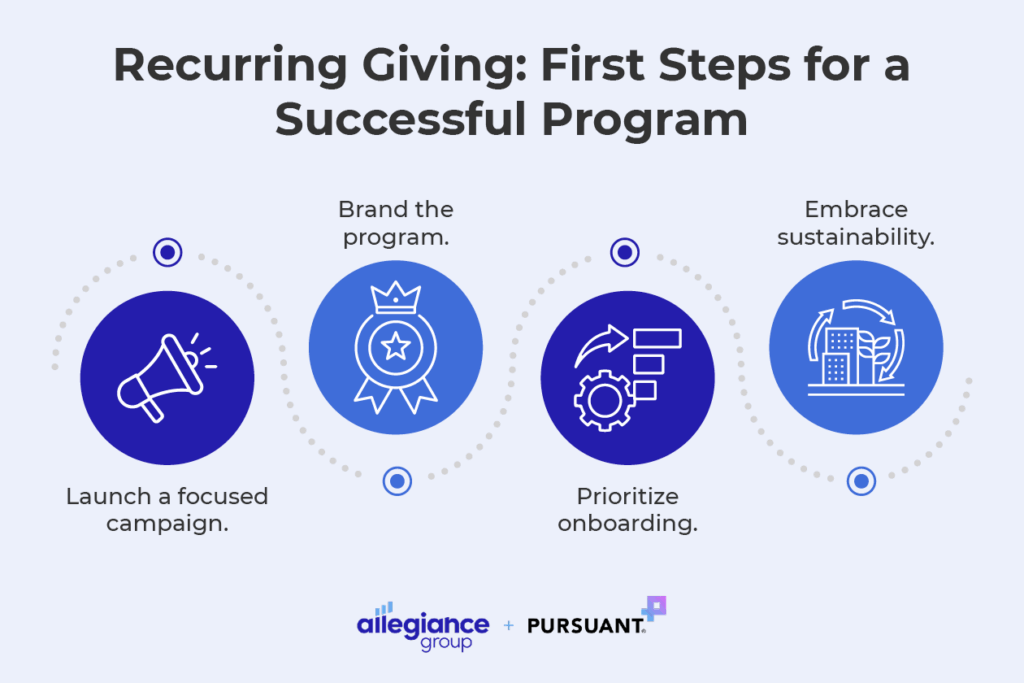
- Launch a focused campaign. Start small by targeting your most loyal one-time donors, dedicated volunteers, and board members. These supporters already trust you and are the most likely to commit to sustainer giving.
- Brand the program. Give your program a unique, appealing name that reflects your mission (e.g., Community Changemakers). Donors can then adopt a shared identity as partners in sustained change.
- Prioritize onboarding. Ensure supporters receive a timely, warm welcome email—not a generic receipt. Follow up with initial impact updates and small moments of appreciation.
- Embrace sustainability. Remind your team that this program is primarily about driving predictable funding, releasing them from the exhausting cycle of constant, high-pressure fundraising.
Want to build a sustainer program that supports your mission and team?
Quick Tips for Recurring Giving Beginners
Approaching Recurring Donors
1. Make recurring giving simple.
If you want recurring donations, you shouldn’t force your contributors to jump through hoops to get there.
Monthly gifts should be a visible option as soon as a person contacts your organization. Include information about your recurring giving program in your newsletters, during public events, and on your website. If your nonprofit has an online donation page, include a box to check for recurring donations and a reasonable suggested amount. Track the success of these methods and tweak the wording or suggested amount as needed.
2. Recognize repeated gifts.
People often respond to the label given to them—you want your recurring donors to see themselves as regular supporters. When communicating with recurring donors, you should address them with the title they’ve earned by calling them a “valued supporter” or a “friend of the cause.” This wording also encourages them to live up to that positive moniker.
You should also publicly thank constant contributors. Hearing their names in live events or newsletters makes donors feel special and encourages others to participate.
3. Ask for their input.
A relationship should be a two-way street. It’s not just about communicating your needs and gratitude to donors; it’s the ability to listen when they have thoughts and opinions.
It’s easy to focus on your organization. Volunteers or organization heads are often so focused on the mission and fundraising aspect that they don’t take the time to ask the donor what they expect to receive.
Allowing donors to voice their questions and concerns provides valuable insight into the type of people who contribute regularly to your cause. You can learn new approaches for future fundraisers. They might even tell a story that would make a great addition to your nonprofit’s promotional materials.
4. Turn success data into stories.
If people have contributed to your cause in the past, show them what their money helped accomplish. But because facts and figures might be a little dry, you may want to turn the effects of their contribution into a story.
When approaching a repeat donor during fundraisers, each volunteer should have access to information about the relationship. Nonprofit software should detail how much a person has given in the past and what initiative the funds were put toward. If possible, find specific examples of individuals or singular events that met their goals because of donor input.
5. Get creative!
Every nonprofit is different, so find your own unique way of asking for regular donations. You might offer prizes or special rewards or give recurring donors other incentives, like meeting the people they help or displaying their names in a public place. Whatever you can do to make consistent contributors feel special is always a best practice.
Best Practices for Soliciting Recurring Gifts
Whether you want to kick-start or grow your recurring giving program, these tips can help you steward this special class of donor:
- Put the option front and center. Recurring giving should always be a clear option on your giving page. If you ask for a one-time donation, give them the option to easily opt into the monthly giving program.
- Say thank you. Thank donors every time they give, not just after the first donation. It can be through a simple transactional email like a receipt, or you can send a text or video to say thanks. What matters is infusing a sense of personal, non-generic gratitude.
- Stay in touch without asking for money. Donors want to know what kind of impact they’re making. So, send them a quick update via text or email. Or, if you have leftover branded swag, send a surprise gift. No matter how you reach out, the goal is to stay connected without making another appeal.
- Offer exclusive content. This could include regular webinars, newsletters, podcasts, or articles specially designed for your recurring donors. Include a note that lets them know this offer is just for them.
Wrapping Up
Building a recurring giving program isn’t just a smart fundraising strategy; it’s a powerful step toward stability, sustainability, and stronger donor relationships. By creating a reliable revenue stream, you free your team from the constant pressure of chasing one-time gifts and offer donors a more meaningful way to stay engaged.
Our team at AGP is ready to help you build a recurring giving program and create meaningful relationships that inspire lifelong giving among your supporters. Connect with us today.
Partner with AGP to transition beyond one-time gifts & chronic fundraising fatigue.
Kim Richardson, AVP, Client Strategy
Kim Richardson is AVP of Client Strategy at Allegiance Group + Pursuant, where she’s spent the past 12+ years helping mission-driven organizations fuel their impact. A passionate fundraising professional with a background in both nonprofit and corporate marketing, Kim excels at crafting smart strategies that drive results.
Her expertise spans fundraising, brand development, cross-functional leadership, and high-level client engagement. She’s proud to have partnered with organizations like Washington National Cathedral and Moody Bible Institute to bring bold ideas to life and move missions forward.