

In 2024, revenue from one-time giving was flat year-over-year. While this figure can be discouraging, there was a bright spot. Revenue from recurring giving programs rose by 5% compared to 2023, and these sustained gifts made up nearly one-third of all online revenue.
These real-world statistics demonstrate a truth that seasoned fundraisers already knew—that sustaining donors are an essential pillar of support for nonprofits. Whether your organization already has a widespread base of recurring givers or you’re looking to build a sustaining donor program from the ground up, we’re here to provide the expert tips and tricks for doing so.
In this guide, we’ll cover:
- Sustainer Giving FAQs
- How to Identify Sustained Donor Prospects
- Recruiting Sustained Donors
- 5 Tips to Boost Sustained Giving Engagement
Ready to bring your fundraising efforts to the next level? Let’s dive in with these tried-and-true sustaining donor engagement practices.
AGP clients grew average gifts from $54.66 to $76.10 with our Sustainer Growth Accelerator.
Sustainer Giving FAQs
What is sustainer giving?
Sustainer giving, also called recurring or monthly giving, occurs when your supporters pledge repeated donations to your nonprofit. Recurring gifts typically repeat on a monthly basis.
For example, a donor might give $30 and check a box on the donation form to “give monthly.” From there, the donations will be automatically charged to the donor’s credit card or bank account.
Why is sustainer giving so important?
Sustained donors are some are your most loyal supporters, and their regular support can bring your nonprofit:
- Predictable revenue: Count on these monthly gifts to provide a stable financial foundation that allows for more accurate budgeting and forecasting.
- Higher retention: Sustaining donors tend to stick around longer. While only about 30% of one-time donors will contribute to the same nonprofit repeatedly, monthly donors will continue to support the same organization for an average of eight years.
- Greater lifetime value (LTV): Because recurring donors are more likely to make repeated donations and they often stay around longer, they often have a higher LTV than non-recurring donors.
- Enhanced efficiency: Your nonprofit will significantly reduce the cost and staff time required to re-solicit donors—sustained donors only need to be acquired once.
- A streamlined major and planned giving pipeline: A monthly giving program will pinpoint your most loyal supporters, helping you identify those who would be most willing to make a major donation or bequest.
How does a sustainer giving program work?
Here’s what the process of enrolling in a sustainer giving program typically looks like:
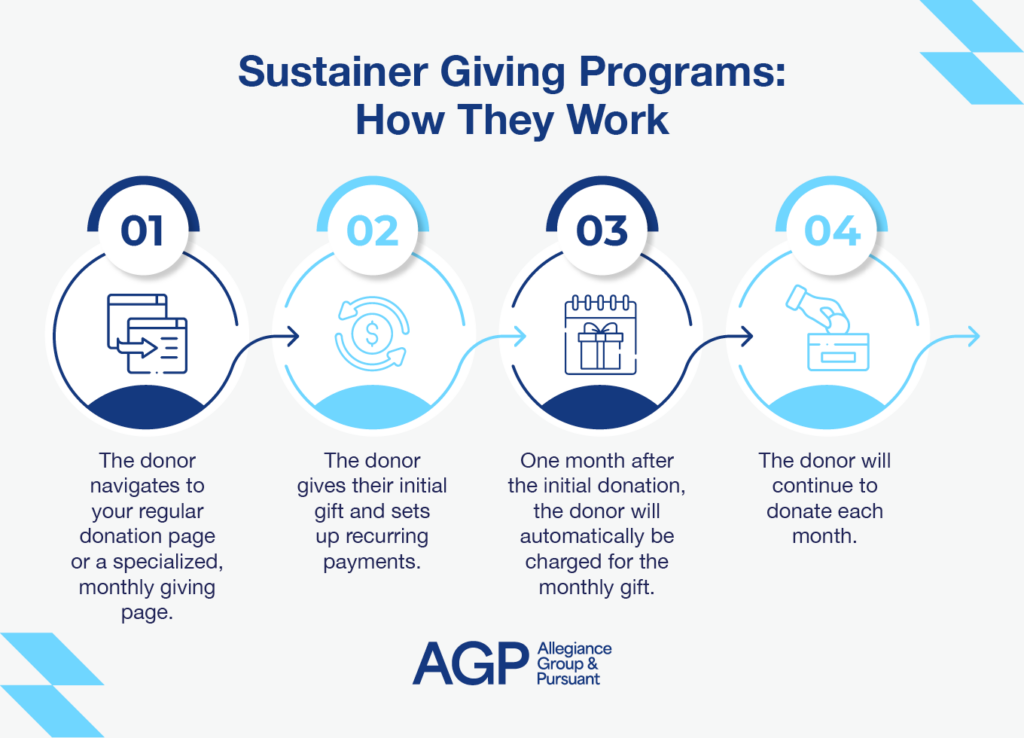
- The donor navigates to your regular donation page or a specialized, monthly giving landing page.
- Example: Feeding America has a standard donation form (that still allows supporters to easily opt into its monthly giving program) and a form specifically targeted to potential recurring donors.
- The donor gives their initial gift and sets up recurring payments.
- One month after the initial donation, the donor will automatically be charged the amount they chose when enrolling in the monthly giving program.
- The donor will continue to donate each month, unless they opt out of the program.
Keep in mind that your work isn’t done when you reach this point. You’ll still need to focus on stewarding the donor to ensure they feel appreciated and motivated to continue donating. We’ll discuss stewardship in more detail later in the guide.
How to Identify Sustained Donor Prospects
To give your sustainer program the greatest chance of success, you’ll need to promote it to donors who are able and willing to give on a regular basis. For most organizations, this will be:
- Small to mid-level donors
- Donors who have given three or more times within the last 12 to 24 months
- Donors who gave online and are familiar with the process (however, this doesn’t mean you should never approach those who give via methods like physical checks)
- Supporters who have donated, engaged with your communications, and/or attended one of your events within the last six months
While you shouldn’t necessarily limit communications promoting your sustainer program to just these donors, targeting them initially can help you build a stronger foundation.
A robust data analytics tool like GivingDNA makes it easier to identify donors who meet these criteria. From there, you can design tailored communications that appeal to their unique motivations and encourage them to start making recurring donations. For instance, you might create a template similar to the following appeal and fill in the bolded sections with personalized information:
“Hi Joyce,
Thank you for being a champion for senior food programs.Because you’ve already contributed $50 to help reach our goals, we invite you to take the next step. By pitching in just $15 a month, you can ensure seniors in our community have food on their tables all year round.”
Identifying the right donors is only the first step—our sustainer giving guide breaks down how to recruit, engage, and retain them.
Recruiting Sustained Donors
Once you have identified potential monthly donors using your organization’s data, you’ll need to plan a cohesive, multichannel campaign. While some donors may find your landing page on your website and decide to join, you’ll also need to intentionally recruit donors with targeted campaigns that emphasize recurring giving.
The following strategies can help your organization engage and successfully recruit prospective sustainers:
- Target the right prospects. For more successful recruiting, target prospects who are already primed for recurring giving. This includes loyal donors who have made four or more gifts within the past year, recent and renewing donors, and specific demographics (e.g., younger donors who are accustomed to subscription models but give small amounts).
- Quantify the potential monthly impact. Break down your large organizational budget into bite-sized, monthly contributions. Take the total revenue needed to support an unfunded program line, divide it by 12 months, and then divide it again by the number of beneficiaries in the program. For example, a monthly gift of $40 could supply new textbooks to five classrooms for the school year.
- Organize both ongoing and time-bound campaigns. Create an evergreen strategy focused on recruiting new donors with quick conversion pathways, testing asks throughout the donor relationship, and generally removing friction from the process of joining. Additionally, organize higher-intensity, time-bound pushes designed to create a surge in donations. These campaigns work best when they have a defined theme and goal and offer an incentive to drive urgency—for instance, challenge donors with a matching gift that unlocks additional dollars for the organization for every new sustainer donor during a specified campaign time.
- Embrace omni-channel marketing. Reach potential supporters everywhere they are, whether that’s via social media, direct mail, phone and text messages, email, or another communication channel. This keeps your message at the top of their minds and offers several touchpoints that nudge them closer to converting.
- Craft a strong appeal. Prepare to make the final ask by pulling inspiration from your nonprofit’s unique value proposition (UVP). Ensure each donor feels that the problem they are trying to solve matters and that they cannot achieve the same impact anywhere else. Brand the program to create a sense of community and exclusivity (e.g., develop a unique name just for sustainers), and offer exclusive benefits like tailored impact reports or behind-the-scenes access to make them feel like insiders.
5 Tips to Boost Sustained Giving Engagement
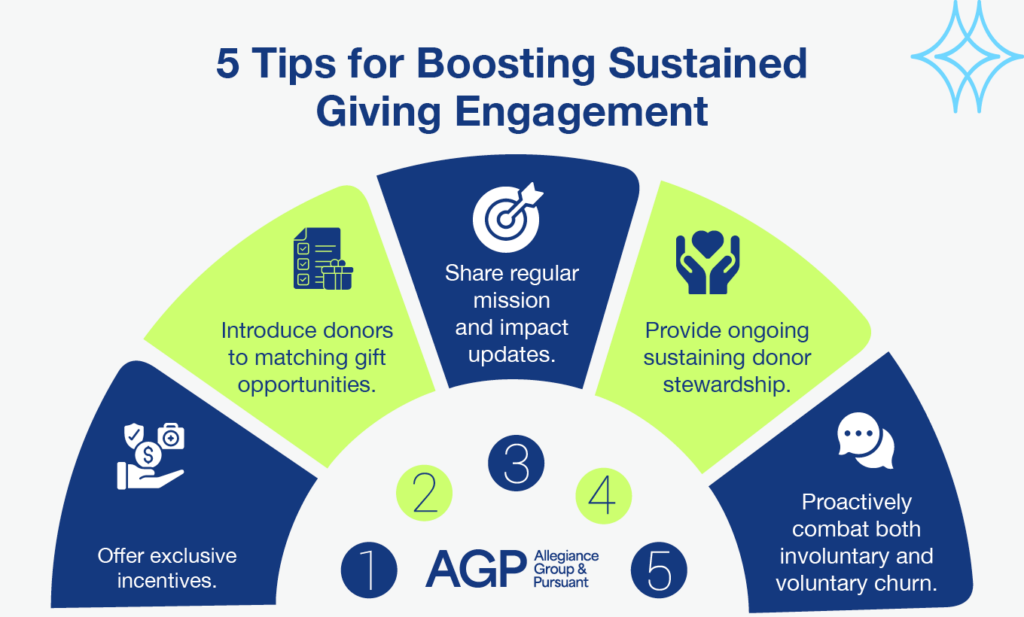
1. Offer exclusive incentives.
Engaging recurring donors by offering exclusive incentives is an effective strategy for inspiring generosity, demonstrating appreciation, and encouraging continued support. Here are free or low-cost incentive ideas to consider:
- Members-only content: Provide sustaining donors with access to premium content, such as behind-the-scenes updates, research reports, or educational materials related to your cause. Remember, it doesn’t have to remain exclusive, but sustainers should receive access before other donors, given their special commitment to the organization.
- Early event access: Offer sustaining donors early access or priority registration to events like gala dinners, fundraisers, or volunteer opportunities. Consider providing a coupon code for a reduced ticket price as well.
- Exclusive merchandise: Create specialty merchandise, such as branded mugs or tote bags, exclusively available to sustaining donors.
- VIP experiences: Host invite-only meetings, VIP tours, and meet-and-greets where sustaining donors can interact with key members of your organization.
Promoting these perks (for instance, on your donation page) can be just what a donor needs to encourage them to upgrade their one-time gift to a sustaining one! This makes it an excellent way to drive additional donations for your cause, including those that will continue to support your mission for the foreseeable future.
2. Introduce sustaining donors to matching gift opportunities.
Corporate or employer matching gifts are one of the most popular examples of corporate giving initiatives. Promoting the opportunity to your nonprofit’s audience is an excellent way to engage supporters, including both one-off and sustaining donors.
Here’s how these programs typically work:
- A donor contributes to a nonprofit fundraiser.
- The donor determines their eligibility for a matching gift from their employer (typically after being prompted to do so by the organization to which they gave).
- The donor completes a brief online submission form for their employer, providing basic details about the nonprofit and their gift.
- The employer reviews the matching gift request, verifies that it adheres to the company’s matching gift criteria, and approves the match.
- The nonprofit organization receives a matching donation from the donor’s employer.
Although this process can vary slightly for sustaining donors (most companies recommend batching recurring gifts into a single annual match request rather than doing so for each gift), many supporters who contribute via recurring gifts can still qualify for their employers’ matching gift initiatives. That makes it a particularly lucrative opportunity for organizations to pursue matching gifts from these supporters, empowering recurring givers to double (or sometimes even triple) their initial impact.
Donors are also more likely to get involved—and stay involved—when they know that they can get their gifts matched. Double the Donation’s research indicates that mentioning matching gifts in an organization’s fundraising appeals boosts response rate by 71% and increases average gift size by 51%.
3. Share regular mission and impact updates.
Mission-related impact is typically the primary motivation for donors who support your cause. When donors believe their dollars are consistently going toward making positive change, they are more likely to continue giving.
As a result, you want to ensure that your sustaining donors receive regular communications that focus on the tangible value of their giving. This could be in the form of:
- An infographic summarizing the last quarter’s impact
- A quote, testimonial, or interview from a beneficiary
- A video update from your team
- A photo showing tangible impact (supplies purchased, progress made on a building expansion, etc.)
- An exclusive newsletter with deep insights
Aim to include particularly engaging elements, such as constituent stories, visuals, donation impact reports, infographics, and more, to effectively communicate the value donors bring to your nonprofit.
4. Provide ongoing donor stewardship.
Your organization’s sustaining donors go above and beyond for your mission. They’ve taken the next step with a commitment to furthering your work on a regular basis, which provides your team with a consistent and steady stream of income.
To maintain this support, you’ll need to go a step beyond traditional stewardship efforts to recognize and appreciate your sustaining donors. For example, we recommend:
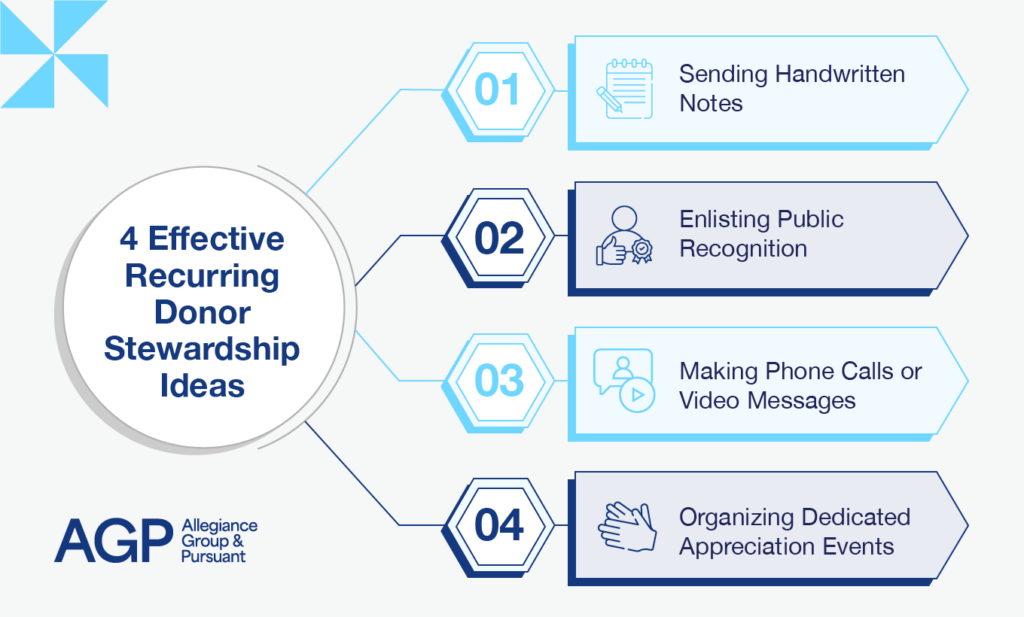
Sending handwritten letters. Heartfelt and personalized thank-you letters can go a long way in expressing gratitude for donors’ ongoing support. When these notes are handwritten and signed by a member of your staff, it indicates an added personal touch!
Enlisting public recognition. Showcase recurring givers on your website, annual reports, newsletters, social media posts, donor walls, and more as a way of publicly acknowledging their commitment to your cause.
Making phone calls or video messages. Instruct staff or volunteers to make personal phone calls or send video messages to thank donors directly for their ongoing support of your organization.
Organizing dedicated appreciation events. Host an exclusive event (in-person or virtual) to celebrate and thank recurring givers. Make sure the focus is not to ask for more but to appreciate sustaining donors’ generous giving.
Remember that the key to effective donor appreciation is sincerity, transparency, and a genuine sense of gratitude. Just like with your initial appeals, take the time to tailor your efforts to match the preferences and expectations of your sustaining supporters.
5. Proactively combat both involuntary and voluntary churn.
Involuntary or accidental churn occurs when a sustaining donor unintentionally stops contributing to your organization rather than actively choosing to unenroll. This is typically due to issues with payment, such as the card on file expiring.
Even though these donors aren’t choosing to leave your program, lost revenue is lost revenue. Proactively prevent these losses by:
- Using an automatic account updater tool or service to catch and refresh expired cards.
- Accepting methods like ACH payments and other electronic transfers (bank accounts do not “expire” the way credit cards do).
- Create an automatic “Service” email template for failed payments, offering helpful advice for what donors should do if they didn’t intend to leave the program.
- Set up a self-service donor portal where supporters can independently update payment information.
Additionally, some supporters choose to leave your monthly giving program, often for financial reasons. To prevent churn and re-engage these supporters, try strategies such as:
- Creating salvage offers to help reduce churn and maintain retention, such as allowing them to lower their contribution, pause, or skip a month.
- Reminding the donors about the concrete impact they are making for your cause (“Your monthly support allows us to provide 5 seniors with daily meals”).
- Expressing your gratitude, asking why they decided to leave, and following up down the line to attempt to win them back.
Read our 9 Tips for Re-Engaging Lapsed Donors.
Wrapping Up
As nonprofits continue to adapt their practices in a constantly changing fundraising landscape, sustaining donors will continue to be a key driver in their ability to make a meaningful impact on the causes they serve.
By implementing the above practices, your team can ensure you have what you need to maximize support from sustaining donors, strengthen and retain these crucial relationships, and ensure a long-term, well-funded future for their missions.
To learn more about how to enhance your fundraising efforts, check out these additional resources:
- What is Mid-Level Giving? + How It Fosters Loyal Support. Focusing on your mid-level giving efforts can help you tap into a segment of loyal, willing donors.
- Digital Fundraising: How to Make Your Efforts Successful. Learn how to spread the word about your sustainer program and other fundraising initiatives online with this comprehensive guide.
- 10 of the Most Effective Fundraising Tools You Need to Try. Browse this buyer’s guide to ensure you have the right technology to help you effectively manage your sustainer giving program.
Ready to grow your recurring giving program?
Our clients now source 56-63% of their annual revenue from sustainers.