
Monthly giving programs are a fantastic way to generate recurring donations and stabilize your nonprofit organization’s funding. On average, monthly giving makes up 31% of online revenue for nonprofits—and donors are showing increased interest in monthly gifts. While revenue from one-time gifts didn’t increase from 2023 to 2024, monthly giving rose by 5%.
If you don’t already have a monthly program in place, it’s time to start thinking about implementing one. Done right, these programs feel “out of sight, out of mind” for both donors and staff members. Not only will effective recurring giving options deliver much-needed funding to your mission, but they will also reduce the burden on your fundraising team.
We’ll cover the essentials you need to start a thriving monthly giving program, including:
- Why Start a Monthly Giving Program?
- 3 Successful Monthly Giving Program Examples
- Monthly Giving Program Roadmap
- 5 Common Pitfalls To Avoid
Partner with AGP to custom-build your thriving recurring giving program.
Why Start a Monthly Giving Program?
To set up your monthly giving program, you’ll need to invest time and resources upfront. But with the following benefits, this initial investment will pay dividends:
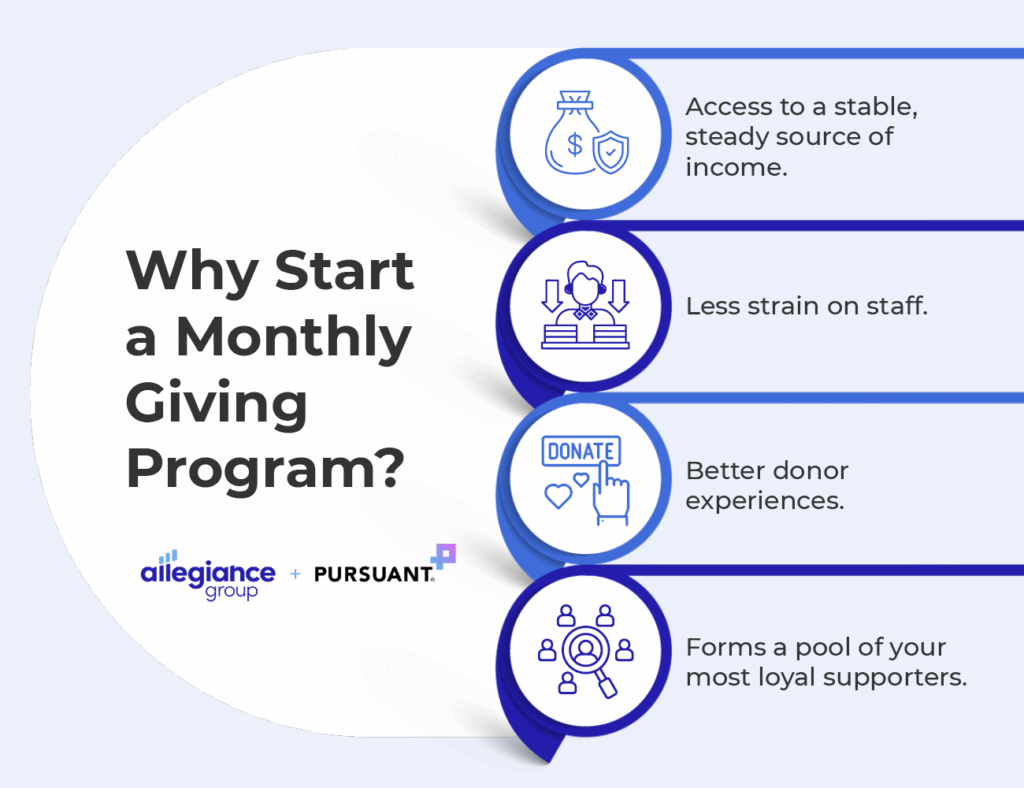
- Access a stable, steady source of income. With a recurring giving program, your nonprofit can count on a certain amount of money each month. This makes budgeting and long-term planning possible and gives you more flexibility in case of unforeseen circumstances or emergencies.
- Reduce strain on staff. Your fundraising team will only need to secure the first donation. From there, funding automatically rolls in each month. While you’ll still need to communicate impact and steward your recurring donors, staff won’t feel fundraising fatigue from chasing down gifts each month.
- Offer better donor experiences. Make donating regularly as convenient as possible by allowing donors to automate payments after their first gift. Monthly donors are also less likely to feel fatigued because they receive fewer fundraising requests.
- Form a pool of your most loyal donors. Supporters who are willing to contribute monthly are often the most dedicated to your cause, and they may have the affinity and capacity for large donations. Consider your sustainer program as a promising pool of prospective planned, mid-level, and major donors.
Monthly donors also tend to have a higher lifetime value, meaning that you’ll see greater returns on the resources you invest in acquiring them. For example, in the context of online giving, the average monthly gift is $24, or $288 annually. This outpaces the average one-time donation of $126.
Now consider average retention rates. Each monthly donor’s lifetime is about eight years with a nonprofit, while non-recurring donors average about 18 months. Your monthly donors’ much longer lifetime, paired with regular contributions, means you’ll see significantly more revenue than one-time donors contribute.
3 Successful Monthly Giving Examples
Many nonprofits have had to navigate new challenges in 2025. For example, rising food insecurity, economic concerns, and general uncertainty have led to increased demand for services and tighter budgets for many food banks. With federal funding cuts, these organizations have turned to private foundations and individual supporters to help them deliver much-needed services to their communities.
Here’s how three of AGP’s food bank clients used monthly giving to win reliable revenue:
- Food Bank Monthly Sustainer: This regional food bank serving the southeastern U.S. made an urgent appeal to stock its shelves after losing federal funding. We created a CTA prompting donors to “Start a Monthly Gift” via emails that retargeted recent one-time donors and paid social ads.
- The Result: Compared to the previous year, the number of new monthly donors more than doubled, and monthly giving revenue more than tripled.
- Serving Hope: A regional food bank located in the Midwest urgently needed resources and new donors after losing federal funding. We promoted the monthly giving CTA via Instagram and Facebook ads and email, using a similar retargeting strategy.
- The Result: Year-over-year, new monthly donors increased by more than 6.5 times, and revenue from this segment increased by more than eight times.
- Full Plate Society: We partnered with a large food bank serving the northeastern U.S. to promote its sustainer program. We used our augmented intelligence tool, GivingDNA to assist with targeting, including by political affiliation, segmented messaging, and email retargeting.
- The Result: New monthly donors more than tripled year-over-year, while new monthly donor revenue increased by 47.4%.
Transform monthly giving from an afterthought to an essential fundraising strategy.
Monthly Giving Program Roadmap
Recurring giving programs can transform your finances, donor relationships, and organizational bandwidth. But to gain these benefits, you’ll need detailed planning and an organized rollout strategy. Check out this monthly giving program roadmap, along with expert tips for each step of the way:
1. Design the Donor Experience
Before asking supporters to start donating monthly, you’ll need to define your program and what value donors receive from joining it. For most organizations, this is about building a community that feels special or exclusive. You can do this by:
- Choosing a creative name for your program that aligns with your mission and the donors’ role (e.g., an animal shelter might use “The Second Chance Society”).
- Offering enticing—but low-cost—incentives, such as exclusive resources, behind-the-scenes tours, or VIP event invitations.
- Explicitly defining what it means to be a recurring donor and how their support uniquely impacts your work.
Expert Tip: Don’t overthink your incentives or blow your budget on “swag.” Many donors want to see 100% of their donation go toward your cause and would appreciate social incentives, like recognition or exclusive information, over physical gifts.
2. Build the Technical Infrastructure
Next, you’ll need to ensure you have the right technical infrastructure needed to handle automatic recurring transactions. Otherwise, your team may have to manually manage them.
To avoid wasting time on manual intervention, make sure your fundraising software and/or donation form supports recurring gifts. Give donors the ability to adjust the recurring gift amount at any time. While you should add a “Make this a monthly gift” check box option to your standard donation form, it can also be a good idea to build out a dedicated landing page and form specifically for monthly giving, like this one from the PAN Foundation.
Finally, create and set up any automated messages you’ll send to monthly donors. For example, you’ll need to create triggers for automatic thank-you emails and donation receipts. These messages should include messages targeted toward your monthly donors.
Expert Tip: To boost retention, choose a payment processor that offers “account updater” features that automatically update expired credit card information. You can also encourage monthly donors to contribute via ACH rather than a credit card, since their banking information is less likely to change.
3. Test the Program
Think of this step as the “soft launch” of your program. Use this time to work out kinks, double down on what’s working, and gather insights from supporters’ perspectives. Here’s how:
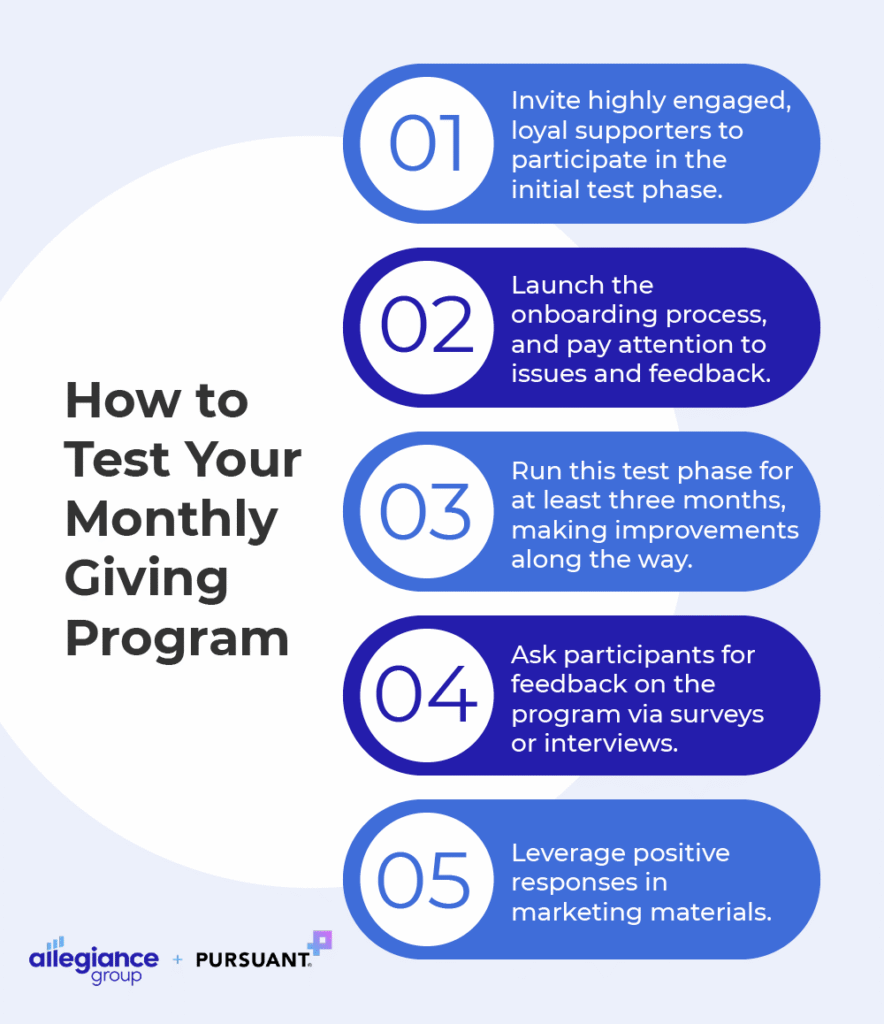
- Invite your loyalists, such as board members, volunteers, and long-term donors, to participate via personal, high-touch communications.
- Launch your onboarding process, noting any issues or feedback from supporters.
- Run the test phase for at least three months, making improvements along the way.
- Ask participants for their final feedback via a detailed survey or interviews.
- Leverage positive responses in your marketing materials as social proof.
Expert Tip: Try calling your potential participants before sending emails or other communications. Often, this more personal channel drives better results.
4. Launch Your Program Publicly
Next, it’s time to launch the monthly giving program to all of your supporters. Treat this like you would the launch of a new program for beneficiaries rather than just another fundraising appeal.
Develop a detailed marketing plan involving multiple, interconnected communication channels. Target your most dedicated supporter segments who are most likely to join the program, and feature compelling statistics and testimonials you gathered from the soft launch phase. Inspire a sense of urgency by offering time-sensitive incentives (e.g., “Our corporate partner will match the first month of all donations made in October.”).
Expert Tip: Recruiting monthly donors may be more challenging than acquiring a one-time donor. Focus more on simply converting these supporters rather than the amount they are giving. Get them to say “yes” to the recurring habit, and then upgrade them later.
5. Steward Your Monthly Donors
We’ve covered just how important monthly donors can be to your mission, so don’t make the mistake of neglecting them once they opt into your sustainer program. Continue to steward these relationships, particularly in the first 90 days when the relationship is more fragile.
In addition to sending personalized thank-you messages, you can foster trust and ensure monthly donors feel appreciated by:
- Sending an email welcome series educating them about the impact of their monthly gift.
- Reviewing failed payments each week and reaching out to those donors in case they need to update their information.
- Regularly monitoring churn (at least quarterly) so you can take preventative steps to protect your retention rate.
Expert Tip: Remember to stay in touch with monthly donors even if you aren’t asking for donations. Commit to sharing at least two or three “no-ask” communications per quarter, like impact updates, check-in messages, or announcements.
5 Common Pitfalls To Avoid

1. Not Asking for Monthly Gifts
As simple and obvious as it seems, you have to ask for monthly donations to receive them. Sure, there will be those who actively support a cause and will take the autonomous initiative to donate monthly. But for the most part, if someone is not aware of the option, they won’t seek out the information on their own.
Don’t be afraid to ask in your donation appeals if supporters would like to join your monthly giving program. Make it easy for them to join by including links to the relevant landing page or form, and provide flexible options that work for them (e.g., adjusting the frequency, gift amount, and/or payment method).
2. Not Preparing
Many nonprofits are forced to operate on minimal budgets, meaning they are minimally staffed. With so few staff, it can be difficult to get things done on time and properly. But, when it comes to your monthly giving program, it’s best to take a little extra time and make sure everything is done right before launching the program publicly.
Test everything and double-check that it works, from email send-outs and links to the people answering the phone to help donors with questions. Not only will the program run more smoothly for you and your supporters, but it will also enhance your reputation as a professional, capable organization.
3. Sending Boring, Impersonal Thank Yous
It’s important to send out thank yous to show your monthly donors that you truly appreciate their commitment and gifts. But, most of the time, these letters of gratitude are incredibly boring, brief, and generic—even worse if they resemble a transaction receipt.
Make your thank-yous personal. Greet the donor by name and acknowledge the group they are a part of. For example, you might start the email with “Hi Adriana, We wanted to express our deep gratitude for your membership in our shelter’s Second Chance Society.” Then, break down how their dollars benefit your community (e.g., “The Society’s October contributions helped us stock our community pet food pantry in preparation for the holidays.”).
4. Sharing Generic Emails
Your mailing list should already be segmented, and monthly donors should have their own dedicated segment. All donors should be appreciated, but monthly donors have demonstrated a deep commitment to your cause. It’s important to recognize that ongoing commitment.
If you’re sending out the same email to your monthly donors as you are to potential donors or one-time donors, you’re not properly recognizing the contribution these donors are making. Even if the dollar amount is less than that of a one-time donor, it’s essential to acknowledge their dedication to your organization.
5. Letting Memberships Expire
Generally, monthly giving programs allow a donor to choose the number of months they wish to donate or include an end date to their commitment. If you aren’t paying attention and let these monthly donations expire, your donors may not notice and won’t renew their membership.
It’s up to you to track when monthly donations are going to expire and catch donors before that happens. This way, no donations fall through the cracks. Send a friendly reminder the month before expiry, along with an easy way for the donors to renew and upgrade.
Additional Resources
An organized, well-maintained monthly giving program can be a game-changer for your nonprofit. Receiving consistent, reliable donations instills a type of security and stability in your organization like nothing else, especially during uncertain times. To keep your monthly giving program active and booming, reach out to our team of marketing and fundraising experts at AGP.
To learn more about how to enhance your fundraising efforts, explore our other key resources:
- 10 of the Most Effective Fundraising Tools You Need to Try. The most successful sustainer programs are grounded in effective fundraising technology. Explore the top tools you need.
- What is Mid-Level Giving? + How It Fosters Loyal Support. Mid-level donors often go overlooked, but they tend to be your most loyal supporters. Discover how to tap into this valuable segment.
- Digital Fundraising: How to Make Your Efforts Successful. So, you’ve launched your program—what’s next? Spread the word and attract new members with a robust digital fundraising strategy.