
We’ve all been there.
That moment when someone asks what your organization does and you tell them about your mission, the numbers served, and a list of programs.
If that sounds like your elevator pitch, it’s past time for an upgrade.
There are tens of thousands of nonprofits, which means someone else is already doing what you do. A well-crafted elevator pitch is your way to say who you are and what you do in a way that avoids fading into the background.
Nonprofits are highly knowledgeable in their fields and spend their time talking to people who may not share the same level of understanding. With an engaging elevator pitch, you can translate what you do and the impact without expecting others to have specialized knowledge.
An elevator pitch plays a more critical role in fundraising and donor engagement than you may realize. A great pitch not only helps you stand out – it can lead to further dialogue, which is particularly important in a one-on-one conversation with donors or potential donors.
Fuse data, strategy, and storytelling to make an unforgettable first impression on supporters.
What is an elevator pitch?
To put it simply, it says what your organization does and why in less than 60 seconds. Although in practice, you have maybe 5-10 seconds to capture someone’s attention before they start to lose interest.
Traditionally, nonprofits have relied on their mission statements or a description of their programs – we serve 5,000 low-income families a year – as their elevator pitch. Is it informative? Maybe, but it isn’t that interesting.
The key is to shift from scripted to meaningful.
Nonprofits often rely on flat, generic pitches. What makes an elevator pitch feel authentic and compelling, rather than rehearsed or transactional, is to put yourself into it
People need to feel your passion — your why. Why does the work matter to you, the world, your constituents? An elevator pitch highlights that and gets people to listen. If you just tell them what you do, nobody cares. You must share your why.
A common mistake in fundraising is thinking the elevator pitch is about the organization. It isn’t. It’s different from marketing because this is about the person you’re talking to and how you can engage their interest.
Trying to say something that appeals to everyone produces bland fundraising appeals and doesn’t work. Your organization isn’t for everyone, so you want your elevator pitch to be the best expression of what you do, why it matters, and what it’s based on.
6 Tips to Craft a Nonprofit Elevator Pitch
The passion behind your work, its significance, and the core values that drive your organization are what inspire enthusiastic supporters to get involved.
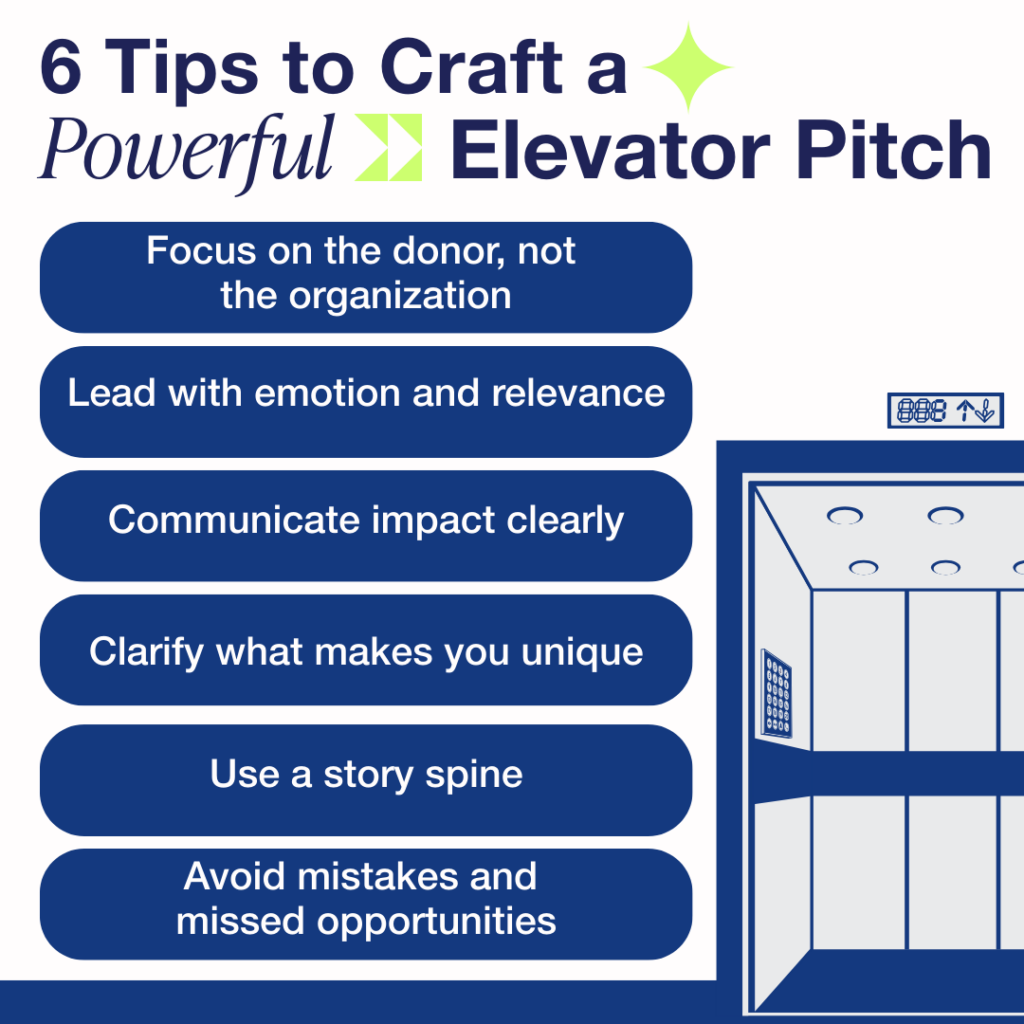
1. Focus on the donor, not the organization
Nonprofits need to make a mindset shift to ensure their elevator pitch focuses on the donor’s role in creating impact, rather than just describing the organization.
Put simply, it’s not about the organization but rather the organization and the donor together — a partnership. It’s the difference in saying, “We use the support of our community to do X,” and describing what happens when you do it together.
2. Lead with emotion and relevance
A strong opening line in your elevator pitch needs to quickly create emotional connection or curiosity.
This means not using jargon or corporate marketing speak — or relying on AI, which flattens emotions. Instead, help people understand why it matters. You are solving human problems, so be human.
Take a typical elevator pitch: “We are the leading breast cancer research organization that funds low cost or no cost mammograms in communities of need.”
Compare it with one that leads with connection and curiosity: “When I was 10, my mother died of breast cancer. When I was 20, I realized it didn’t need to happen.”
Or lead with a question: “Do you know how many Americans are without running water?” or “Did you know 2 million people in America are without running water?”
With this approach, you have created curiosity by leaving things out and creating opportunities for people to ask questions. Then you can follow up on how you’re addressing the issue and why it matters.
3. Communicate impact clearly
Nonprofits often suffer from an abundance of knowledge. The key is to communicate the difference donor support makes clearly and powerfully, without overwhelming listeners with too much information.
- Avoid big numbers. While they may seem impressive to you, without context, it is often meaningless. Instead of saying we serve 60,000 children in our community to get 50% of their calories from school lunches, say one out of every two kids.
- Break it down to simple terms. Our organization serves one in five people who are unsheltered, so we are raising money to serve those other four.
4. Clarify what makes you unique
To create a compelling elevator pitch, an organization needs to identify and express what truly sets them apart — especially when others may be working on similar issues. The best place to get started is to go through a unique value proposition exercise.
Be honest and do the deep work until you sound unique, engaging, and interesting. Test it — often — on people who don’t know you or the organization, otherwise you’ll end up sounding like everyone else. Once you have that, keep honing it until you find pieces that resonate most and use them in your elevator pitch.
5. Use a story spine
Nonprofits can use this framework to create pitches that are clear, concise, and memorable — and showcase donor impact. You start with the original condition, then X happened, there was an intervention, and here is where we are now.
For example, Ben came into our shelter after losing his job, then his home. A generous donor funded a month of his stay, and during that time Ben was able to enroll in job training and receive support services. He has now moved into transitional housing and continues his training program.
Discover Your Nonprofits Unique Value Proposition
6. Avoid mistakes and missed opportunities
The most common mistakes nonprofits make in their elevator pitch are not creating curiosity and space for inquiry.
Remember, don’t make it all about your organization and what you do — it’s a partnership with your supporters. And avoid flat, generic language.
Real example(s) and transformation
“When I was 10, my mother died of breast cancer. When I was 20, I realized it didn’t have to happen. That’s when I found out a simple mammogram could have found her cancer up to two years sooner — when it was more treatable.
“I joined Test It because I didn’t want that to happen to anyone else. For example, fewer Black women in the U.S. are diagnosed with breast cancer than white women, but they’re 40% more likely to die of it, usually because it’s found so late. Right now, we’re working on a project to overcome screening reluctance among Black women that’s rooted in historical distrust of the medical profession, and to bring free screening tools directly to communities that don’t have access. Every $50 we raise is enough to sponsor another mammogram that could let another little girl keep her mom.”
“Most people don’t realize that oceans absorbed a third of all human-caused carbon dioxide emissions from 1800 through 1994. That makes oceans among the greatest allies against global warming, but only if we take care of them.
“Blue Carbon Partners exists to find ways to expand the greenhouse gas trapping power of water without disturbing ecosystems. Last year, we secured a landmark donation to begin restoring 15,000 acres of wetlands along the Mississippi River. These wetlands are not only home to many important species but – critically – filter the water that moves through the Mississippi and into the ocean. Our signature project is removing trash and invasive species – acre by acre – to protect native wildlife and allow the water to cycle naturally. With you as our partner, we’ve forecast that we can reduce pollution flowing into the river by 15% over the next five years.
Share your passion. If your elevator pitch doesn’t come from a place of passion, why should anybody care?
Cathe Hoerth, AGP’s Associate Creative Director
Finally, remember that specificity matters when it comes to creating memorable pitches. It’s why you focus on that one story, avoid using jargon or adding too many details. Keep it specific and focused, then practice. It’s the best way to make that elevator pitch shine.