
Your direct mail campaign just drove an online gift, but email got credit for it.
So, the higher-ups want to cut the mail budget because “it underperformed.”
I call that the attribution trap.
It shows up when we measure channels in isolation instead of understanding how donors actually behave. And if you’ve ever been in a room trying to defend a program, you know is working but can’t prove it with the data in front of you, you’ve seen this play out firsthand.
“The biggest mistake I see is that programs are still being managed and measured in silos, direct mail, digital, events, all tracked separately. But donors don’t behave that way.”
The good news: you can get out of it. Here are five ways I see organizations start to break the cycle.
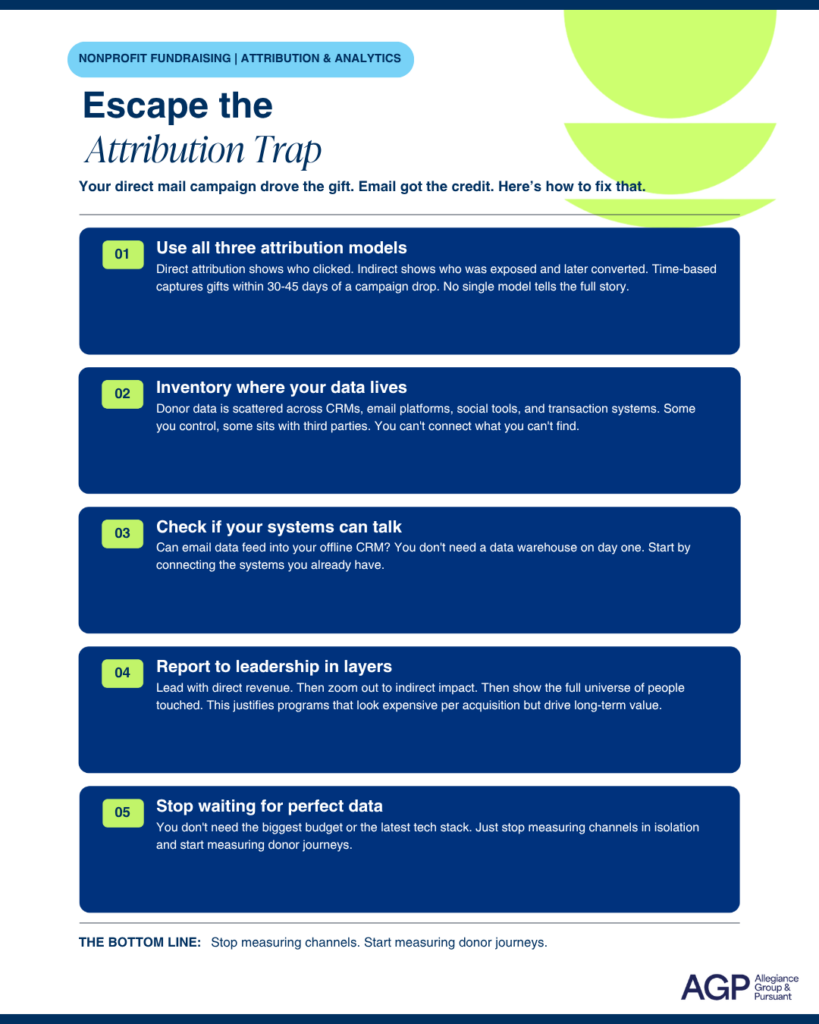
1. Use All Three Attribution Models
No single model tells the full story. That’s the first mindset shift.
- Direct attribution shows what someone clicked or responded to (“we emailed 1,500 people and 600 clicked”).
- Indirect attribution shows exposure and influence (“10,000 people were exposed and went on to give”).
- Time-based attribution connects activity to campaigns within a defined window.
You need all three, because donors don’t experience your program in one clean, trackable moment.
The biggest mistake I see is teams comparing these models side by side or letting one “win.” That usually leads to overvaluing whatever is easiest to track.
In reality, the final touchpoint is rarely the reason someone gives.
A donor might:
- see a paid social video
- attend an event
- talk to a gift officer
- receive a direct mail appeal
- and then give online
But the report says email or search drove the gift. That’s the trap.
2. Inventory Where Your Data Lives
Most organizations don’t have a data problem. They have a visibility problem.
Donor data is scattered across your CRM, email platform, social tools, transaction database, and third-party platforms.
And even then, it’s incomplete.
Some of the most influential moments in a donor journey aren’t captured anywhere:
- a conversation with a gift officer
- attending an event
- a piece of mail that sticks around for weeks or months
- peer-to-peer or offline giving experiences
“Where individuals convert is often different than the source by which they were influenced.”
Those “human” touchpoints create blind spots in attribution. When we ignore them, we over-credit what’s easy to track — clicks, pixels, and last-touch conversions.
3. Check Whether Your Tools Can Talk to Each Other
You don’t need a full data warehouse to improve attribution. But you do need a basic level of connection between systems.
Start with one goal: constituent touchpoint clarity.
Can you answer:
- Who is receiving what communications?
- Across which channels?
- And how that maps to revenue or retention?
At minimum, you should be able to track touchpoints at a constituent or segment level and visualize how those interactions stack up over time.
When you do that, something important happens: you stop optimizing for channel performance and start seeing patterns in donor behavior.
4. Report to Leadership in Layers
Attribution isn’t just a data issue; it’s a communication issue.
If you only show direct revenue, some of your most important programs will always look inefficient.
Instead, report in layers:
- Start with direct revenue
- Add indirect influence
- Then show the full universe of people touched
This helps explain why a channel that looks expensive per acquisition can still drive long-term value.
It also opens the door to better decisions.
One of the most effective approaches I’ve seen is responsible testing:
- testing audiences with and without certain channels
- comparing omni-channel versus single-channel segments
- measuring not just conversion, but generosity and retention
That’s where you start to see the real impact of something like direct mail, even when the gift comes in online.
5. Stop Waiting for Perfect Data
You don’t need the biggest budget or the latest tech stack to do this well. But you do need to stop measuring channels in isolation.
Right now, most programs are still structured, and measured, in silos.
And here’s the reality: donor journeys aren’t linear.
People engage across channels, over time, in ways that don’t fit neatly into a single attribution model. They may be motivated by one experience, but give through another. So instead of asking, “Which channel drove this gift?” Start asking, “What combination of touchpoints moved this person to give?”
That shift changes everything.
The Bottom Line
Stop measuring channels. Start measuring donor journeys.
Your supporters aren’t motivated by a single touchpoint. They’re influenced by a series of interactions, online and offline, that build over time.
When you start measuring that full picture, you can finally answer the question that matters:
What actually drives impact and where should we invest?
How is your team handling attribution today?
If you want to go deeper, our session on uncovering the true impact behind your campaigns explores how to identify those “invisible” donors and make smarter investment decisions because of it.