

For much of the year, fundraisers and nonprofit leaders have faced continued economic uncertainty, budget cuts, and market volatility that disrupted once-reliable revenue streams. Government grants can, and have, vanished overnight. Major gifts have been unreliable with stock downturns, and even small monthly donors may have scaled back as household budgets tighten.
Amid this ongoing turbulence, mid-level donors stand out as a stabilizing force. Less swayed by market swings and more deeply committed to your mission, these donors provide the steady support nonprofits can count on. Yet, they’re often overlooked, when their reliability is exactly what makes them so vital.
We’ll explore why mid-level donor programs are so important and cover the steps you’ll need to get started.
Why Mid-Level Donor Programs Matter
Nonprofits are facing a tough financial climate: nearly 80% are already seeing flat or declining revenue in the most recent quarter, with a greater percentage bracing the trend to continue in the next, according to an article from the Montana Nonprofit Association on the effects of H.R. 1, also known as the “One Big Beautiful Bill Act.”
Of those organizations, 22% have already experienced “significant decreases” in federal funding and 30% expect significant decreases in the next three months.
At the same time, most nonprofits have seen costs go up while hiring freezes are squeezing organizations even tighter, leaving fundraisers to do more with less. Now is the time for organizations to look to their mid-level donors who offer consistent, reliable support to keep your mission alive and bridge the gap.
Data from the “Fundraising Effectiveness Project” shows that:
- The number of donors fell by 4.5 percent year-over-year (YOY) in 2024 for the fourth consecutive year.
- Donor retention dropped – for the fifth straight year – by 2.6% to 42.9%.
- Mid-level donors give 3-10 times more than entry-level donors and are primed for upgrade. Two-thirds of major donors started in mid-level giving.
- Mid-level donors account for 40-50% of your revenue and often give more than a third of the money raised – while typically representing 1% of your donors.
- These donors typically support organizations for at least five years – a significant lifetime value.
Unlock the potential of your mid-level donors with our Mid-Level Accelerator solution
How to Start a Mid-Level Giving Program
Building a strong mid-level giving program requires deliberate steps. Through intentional segmentation, personalized messaging, and thoughtful recognition, you can strengthen donor relationships and create a solid base of support with long-term giving potential.
1. Invest in the right technology.
When developed effectively, your mid-level program can grow into a robust recurring giving machine of loyal donors who will sustain your nonprofit for years to come. But as the program expands, it can become more difficult to manage.
Platforms like GivingDNA can help with segmentation, behavior tracking, and personalizing communications at scale. Some of its features are:
- Wealth & Propensity Modeling – This deep dive can reveal both the capacity and likelihood of giving. This helps you find the donors in your file who are ready to move into a mid-level or major-gifts program.
- Portfolio Prioritization – Finds the right prospects at the right time, so organizations can focus cultivation efforts where they’ll have the greatest impact.
- Moves Management – Tracks and supports personalized stewardship strategies, helping teams identify which mid-level donors to prioritize for deeper engagement and more personal attention, ensuring consistent, meaningful touchpoints.
- Robust Segmentation – Groups donors based on giving behavior, capacity, and interests, making it easier to create campaigns that resonate with each mid-level segment.
- Actionable Dashboards – Provides clear reporting and visualizations to help you measure progress, identify trends, and adjust strategies in real time.
Don’t neglect artificial intelligence (AI). AI and predictive analytics let you see who’s primed to donate monthly, enabling you to build a steady pipeline into your mid-level program. These tools can also help you uncover relevant upgrade experiences and other ways to connect.
With enough data, you can then map a donor journey to ensure you’re engaging mid-level donors consistently and meaningfully. This will likely involve multiple departments or teams, so you can leverage marketing automation tools, which can make customized communication a breeze.
2. Identify and prioritize mid-level donors.
There’s no need to recruit new first-time donors for a mid-level giving program — you already have plenty of candidates in your donor file already. An advanced platform like GivingDNA can help you identify and prioritize existing donors with mid-level potential.
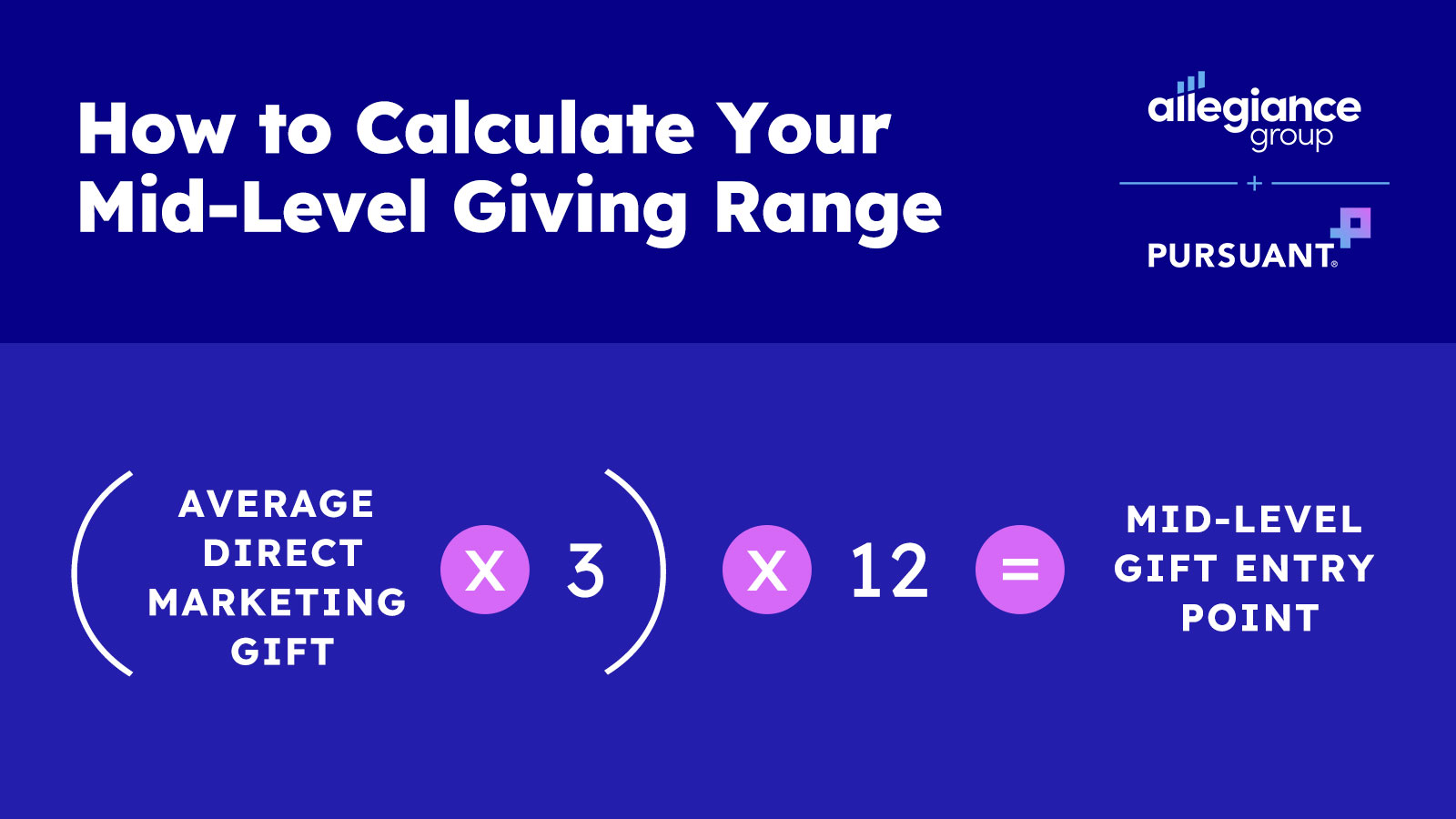
To calculate your mid-level giving range:
1. Multiply your average direct marketing gift by three. For example, if your average direct marketing gift is $60, multiply that by three to get $180.
2. Take that number and multiply it by 12 to determine the entry point. Using our example, which means your mid-level program starts at $2,160 a year.
The top end of the mid-level group could be your major gift threshold. Those who fit into your established giving range would be considered mid-level donors. You can also take the top 5% of your mass-market donors who don’t hit the major gift minimum.
With your mid-level file in place, segment it into tiers based on giving history, engagement level, and capacity. Then, tailor your cultivation, stewardship, and outreach efforts accordingly. Those on the lower end of the mid-level spectrum might be best targeted for small, incremental increases in their donations. Meanwhile, those donating larger annual amounts are excellent candidates for an upgrade to major giving.
3. Begin personalizing donor engagement.
Mid-level donors need personalized experiences, particularly when you have a large mid-level file. Segmenting engagement opportunities and experiences by giving amounts will incentivize donors to give more.
Remember, there’s a significant difference between annual donations of $1,000 and $10,000. Those who give $833 a month likely have very different expectations from those who give $83 a month.
You might customize:
- Thank you notes to reference past impact
- Exclusive content offering behind-the-scenes insights
- Leadership engagement opportunities, like webinars or intimate donor briefings
Use what you know about these donors to create experiences that cater to their specific interests. What is their preferred method of communication? Also, look at their past engagement to understand what programs or events they prefer. This could mean giving them exclusive opportunities to attend an event or fund a new program.
4. Create a tiered mid-level giving strategy.
Developing structured tiers within your mid-level giving program further enables you to deliver more personalized communications. For example, use data-driven segmentation to guide strategy by donor level:
- Mid-level Stewardship: All mid-level donors receive personal thanks
- Mid-level Cultivation: Ongoing personal & personalized engagement
- Major Gifts Qualification: Proactive identification and qualification of your next major gift donors
By breaking your mid-level program into tiers, you can easily see who’s on the cusp of moving up to the next level, so you can target them accordingly. Each tier should have a personalized engagement cadence, stewardship plan, and upgrade pathway.
Most mid-level donors will be in the entry-level tier. Enhanced email and direct mail outreach will be sufficient for this group. The middle tier is where your team should focus its cultivation efforts, while those in the top tier should be passed along to your major gifts team.
5. Develop stewardship and recognition strategies.
Mid-level donors tend to be the most loyal, but you can deepen their commitment to your organization through stewardship and recognition. Examples include:
- Tailored impact reports that align with donor interests
- Personal milestone recognitions, such as giving anniversaries or birthdays
- Public acknowledgment in donor communications when appropriate
Stewarding your mid-level donors doesn’t have to be costly or time-consuming. Even small touches, such as higher-quality paper or special thank-you notes, can make a significant impact. In addition, select perks that donors will appreciate over meaningless merch like coffee mugs or tote bags. Think quarterly reports from your executive director or invitations to special events.
You might also ask volunteers to call mid-level donors once or twice a year to express gratitude. If your group is too large for this, focus on the middle and upper tiers, which have more upgrade potential.
5 Tips for Young Mid-Level Donor Programs

In addition to technology and data tools, mid-level giving success also depends on the structure put in place around your program. Here are a few practical steps nonprofits can take to optimize new initiatives and set the stage for long-term growth:
- Set clear, early goals. Determine what success will look like within year one (or another specific timeline) and pinpoint the key performance indicators (KPIs) you will need to track (e.g., number of donors, average gift size, etc.).
- Start a pilot tiered program. Launch just one level to begin at an accessible entry point. Prioritize highly engaged prospects, test out the program, collect feedback, and iterate.
- Identifying a dedicated “point person” or team. Assign specific staff members to oversee the program, ensuring they understand what’s required of their role to prevent mid-level goals from falling by the wayside.
- Investing in tracking and basic infrastructure early. Nonprofits should have a way to track progress and maintain the program from the outset – this makes it easier to measure performance and scale in the future.
- Considering exclusive experiences. Early on, nonprofits could offer exclusive experiences that don’t require a ton of time/resources. For instance, behind-the-scenes tours, early or VIP access to events, etc.
As you launch (or refine) your mid-level giving program, be sure to align stakeholders around realistic expectations. You may have some wins – like engaging a certain number of new donors or piloting a tier – that happen quickly, while larger wins like revenue growth happen more slowly. With consistency and a clear strategy, your program will have the foundation it needs to grow into a powerful engine of support.
Don’t Neglect Mid-Level Donors; Empower Them
Donors who fall in the mid-level range are all too often overlooked, but these are typically your most loyal constituents. Now more than ever, you need sustainable support to see you through ongoing economic uncertainty.
With a strong mid-level program as your foundation, you can build deeper relationships with donors who share your commitment to your mission. More importantly, you’ll gain visibility into who’s ready to give more, creating a steady pipeline of donors with upgrade potential.
We’ve created the Mid-Level Accelerator, a scalable donor engagement solution that helps nonprofits of any size build and grow a thriving mid-level program. With flexible tiers, it gives you the tools to strengthen donor relationships today while creating a steady pipeline of upgrade-ready supporters for the future. Contact us now to learn more.