
Consider how many communication channels you use daily. You might wake up, browse social media, check your email, and read a couple of news articles. During your morning commute, maybe you tune into a podcast or turn on the radio. You check text messages throughout the day, and when you get home that evening, you collect physical mail from your mailbox.
Now, consider how often advertisers promote their products or services through these channels. Which campaigns are the most effective and memorable? In most cases, it’s those that establish multiple touchpoints across communication channels, offer consistent customer experiences, and guide audiences from awareness to conversion.
You can apply these observations and practices to your nonprofit’s marketing and fundraising efforts by implementing an omni-channel marketing strategy. Here are the basics of omni-channel marketing, the steps you need to get started, and common challenges and recommended solutions.
New to omni-channel marketing? The AGP team is ready to share our expertise.
What is omni-channel marketing?
Omni-channel marketing is a communication strategy that integrates various communication channels to create a unified, consistent experience for your audience of supporters. While you should use the communication channels your audience prefers, popular channels include your website, email, social media, text, and direct mail.
This approach focuses primarily on the user experience, addressing your supporters’ preferences and past behaviors. By showing that you understand and value their unique perspectives and motivations, you’ll foster more trust and loyalty among your supporters—ultimately showing that you value them for more than just their donations.
How does omni-channel marketing work?
Omni-channel campaigns leverage various communication channels to support a single supporter experience. For example, let’s say you run a wildlife conservation organization and launch a campaign focused on preserving endangered species in the Amazon Rainforest.
Here’s what the donor journey would look like for Sarah, a mid-level donor who has given sporadically in the past:
- Awareness: Sarah follows your nonprofit on Instagram and, while scrolling, sees a video you posted about endangered jaguars in the Amazon Rainforest. She watches the full video, likes the post, and comments in support. Your organization notes Sarah’s interest in big cats and her willingness to interact on social media.
- Consideration: 24 hours after engaging with your post on Instagram, Sarah receives an email about jaguars in the rainforest. The email dives deeper into the story of a specific jaguar your nonprofit aided and the impact of donations to your cause. It features a prominent call to action (CTA) button that Sarah clicks—however, she doesn’t decide to donate right away. You note that she is receptive to email marketing but needs more motivation to donate.
- Decision: Your organization sends Sarah a follow-up email 48 hours later, inspiring a sense of urgency. The message is also more personalized, referencing a donation amount similar to what Sarah gave in the past and describing the immediate difference that funding would make. This time, Sarah clicks through the CTA, arrives at a custom Jaguar Protection Campaign donation page, and decides to donate.
- Action: Sarah makes a one-time, mid-sized donation to the jaguar campaign. Afterward, she is redirected to a personalized thank you page that greets her by name and details the specific project she helped fund. She also receives a timely, personalized thank-you email that details the impact her support will have.
- Post-Donation Follow-Up: In addition to compelling thank-you messages, you share a follow-up survey. You ask Sarah which communication methods she prefers, allow her to input relevant contact information, and gather her thoughts on what could be improved.
In your own campaign, you’ll need to consider donors’ preferences, interests, and behaviors. Examine interactions with the campaign and make inferences about how they prefer to engage, then adjust your strategies. Leverage various types of channels media and segment donors to offer personalized, engaging experiences.
Should nonprofits use multichannel or omni-channel marketing?
Multichannel and omni-channel strategies are often confused because they both involve communicating with your audience via multiple channels. However, these strategies are different:
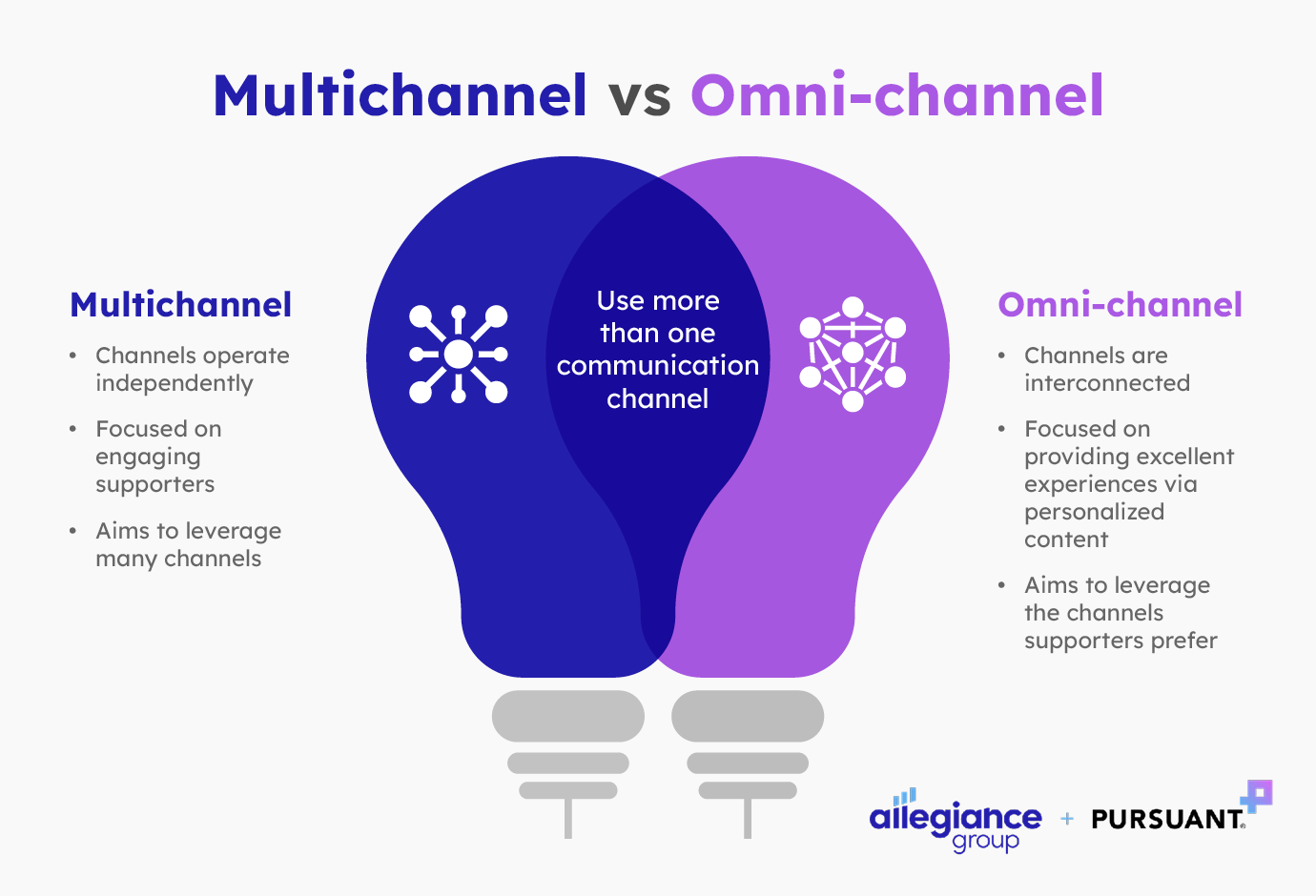
- Multichannel: Channels operate independently, and the goal is simply to engage supporters and establish many touches that lead to a donation or other conversion.
- Omni-channel: Channels are integrated, seamlessly nudging supporters closer to donating. The goal is to provide holistic, engaging experiences through compelling, personalized content delivered via supporters’ preferred channels.
This more personal, layered approach can benefit your organization by:
- Building deeper relationships with donors. Personalized messaging shows that you are making an effort to understand and connect with your donors. Explicitly addressing the causes and issues they care about affirms their decision to support your work. For example, you might highlight your food bank’s work to get more healthy, kid-friendly snacks to families in your community during school to the segment of donors who are passionate about ending childhood hunger.
- Boosting responses and conversions. When you personalize messages, you ensure they are relevant and compelling to the recipient. This will boost metrics like open rate, click-through rate, and conversion rate. Additionally, it will lower the apathy or frustration donors may feel toward more repetitive or boilerplate messaging.
- Maximizing available resources. With consistent data tracking and analysis, you’ll better understand which channels and strategies perform best among your supporters. From here, divert more resources to the most effective strategies to earn a higher ROI.
- Capturing opportunities that might otherwise fall through the cracks. When you divert resources to the most promising channels and strategies, you can identify and capitalize on more opportunities. For instance, let’s say you notice that supporters engage often with text messages, so you ramp up these efforts. Funding grows by 50%, you recruit 100 new donors, and engagement increases—but without a tailored, donor-first approach, you may have missed these opportunities.
Want to dig deeper? Download our comprehensive omni-channel fundraising guide!
What are the steps to starting a nonprofit omni-channel marketing campaign?
If you’re considering implementing an omni-channel marketing strategy, here’s a brief overview of the steps you need to take:
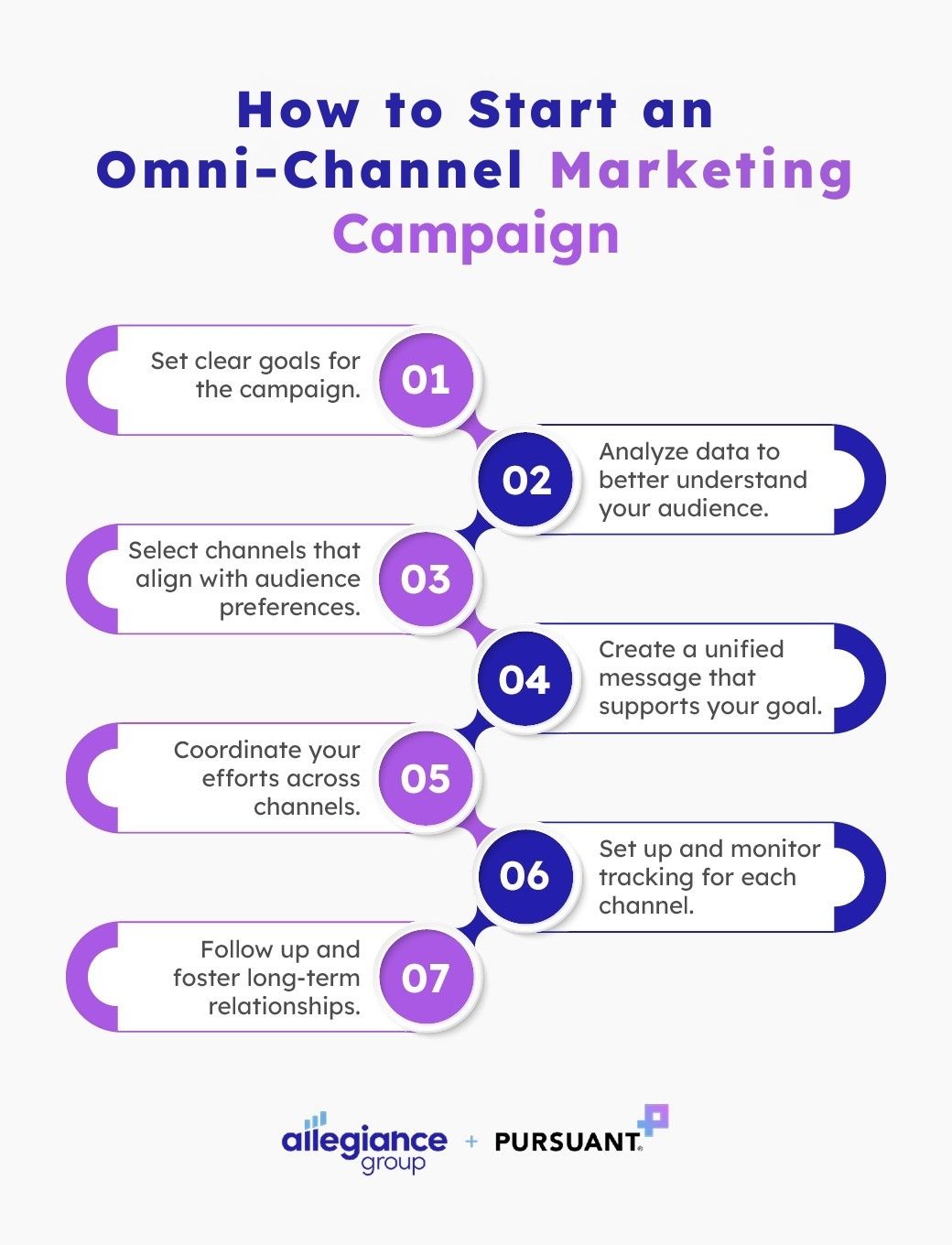
- Set clear goals for the campaign. The goal(s) should be specific and measurable, and you should be able to define specific marketing objectives to support them.
- Analyze data to understand your audience. Identify patterns, trends, and preferences. Segment donors based on shared behaviors, interests, communication preferences, etc.
- Select channels that align with audience preferences. Use the channels that already motivate engagement and action (i.e., donating).
- Create a unified message that supports your goal. Then, personalize this message depending on the communication channel used or the audience segment being targeted.
- Coordinate your efforts across channels. Ensure content delivers complementary, lead-nurturing messages across channels (e.g., reinforce messages from email campaigns in your social media posts).
- Set up and monitor tracking for each channel. This step can be complex and may involve tracking custom fields for interest topics, using UTM codes and various conversion tracking tools. Monitor this data throughout the campaign to make adjustments as needed.
- Follow up and foster long-term relationships. Look beyond the short-term. Follow up with personalized thank-you messages, recommend other ways to engage, and maintain contact with the supporter after the campaign ends to keep them engaged and prevent lapsed donors.
Because this process involves complex data analysis, a strong understanding of attribution models, and experience with various marketing channels and strategies, we strongly recommend working with a nonprofit marketing agency.
At Allegiance Group + Pursuant, we leverage our experience within the nonprofit sector to address the unique challenges and goals organizations like yours hold. Through services like digital marketing, direct mail, strategy and planning, web development, and more, we help mission-driven organizations meet their fundraising and donor engagement goals.
Contact us today to learn more about how Allegiance Group + Pursuant can help you inspire action, amplify your organization’s results, and ultimately further your mission.
Why is executing an omni-channel strategy difficult?
There are clear benefits to using an omni-channel strategy. However, starting and executing a successful omni-channel campaign can be challenging. Depending on your nonprofit’s resources, bandwidth, and marketing expertise, this strategy could even be met with internal pushback.
Be prepared to defend this effective strategy by getting familiar with possible setbacks and ways to overcome them. Here are some common obstacles nonprofits face when launching an omni-channel campaign and our recommended solutions.
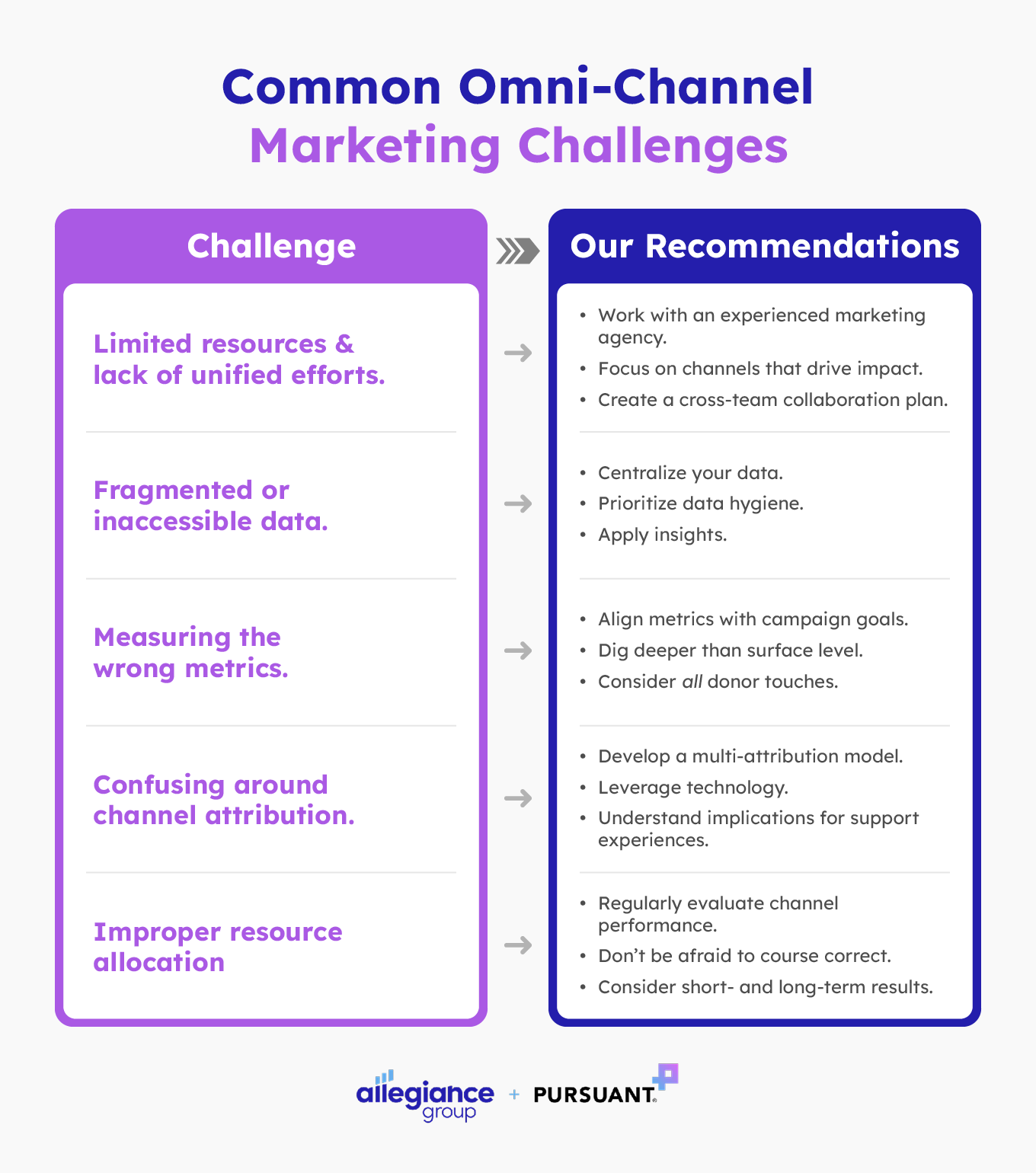
Limited resources and lack of unified efforts.
Nonprofits often operate with limited resources, and it can be difficult to allocate funding and staff time toward marketing activities—especially for omni-channel campaigns that require extensive planning and strategizing.
Additionally, omni-channel campaigns need support from various staff members or teams. If you’re short-staffed or already stretched thin, it can be challenging to effectively coordinate your efforts across teams.
Our expert approach:
- Work with an experienced marketing agency. Our team of experts at Allegiance Group + Pursuant has decades of experience in the nonprofit marketing sector. We’re well-equipped to plan, execute, and oversee complex omni-channel campaigns that deliver the results your organization needs to further its mission.
- Focus on channels that drive impact. To secure stakeholder and staff buy-in and maximize your limited resources, identify and prioritize the channels that are most likely to drive donations. Analyze past data to identify the channels that consistently attract donations, then develop personalized strategies for each of them.
- Create a cross-team collaboration plan. Omni-channel campaigns may involve members of your marketing, fundraising, and programming teams. Share a detailed marketing plan with everyone involved, plan regular meetings, and align on shared goals.
Fragmented or inaccessible data.
When it comes to personalized marketing, data is king. But without reliable, accurate data about your supporters’ past behaviors, interests, preferences, and giving motivations, nonprofits may struggle to craft personalized messaging.
Further, this data may be stored across multiple databases or software solutions (e.g., Google Analytics, a social media marketing tool, and an email marketing platform). This forms data silos and prevents organizations from gaining a truly comprehensive view of marketing and supporter data.
Our expert approach:
- Centralize your data. Invest in a constituent relationship management (CRM) system and dedicated data analytics platform. This will unify all of your data on a single platform, giving you a comprehensive view of your supporters and highlighting actionable insights, patterns, and trends.
- Prioritize data hygiene. Data hygiene is the process of maintaining “clean” data that is up-to-date and free of errors. This can involve verifying your data, removing duplicate or irrelevant data, appending new data to fill gaps, and enforcing standardized data entry.
- Apply insights. Use what you learn from your data to craft your messaging, select communication channels, identify high-potential donors, and predict future behaviors.
Measuring the wrong metrics.
Metrics matter—they determine whether your campaign was successful. However, the metrics you track and analyze must correlate with your goals. Often, organizations are tempted to track vanity metrics that do not align with their core goals. For instance, if your goal is to raise $20,000, the number of likes you receive on an Instagram post is not a very useful or relevant metric.
Studying the wrong metrics can lead to misguided efforts and missed opportunities that ultimately neglect broader fundraising goals and long-term donor engagement.
Our expert approach:
- Align metrics with campaign goals. Track metrics that directly relate to your goal. For fundraising goals, this means tracking donations. Or, if you’re looking to acquire new donors, this means recording the number of first-time donors during the campaign.
- Dig deeper than surface level. High social media engagement looks good, but is it truly driving conversions and long-term donor engagement? Identify and prioritize the channels that yield the most conversions and repeated donor interactions.
- Consider all donor touches. Record all of the ways you reached out to donors, not just the messages that donors engaged with or responded to. This reveals opportunities to improve communications (e.g., donors tend to engage more with emails that feature compelling graphics) and provides a comprehensive understanding of how each message supports the donor journey.
Confusion around channel attribution.
Channel attribution is the process of identifying which marketing channel a supporter interacted with before making the decision to donate. Accurate attribution is especially challenging with omni-channel marketing because supporters interact with multiple integrated channels before converting.
Not only does this cause confusion about which channels are successfully driving conversions, but it can be difficult to understand how other channels and strategies support those conversions.
Our expert approach:
- Develop a multi-attribution model. These models distribute the “credit” for a conversion across all touchpoints the donor interacted with, showing you which ones are the most influential.
- Leverage technology. Various analytics platforms can give you a clearer picture of how channels interact to motivate donors to take action. Explore options like Google Analytics, HubSpot, or Salesforce to find the tools that meet your needs and integrate with existing technology.
- Understand implications for supporter experiences. Unlike multichannel fundraising, an omni-channel strategy prioritizes supporter experiences over channel and message quantity. Look out for indications that donor experiences are being impacted. For example, a steep drop-off in engagement could indicate gaps in the campaign that you need to remedy with stronger calls to action or channel integration.
Improper resource allocation.
Some organizations may see strategies working well for one channel and replicate the same tactics across every other communication channel. However, you shouldn’t use this blanket approach just because you have the resources to do so. Using every channel in the same way or launching impersonal, mass marketing messages, for example, won’t be as effective as a more tailored approach.
If you don’t understand your return on ad spend (ROAS) for each channel and the effectiveness of individual strategies, you may over-invest in those with lackluster performance. Or, you may miss opportunities to invest resources in channels with great potential.
Our expert approach:
- Regularly evaluate channel performance. Measure how much each channel contributes to your goals and adjust your spend accordingly. For example, if social media only generates 5% of your conversions, divert resources from that channel to a more successful one.
- Don’t be afraid to course correct. The channels and strategies you outline in your marketing strategy may not always go to plan, especially if your organization is new to omni-channel marketing. While you shouldn’t change your goal halfway through a campaign, it’s okay to swap strategies that clearly aren’t working for something more impactful.
- Consider short- and long-term results. Short-term goals, like earning donations, and long-term goals, like developing deep, loyal donor relationships, are both important. To go beyond transactional, one-time giving, balance the two. For example, promote community-building activities and opportunities alongside your fundraising appeals.
Additional Resources
Omni-channel marketing can deliver the results you urgently need, like fundraising dollars and establishing meaningful, lasting relationships with donors. To enjoy these benefits and make the most of your hard-earned resources, consider working with a seasoned marketing team to execute your omni-channel campaign.
Reach out to the AGP team today to discover how we can help you amplify your impact and drive action for your cause.
Learn more about effectively fundraising and promoting your cause with these resources:
- An Inside Look at Crafting a Strong Nonprofit Marketing Plan. Your marketing plan is your campaign’s roadmap. Discover the key elements you must include in your plan here.
- Unlock the Secrets of Digital Marketing for Nonprofits. Digital marketing is crucial for nonprofits to engage supporters in the digital age. This comprehensive guide reveals all the industry secrets.
- 7 of the Most Effective Fundraising Tools You Need to Try. Are your fundraising tools effective and user-friendly for staff and supporters? If not, consider switching to one of our top recommendations instead.