
In the internet age, nonprofits need to have a prominent digital presence. On average, nonprofits increased digital advertising spending by 11% in 2024, proving the effectiveness of digital channels in a tumultuous economic climate.
Investing in these channels allows mission-driven organizations to reach far beyond local communities, attract more donors, increase supporter retention and engagement, and grow their operations. In this guide, we’ll explore digital marketing for nonprofits and how your organization can make its campaigns as effective as possible:
- What is digital marketing for nonprofits?
- What are the benefits of digital marketing for nonprofits?
- What are the steps for creating a digital marketing campaign?
- How can nonprofits enhance their digital marketing campaigns?
Need help reaching more donors online?
What is digital marketing for nonprofits?
Digital marketing for nonprofits refers to the strategic use of online channels like social media, email, and search engines to fundraise, acquire donors, or spread awareness of a cause.
The purpose of these marketing campaigns differs between businesses and nonprofits. While businesses want to sell their products or services to maximize profits, a nonprofit’s primary goal is to further its mission. This can mean maximizing revenue through fundraising initiatives. However, nonprofits also launch campaigns to recruit volunteers, inspire advocacy efforts from supporters, or spread awareness of their cause.
What are the 5 P’s of digital marketing?
The 5 P’s of digital marketing include product, place, price, promotion, and people. Think of this as a framework you can use to ensure your campaign remains cohesive and mission-driven.
This concept is based on the original 4 P’s of marketing (product, place, price, and promotion), which were conceptualized by E. Jerome McCarthy in 1960. Each element informs a specific area of your marketing mix (the tactics you use to promote your cause). Over time, the 4 P’s have been modernized and expanded, and some organizations consider up to 7 P’s.
As a nonprofit, keep the following 5 Ps in mind as you develop your marketing strategy:
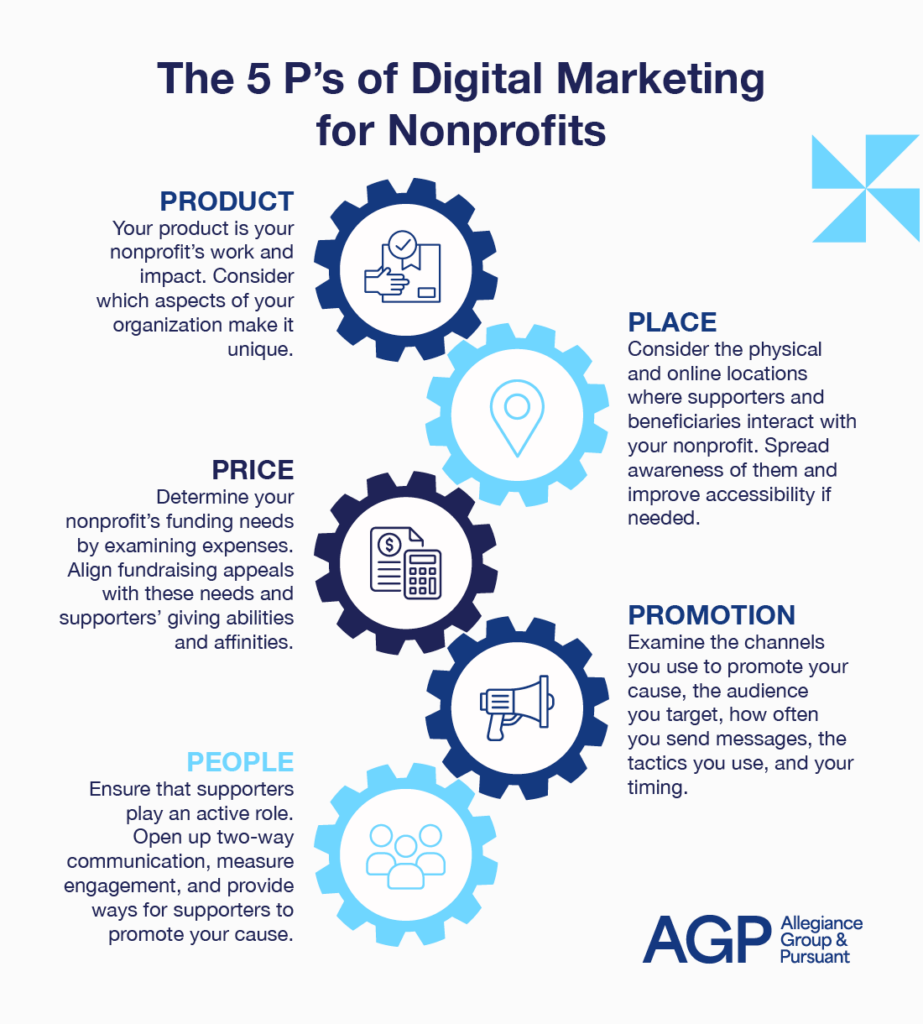
- Product: Your nonprofit’s “product” is its reputation, the work it does, and your intended and actual impact. Evaluate what makes your nonprofit unique and the experiences supporters hope to gain from engaging.
- Place: Consider physical and online locations where supporters can engage with your nonprofit, such as in an office or on social media pages. Do constituents know about these spaces, and are they accessible?
- Price: While nonprofits typically don’t sell a product at a specific price, donating, volunteering, and becoming a member still come at a “cost” to your supporters. Balance the amounts you request in fundraising appeals (i.e., the “price”) with your program’s expenses.
- Promotion: Examine the communication channels you use, who you target, how often you market your mission, and what tactics you use. Consider whether you take advantage of times when giving peaks—such as on Giving Tuesday or year-end.
- People: Donors want to actively take part in furthering your nonprofit’s mission. Offer opportunities for two-way communication, give donors tools to promote your nonprofit, and measure their engagement.
Keep each of these elements in mind when planning your campaign to ensure that your tactics align with your organization’s broader goals and values. This way, you’ll defer to your mission before implementing anything new.
What are the benefits of nonprofit digital marketing?
Digital marketing offers a more cost-effective way to promote your nonprofit. For example, a 30-second commercial on network television can cost over $100,000 in broadcasting fees alone. Creating a post for your Instagram account is virtually free.
In addition to being more affordable than traditional marketing platforms, digital marketing can benefit your nonprofit by:
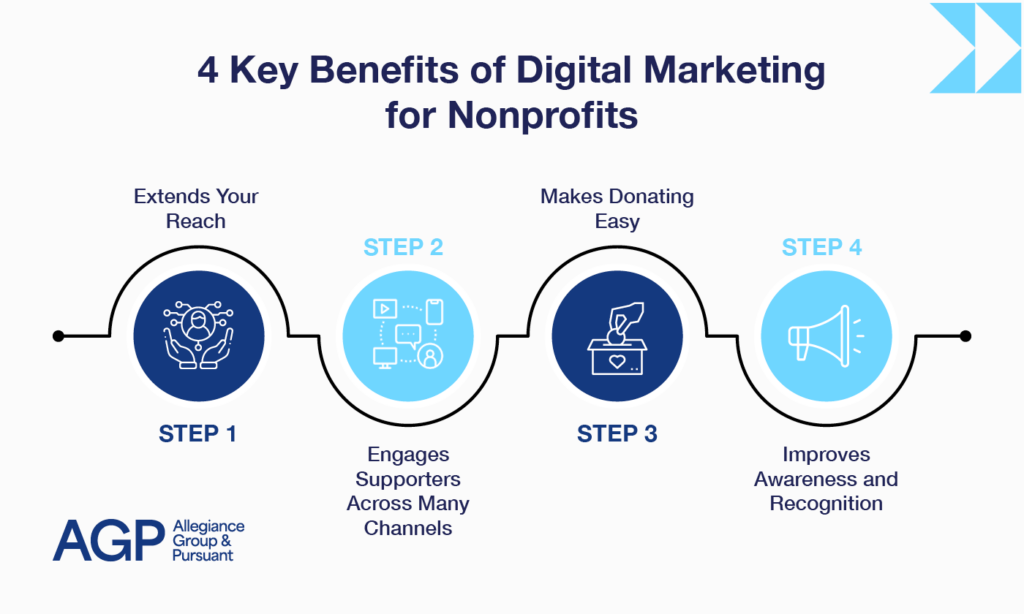
- Extending your reach. Connect with supporters at any time, from anywhere. An email or social media post can instantly reach audience members worldwide.
- Engaging supporters across many channels. Reaching out regularly through multiple channels, like email, social media, and text, keeps your nonprofit at the top of your supporters’ minds and informs them of ways to get involved and stay engaged.
- Making donating easy. Donating online tends to be the easiest option for most supporters because they can give in just a few clicks. With digital marketing, you can make the process even easier by linking them directly to your donation form.
- Improving awareness and recognition. Once you establish more touchpoints with donors, they’ll be more likely to think of your organization and discuss your cause with others in their network. Boost recognition by keeping your branding consistent across various channels.
Cultivating a digital presence also enhances your credibility. For example, when most people hear about a new business, restaurant, or nonprofit, their first instinct is to Google the organization. Having a polished website that appears in the top results on Google makes your nonprofit appear more trustworthy and allows you to show off the work you’ve done.
Get these benefits (and more!) by working with AGP.
What are the steps for creating a digital marketing campaign?
Planning a marketing campaign is not always a straightforward, linear process. In most cases, however, these steps can provide your nonprofit with some structure as you bring your digital campaigns to life:
1. Define your nonprofit digital marketing goals.
Setting clear, measurable goals should be the foundation of your campaign. By defining what you want to achieve upfront, you can create a roadmap that guides your strategy and helps you accurately evaluate success.
Set clear, tangible objectives with the SMART goal framework:
- Specific: Define success using a certain metric or other numeric value (e.g., fundraising dollars raised).
- Measurable: Have a way to track how marketing tactics help you progress toward your goal, such as conversion rate.
- Achievable: The goal is ambitious, but you can realistically reach it within the set time period. Specify what actions you will take to achieve your goal.
- Relevant: Goals align with current organizational priorities and external factors (e.g., holidays).
- Timebound: There is a deadline by which you must achieve your goal.
For example, let’s say your food bank is aiming to increase the amount of resources available to help your community in times of need. To ensure a reliable safety net for your community, your goal might be to raise $250,000 for your Emergency Relief Fund through a targeted, multi-channel campaign. You’ll do this by expanding your outreach through targeted marketing channels, as well as building strong partnerships and awareness within your local community.
When choosing which goals to prioritize, get your leaders and board members involved. Prioritize achieving goals that are most urgent and will have the greatest impact first. Alternatively, you can work to achieve multiple, similar goals at the same time under one marketing campaign.
2. Identify and understand target audiences.
Next, identify the specific audiences you need to engage to achieve your goals. You’ll need to gain a deep understanding of exactly who you are trying to reach, from potential donors to beneficiaries. Creating detailed personas can help you visualize these groups and tailor your messaging to their specific needs and behaviors.
Think of these personas as characters in a novel. A donor persona will include information like:

- Name
- Age
- Education
- Occupation and career history
- Communication preferences
- Philanthropic goals and history
- Reasons for giving and affinity for your cause
It’s best to create separate personas that represent each of the different audiences you target. Not only should you create different personas for donors versus volunteers, but you should also work to understand the differences between individuals who are major donors and those who give moderate amounts once or twice a year.
3. Select communication channels.
Once you’ve selected a target audience for the campaign, determine how you will reach them. Choosing the right platforms ensures that you actually reach the audience you’ve painstakingly researched. Commonly used digital marketing channels and tactics include:
- Social media
- SMS
- Website
- Paid advertising
- Search engine marketing (SEM) and search engine optimization (SEO)
- Video and content marketing
- Influencer and affiliate marketing
Select channels based on your target audiences’ unique communication preferences. For example, perhaps your audience of young professionals is too busy to engage with an hour-long podcast, but they are willing to check out and share your social media posts.
Additionally, confirm that your audience actually uses the channels you want to employ. Reference metrics from past marketing campaigns to identify how new supporters found your nonprofit and which channels receive the most engagement. For example, you may want to adjust your strategy accordingly if two-thirds of your monthly web traffic comes from social media referrals.
4. Develop compelling content.
Getting your message in front of supporters’ eyes is crucial, but you still need solid content to catch supporters’ attention and motivate them to take action—whether that’s donating, volunteering, or signing a petition. To create effective marketing messages that inspire your supporters, include the following components:
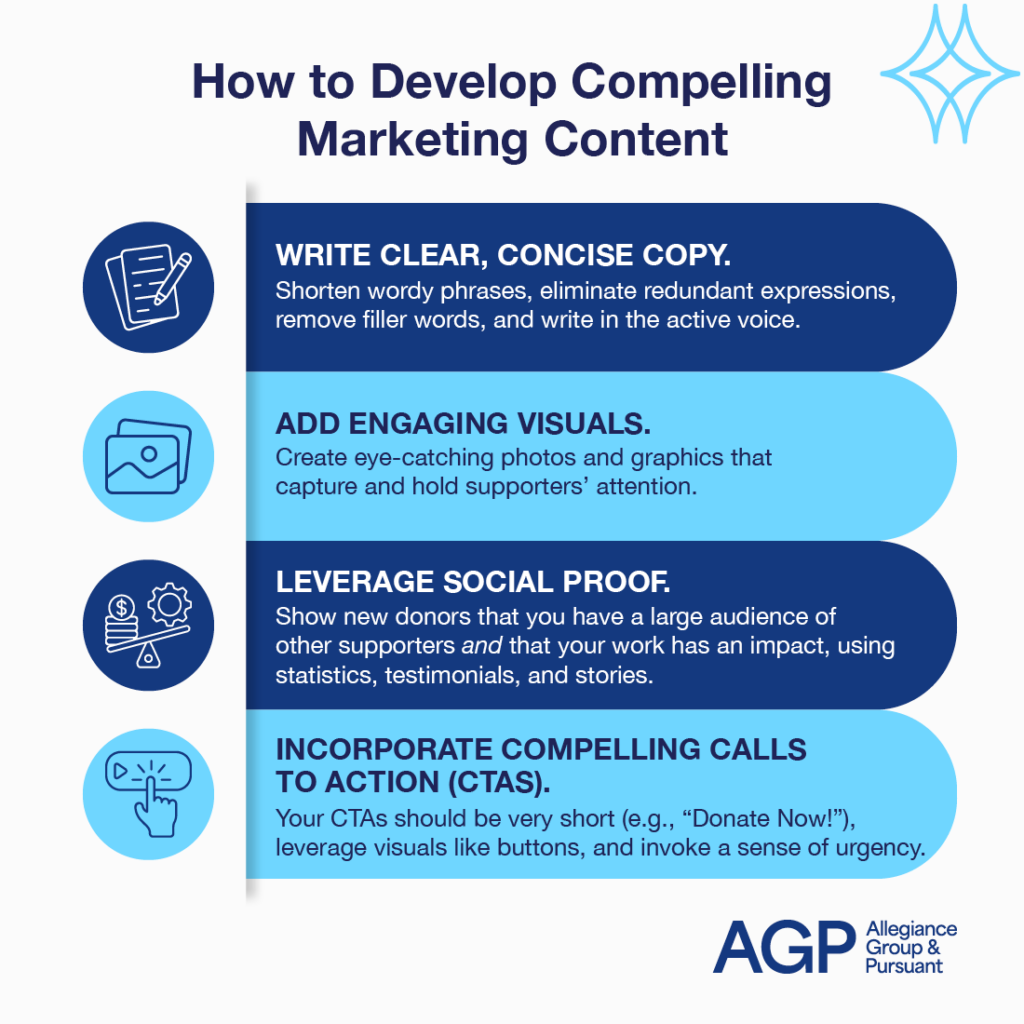
- Clear, concise copy. Whether you’re writing a 300-word marketing email or a short caption for an Instagram post, be economical with your words. Shorten wordy phrases, eliminate redundant expressions, remove filler words, and write in the active voice.
- Engaging visuals. Most digital platforms have clutter and distractioning. Users dedicate only a couple of seconds to each post before deciding whether to scroll. To cut through the noise, you’ll need to create eye-catching photos and graphics that capture and hold supporters’ attention.
- Social proof. Social proof is the phenomenon that occurs when an individual looks to the behavior of others when making a decision. Show new donors that you have a large audience of other supporters, and that your work has an impact. For example, you might create a graphic reporting a statistic like, “Thanks to generous donations from 5,000 loyal donors, we were able to build a new wing for our animal shelter!”
- Compelling calls to action. Calls to action (CTAs) are what motivate your audience to take the next action, such as donating, signing up to be a volunteer, or subscribing to your newsletter. Your CTA should be very short (e.g., “Donate Now!”) and leverage visuals like buttons. Some nonprofits invoke a sense of urgency to inspire supporters to take the next step.
Tailor each of these messages to the communication channel you are using. Messages that are highly visual and contain just a few lines of clear, accessible copy will perform best on Instagram. Longer, more educational blog posts, on the other hand, will establish your nonprofit as a thought leader and boost your rankings on search engine results pages.
5. Monitor progress and optimize your strategy.
Digital marketing allows for real-time analysis, meaning you don’t have to wait until your campaign ends to gauge its success. This gives you the opportunity to adjust the tactics, messages, and communication channels you use along the way, increasing the likelihood that you’ll meet your goals.
Throughout your campaign, track key performance indicators (KPIs) for each communication channel used. For example, for social media posts, you should track likes, comments, shares, and follows to gauge how successful your efforts are. If you are not on track to meet your goals, change your approach.
One way to test various marketing tactics at once is to use A/B testing. To perform an A/B test, you’ll create two similar marketing messages with one key difference (e.g., changing the subject line of your marketing email). Then, you send the “A” message to one section of your supporters and the “B” message to the other section.
After sending, measure metrics like response, click-through, and conversion rates to determine which strategy was most effective—then, use that strategy going forward.
6. Report final results.
Conduct a post-campaign analysis to measure your return on investment (ROI), pinpoint concrete successes, and identify ways to refine future initiatives. For multichannel campaigns, track the individual performance of each communication channel. Here are some of the areas your organization might be looking to increase or enhance, along with metrics you can use to measure them:

- Fundraising dollars: Track total donations sourced by your campaign (e.g., a donor saw a social media post and clicked a link to donate). Analyze changes in average gift size from before and during the campaign to assess its effectiveness.
- New donors: Measure increases in unique site visitors—those who have never been to the website before. Pay special attention to pages related to donation, volunteering, and other forms of engagement. Also, look for new leads captured via email or volunteer sign-up forms.
- Event attendance: Count the number of event registrations sourced by your campaign and compare it to past event performance. Determine your attendance rate by tracking the number of people who actually attended out of those who registered.
- Email subscribers: Track the total number of new subscribers your nonprofit obtained during the campaign. For each communication channel, determine the conversion rate—in this case, the number of users who signed up for your email list.
Once you’ve established whether your nonprofit met its goal, look for major successes and areas for improvement. For example, perhaps improving your graphics increased engagement with Facebook posts by 200%, but one of your more experimental email messages showed a decrease in click-through rate. Additionally, flag any trends or patterns, such as an increase in donations on a certain day of the week, for future reference.
How can nonprofits enhance digital marketing campaigns?
At AGP, we specialize in developing innovative marketing services for nonprofits. Working with a team of experts brings you invaluable outside perspectives and industry knowledge, allowing you to maximize your budget and increase your impact.
Our digital marketing services attract and engage more supporters, enhance your fundraisers, and expand your reach—all to further the important work you do.
Our offerings include:
- Campaign planning and strategy development
- Copywriting, design, and development services
- Development and execution of digital advertising campaigns
- Email campaigns
- Mobile marketing
- Robust data analyses
Additionally, we provide other services such as direct mail fundraising and website and app development, along with fundraising products. No matter your nonprofit’s needs, we’re here to help you grow and further your mission.
Contact us to see how AGP can support your nonprofit today!
Wrapping Up
Growing your nonprofit means attracting more supporters, expanding your reach, and inspiring donors and volunteers to take action. Digital marketing campaigns provide a solid foundation for each of these goals, helping your nonprofit develop a strong, credible, and compelling web presence.
To learn more about improving your fundraising campaigns and increasing your impact, check out some of our other resources:
- 10 of the Most Effective Fundraising Tools You Need to Try. The fundraising tools you use should make your job easier and streamline the process for donors. Learn about our top recommendations.
- How to Get Donations for a Fundraiser: 10 Best Practices. Donations supply the funding you need to continue your operations—these strategies will help you maximize your fundraising revenue.
- How to Improve Donor Retention. Did you know that it costs more to recruit a new donor than to retain an existing one? Step up your donor retention efforts with these tips.
- Building a Digital Presence Through Paid Media: It’s Easier Than You Think. Nonprofits of all sizes and with any budgets can use the data from their owned media to kick off their paid media efforts.