The American Physical Therapy Association (APTA) represents physical therapists and physical therapist assistants nationwide. Through its ChoosePT consumer website, APTA connects the public with licensed physical therapists and promotes the value of physical therapy.
The Situation
Find a PT, located on ChoosePT.com, is APTA’s primary online search and referral tool designed to connect consumers with physical therapists. While the platform was critical to engaging both members and the public, the existing experience was outdated and difficult to use.
The search interface presented consumers with an overwhelming number of input fields (faceted filtering) that behaved strictly excluded any results without an exact match to the user’s selected inputs. This often led to errors and zero results even in highly populated areas. Although location convenience was one of the most important factors for consumers choosing a physical therapist, the interface did not make location information easy to identify or evaluate.
Content and data issues further complicated the experience. The language used to describe therapists’ skills and capabilities relied heavily on clinical terminology familiar to physical therapists but unfamiliar to consumers. Behind the scenes, the therapist and practice data lacked the structure needed to support a user-friendly presentation or search function that aligned with how consumers expect to search and evaluate providers.
The Work
AGP took a holistic, research-driven approach to redesigning the Find a PT tool, combining discovery, user testing, data strategy, and technical integration. We partnered with our friends at Blend Interactive to build the experience on Optimizely.
Discovery and user research
The team analyzed existing workflows, conducted stakeholder interviews, and performed user testing with both physical therapists and consumers seeking care. This research surfaced critical usability, information architecture, and data structure challenges that informed the redesign.
Simplified search experience
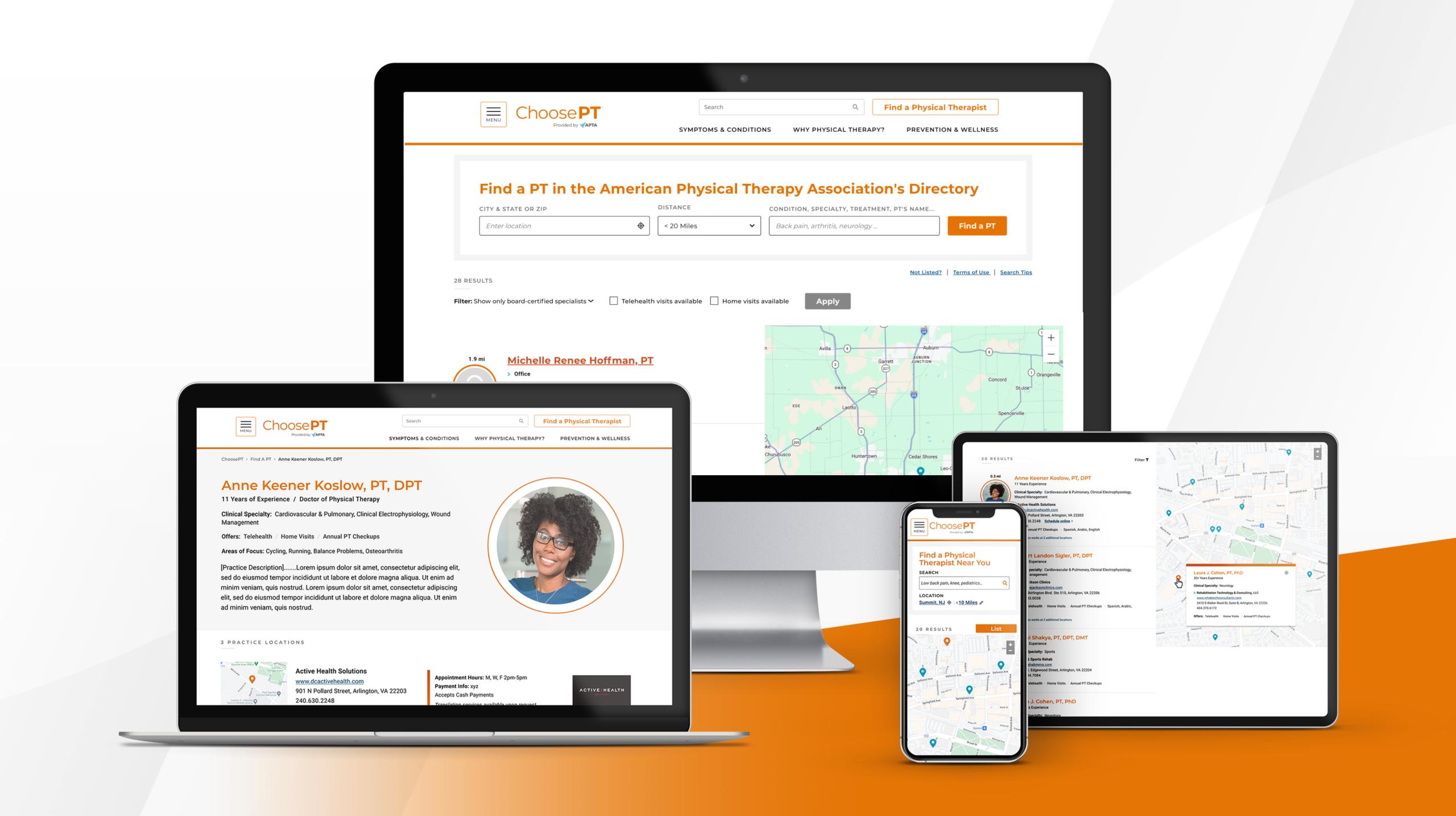
AGP replaced the complex set of search fields with a single, intuitive search input that allows users to enter common words or phrases. Clinical terms were mapped to everyday language so consumers could search using the vocabulary they naturally use.
Location-driven results and mapping
To reflect how consumers choose physical therapists, AGP introduced a map alongside the search results. Geolocation is used to automatically filter and deliver results based on the user’s location when they first land on the search tool page, making proximity immediately clear and improving the overall efficiency of the search experience.
AGP was a thoughtful partner throughout this project. Their UX/UI designer helped us simplify a complex search experience and translate our data to create a tool that better reflects how consumersactually lookfor care. Their team brought the right mix of strategy, usability insight, and technical understanding to help deliver a Find a PT experience that is easier to use and better aligned with our goals.
Suzanne Kitts
Public Relations Manager, American Physical Therapy Association
Consumer-friendly profiles and language
Therapist profiles were streamlined to remove information that was not relevant or understandable to consumers. Technical terminology was replaced or clarified with plain-language descriptions, reducing clutter and making profiles easier to interpret.
Data integration and architecture
The Find a PT directory was integrated with APTA’s database which serves as the system of record. An interim architecture was implemented using a nightly job that queries the Protech API to retrieve eligible therapist records and build searchable documents. The platform later transitioned to a real-time API model for faster, more dynamic updates.
Geolocation and performance optimization
To support the new map functionality, address data stored as text within the AMS was enhanced using Google Geocoding to generate latitude and longitude coordinates. Caching was implemented to optimize performance. On the search page, hidden latitude and longitude fields enable seamless form submissions, ensuring accurate, efficient mapping and filtering for users.
The Results
The redesigned Find a PT experience delivers a simpler, more intuitive search journey for consumers while maintaining robust, integrated data management behind the scenes. Improved usability, clearer location-based results, and consumer-friendly language make it easier for users to find and evaluate physical therapists. At the same time, scalable integrations and improved data structure position the platform for ongoing enhancements.