
With 1.8 million charities in the U.S. and 10 million worldwide, the nonprofit space is crowded. Attracting people who will support your organization, and especially those who will become long-term donors, depends on demonstrating your values, impact, and uniqueness. When donors align with your values, they’re more likely to stay.
That’s where your unique value proposition (UVP) comes in. A strong UVP clarifies why your nonprofit matters and why people should support you. In this blog, we’ll walk you through six steps to craft a compelling UVP and integrate it into your fundraising and messaging.
Need a hand creating your unique value proposition? Reach out to the experts at AGP.
Understanding the Unique Value Proposition (UVP)
Your unique value proposition is a clear statement of the value your organization provides. It’s what distinguishes your nonprofit from others and positions you as the best possible solution to the challenge or issue your mission serves.
In general, an effective UVP should do four things:
- Clearly state the problem to be solved.
- Address values shared with your ideal donor.
- Demonstrate concrete impact and outcomes.
- Highlight unique solutions or strategies.
Keep in mind that a UVP is different from your mission statement. A mission statement is a guide that ensures the programs or projects you undertake align with your organization’s goals. It’s why you do what you do.
A unique value proposition speaks directly to donors about why your organization can best help them achieve their goal of solving the problem in a way that aligns with their values. It is not a description of everything your organization does or how you do it; it’s focused on the aspects of your work that donors are most enthusiastic about supporting.
The Link Between UVP and Fundraising Success
Donors give to charitable organizations not to support the organization itself, but to make a difference to the issue the organization exists to tackle. They want to do that effectively, efficiently, and in a way that resonates with them on a human level.
At the heart of your UVP lies the “why” that motivates your donors to give. Maybe it’s the family member they lost to breast cancer or the poverty they experienced as a child. Your unique value proposition must tap into this. Be specific.
A UVP answers the question, “Why should I, as someone who cares about your mission, give to you instead of to another organization tackling the same problem, or not at all?” A clear UVP rooted in your donors’ motivations, values, and interests will allow you to create simple fundraising offers that will move them to action.
Define Your Nonprofit Value Proposition Step-by-Step
Defining your organization’s unique value proposition starts with the donor. What is the “why” behind their giving? If your UVP aligns with their “why,” you’ve found the sweet spot.
We’ve outlined a six-step process to help you uncover the “why” you share with your core audience. Before you start, we recommend gathering input from internal and external stakeholders, including fundraisers, the marketing team, data specialists, and development staff.
The Link Between UVP and Fundraising Success
If there’s a Golden Rule in fundraising, it’s this: People give to people, not organizations.
Donors often don’t trust large organizations and aren’t swayed by platitudes. They aren’t interested in large-scale issues like ending homelessness — that goal feels too big. But providing meals and blankets for the homeless people in their community is more attainable. It’s a difference they can see.
At the heart of your UVP lies the why that motivates your donors to give. Maybe it’s the family member they lost to breast cancer or the poverty they experienced as a child. deep down, donors have a personal connection,
Your unique value proposition must tap into this. Be specific.
Define Your Nonprofit Value Proposition Step-by-Step
Defining your organization’s unique value proposition starts with the donor. What is the “why” behind their giving? If your UVP aligns with their “why,” you’ve found the sweet spot.
We’ve outlined a six-step process to help you uncover the “why” you share with your core audience. Before you start, we recommend gathering input from internal and external stakeholders, including fundraisers, the marketing team, data specialists, and development staff.
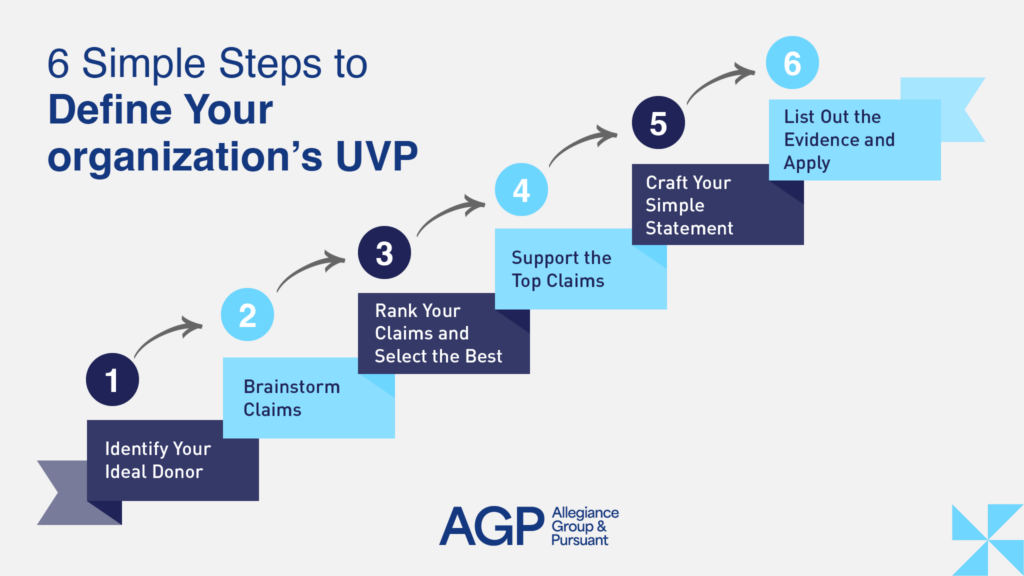
Take these steps to define your organization’s UVP:
- Identify Your Ideal Donor: Think about what your most committed donors say about giving to your mission. What messages do they respond best to? Also, consider the impact they want to make and what characteristics they share.
- Brainstorm Claims: List five to 10 claims you can make about your impact. This can include what your ideal donor will find most appealing, relevant, or compelling.
- Rank Your Claims and Select the Best: Score your claims for appeal and exclusivity on a scale of one to five, with “one” being the least appealing or exclusive to your ideal donors and “five” being the most appealing or exclusive. Then, identify the three most exclusive claims by totaling the appeal and exclusive scores.
- Support the Top Claims: Find evidence that backs up each claim. For instance, do you have data to support your claims? And can you deliver on your promises?
- Craft Your Simple Statement: This is a summary and should be something that everyone in the room agrees on. It outlines what’s most important — the claims you’ll focus on above everything else your organization does.
- List Out the Evidence and Apply: For each claim, expand your evidence statements into proof points that will build your UVP. Your simple statement and proof points will help you decide what to include in your creative materials.
Organizations should review their UVP roughly every one to three years, or more often based on donor feedback or if there are significant changes in the market, target audience, or programs. Create a process that works for you.
For more details about this process and examples, download the free eBook “Discovering Your Nonprofit’s Unique Value Proposition: A Step-by-Step Guide.”
Discover your nonprofit’s unique value proposition with detailed guidance and tips to identify your ideal donor.
Examples of Successful UVPs
Looking at other successful UVPs can help inspire your own. Find your industry in the slider tool below to see how you can transform a bland or generic statement into a compelling UVP.
See the Difference: Transform Your Value Proposition
Select your organization’s vertical below to see examples for how shifting your focus from what you do to the measurable impact you create transforms your messaging.
Next, let’s look at some organizations that have mastered the UVP in their messaging:
Feeding America
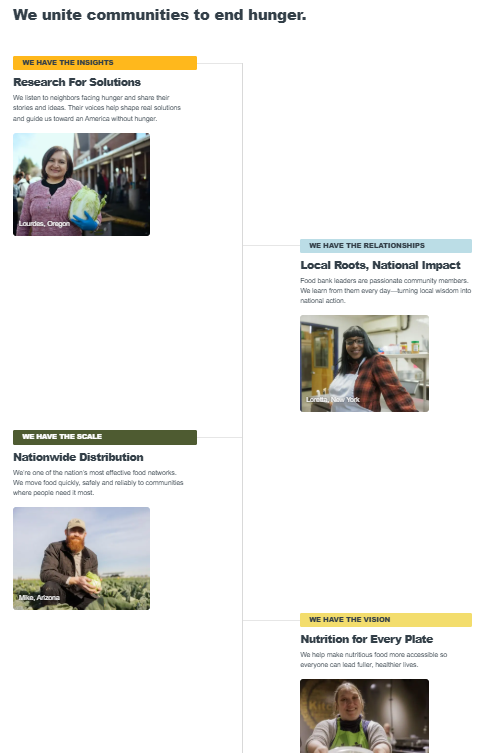
On its homepage, Feeding America shares four distinctive features of their organization in short form. A link takes users to a more detailed UVP page providing proof points and more detail.
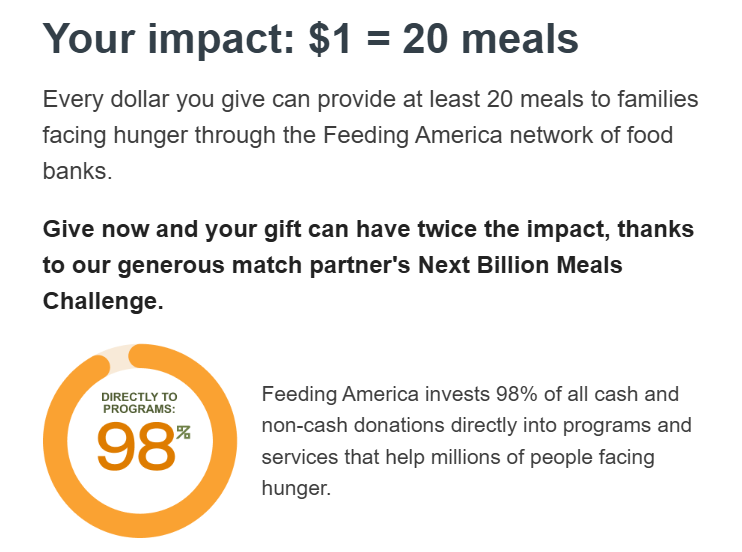
Building on this, Feeding America’s donation page adds a simple, quantifiable impact statement rooted in their UVP:
The Water Project
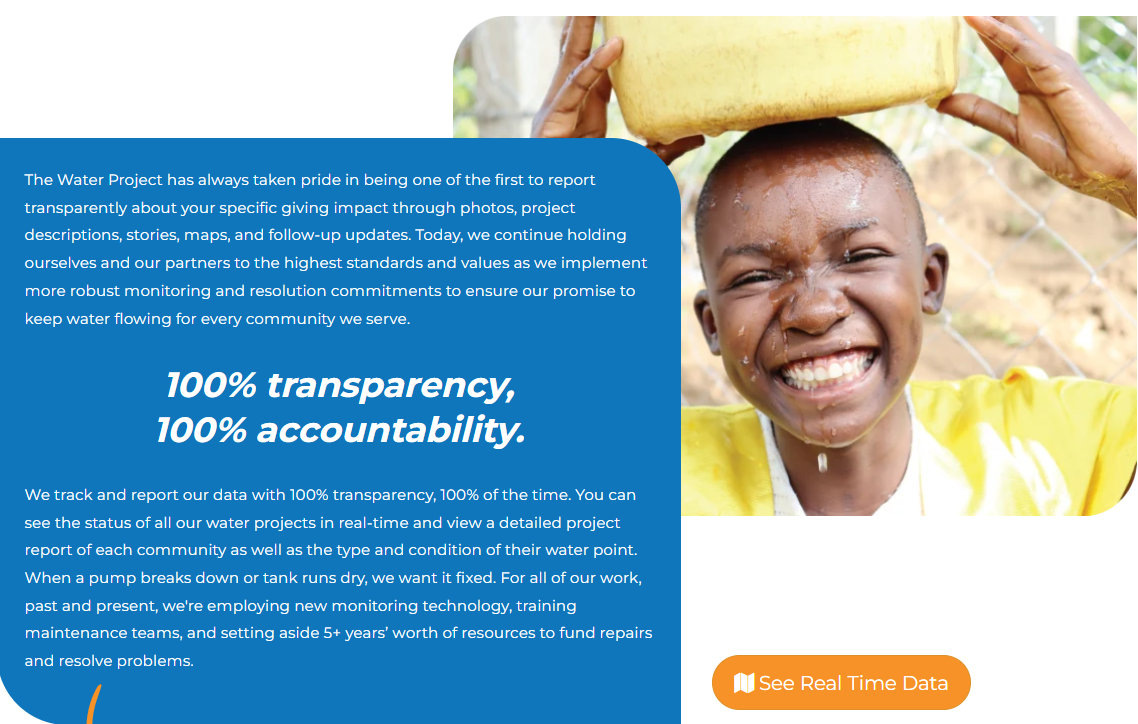
Most water charities share the same information about the problems of unsafe water and the process of providing appropriate water solutions. The Water Project provides this information, but also shares an important distinction that is highly appealing to donors:
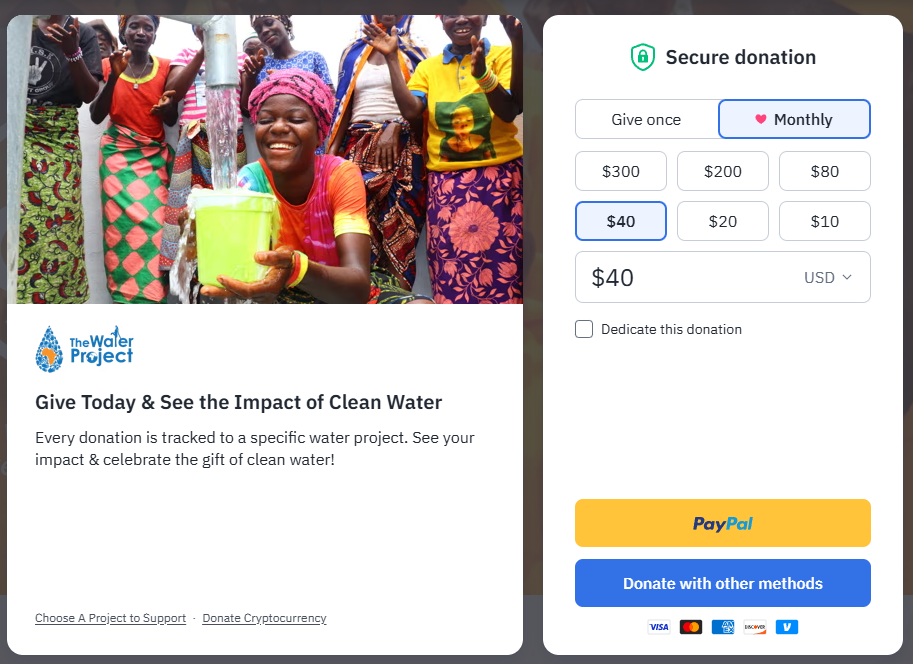
Their donation form reinforces this uniqueness and mark of trustworthiness as a key part of their offer:
Habitat for Humanity
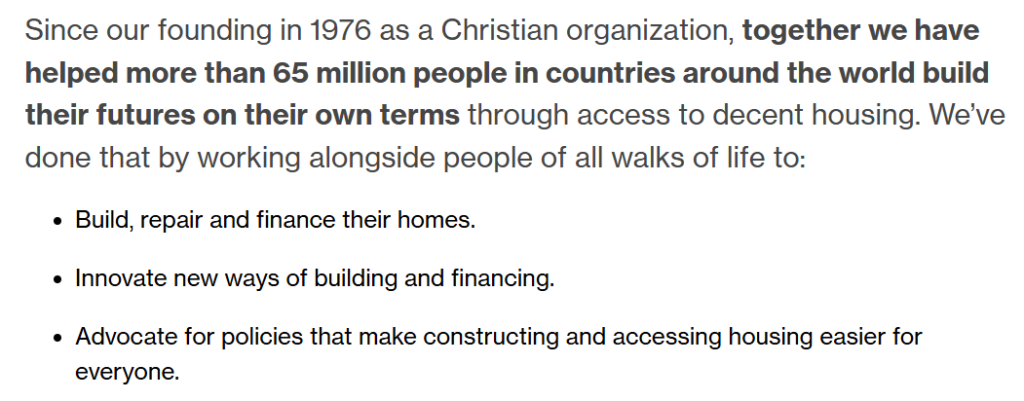
Habitat for Humanity provides a simple summary of their UVP on their “About Us” page:
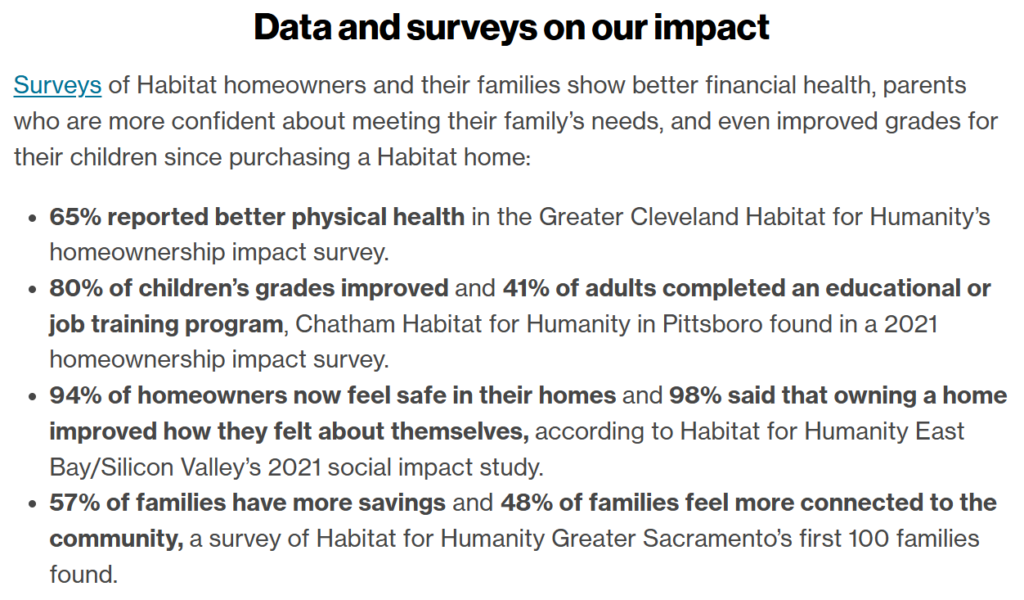
Their Impact page drills down into the proof points:
NAMI
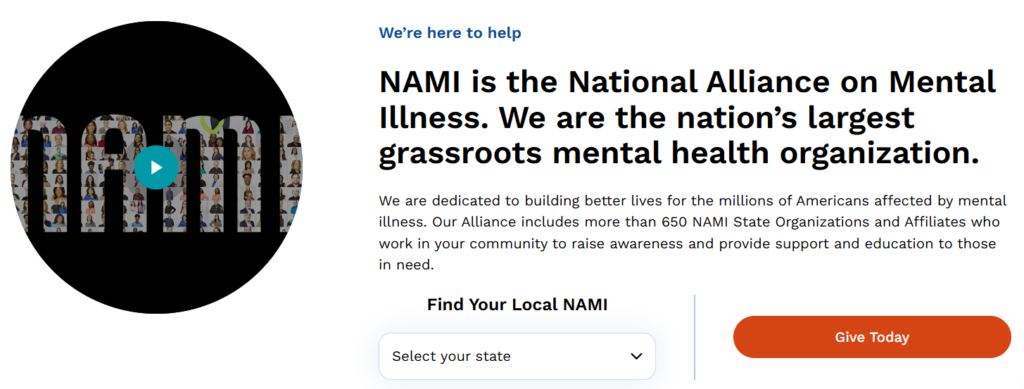
NAMI, the National Alliance on Mental Illness, places their UVP prominently on their homepage:
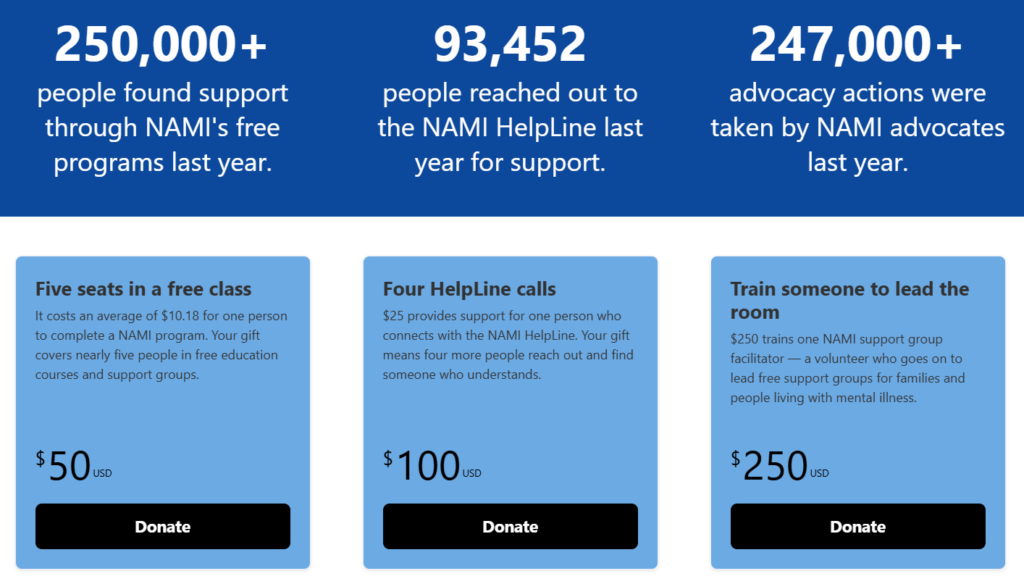
Their donation form offers proof points on their effectiveness and concrete impact statements for their donation amounts, while also emphasizing their reach and grassroots nature:
The SPCA of Texas
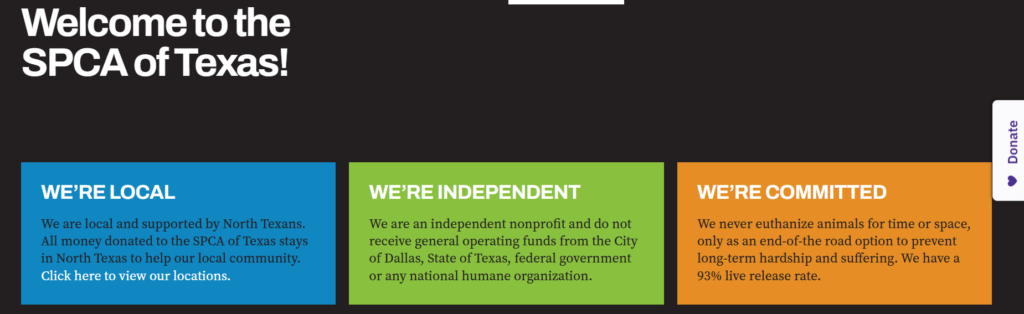
All animal shelters exist to help animals in need. On their “About Us” page, the SPCA of Texas starts by quickly listing three points that can strongly influence an animal lover’s giving decision.
They follow this by listing four key areas of focus with supporting information:
- We prevent and prosecute animal cruelty.
- We care for animals.
- We connect people and pets.
- We keep animals in their homes.
While not 100% unique, each of these items is very appealing to donors and may not all be combined by other local animal shelters, demonstrating the comprehensive role of the SPCA of Texas in animal welfare.
UVP Case Study: PAN Foundation
Consider a national patient assistance foundation that helps underinsured people with life-threatening, chronic, and rare diseases get the medications and treatments they need. The foundation partners with donors, healthcare providers, and pharmacies to lower or cover out-of-pocket costs.
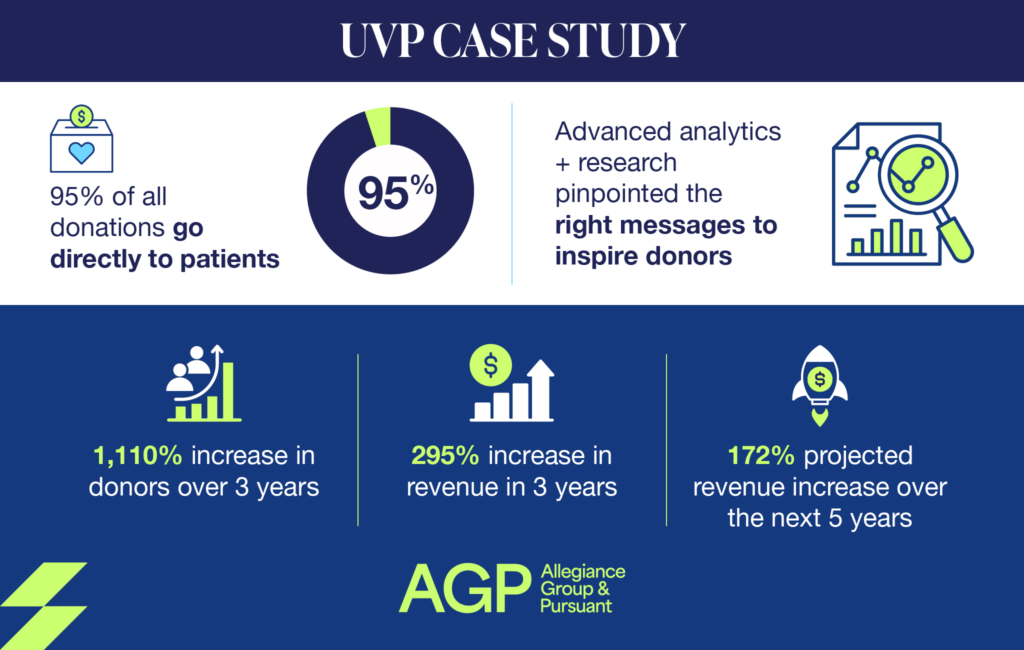
The mission is compelling, and 95% of all donations go directly to patients. However, the organization had little brand awareness and a small donor base.
The foundation partnered with AGP to evaluate how it communicated its unique value. Our team used advanced analytics and research to pinpoint the specific messages that would inspire those potential donors to give. When those messages were put in front of the right audience, the results were significant:
- 1,110% increase in donors over three years
- 295% increase in revenue in three years
- 172% projected revenue increase over the next five years
You’ve Defined Your UVP — What Now?
Your UVP is a starting point, not a destination. Once you’ve done the research to identify your most compelling claims and gathered the proof points to back them up, it’s simple to weave those claims into messaging, engagement strategies, and everyday interactions such as elevator pitches.
To ensure consistency with your mission, goals, and programming, your UVP should serve as the foundation for all communications, from donor appeals and grant proposals to social media and community outreach. It should be reflected in the language your staff and board members use, the stories you tell, and the impact you showcase.
Integrating the UVP Into Fundraising Planning and Messaging
With your UVP in hand, you can plan marketing and fundraising campaigns that will resonate with your target audience. Remember, your unique value proposition speaks to why somebody gives to your organization. So, the why should be at the heart of all your creative work.
- Focus on the beneficiaries and be specific
- Avoid technical language and jargon
- Use real images (not stock photos) and videos to show impact
- Leverage storytelling about the difference a donor made, and share the stories of donors
Communicating Your UVP
Your UVP should be the basis of your donor communications and offers. Say that your unique value proposition is that you are the leader in providing healthy meals to kids in a 13-county area by partnering with local farms and food producers to deliver fresh produce within three days of it being picked, via your energy-efficient and environmentally-friendly fleet of electric vehicles. Three potential campaigns to draw from this would be:
- Provide summer fruits and vegetables to kids who need them
- Support local food producers while helping kids, building a more resilient community
- Help fund charging and maintenance on the fleet, keeping our carbon footprint low and ensuring food deliveries are reliable (remember that through your research, you found that the electric vehicles were important to your most loyal donors, which is why it’s in your UVP)
Building on the first idea, here’s what that might look like on your various channels:
- Record an interview with a child and parent who receives your services on video. Post the extended version on YouTube and snippets on Facebook, Instagram, and X (formerly Twitter).
- Transcribe the recording into an interview-style blog post you can share on your website and in emails.
- Pull some quotes and images from the interview and create graphics to share on your website and social media pages, and even in holiday cards.
- Feature the quotes and graphics in an omnichannel campaign where the offer is “$X can provide summer fruits and veggies to X children in a summer’s day” and the quotes and graphics form the emotional heartbeat. Remember to keep the focus on people. Not “We will feed 3,000 kids this summer,” or “Help us feed 3,000 kids this summer,” but “You can help feed 3,000 kids this summer.”
You can also interview volunteers who pack up the food to create content from a donor perspective. By investing in a writer, photographer, and videographer for a few hours or days, you can capture stories that will fuel your campaigns for the entire year. And the best part is that the claims most compelling to your donors—your unique value proposition—will be at the center of it all.
Nonprofit Value Proposition FAQ
Is a value proposition the same as a mission statement?
No, they are two separate things. While they are closely related, a value proposition and a mission statement serve different purposes.
Your mission statement explains the overarching goal of your organization, or the “why” behind your organization’s existence. It should be an inspiring declaration of the future you are working to create and the broad impact you hope to achieve.
A UVP, on the other hand, explains why a donor, volunteer, or partner should choose to support your organization over another one that tackles similar issues. Think of it as a clear, compelling argument that highlights your unique approach, specific impact, and the tangible reasons why your nonprofit is the best investment of their time or financial contribution.
What components make for a strong UVP?
A strong UVP must be easy for your supporters to understand and directly address their core motivations. Use clear, concise language to communicate what you do and the results you achieve.
Effective UVPs typically include the following core components:
- Your intended impact: Identify the specific problem you are solving and who you are helping.
- Meaningful differentiation: Clarify what makes your approach uniquely effective compared to peer organizations.
- Measurable outcomes: Detail the tangible impact you are making with the time and resources your supporters give.
- Emotional resonance: Explain how your work connects with your audience’s core values and beliefs.
Where should I use my value proposition?
Your value proposition should be featured anywhere you are asking for support, engagement, or funding to ensure a consistent experience for your constituents.
Specifically, you should weave your UVP into the messaging in the following key areas:
- Your website homepage
- Donation pages
- Direct response campaigns
- Major gift proposals and grants
How often should we review or update our value proposition?
As a general best practice, you should formally review your UVP every one to three years to ensure your core messaging stays aligned with long-term goals and current programs. However, you may need to review it sooner if your nonprofit undergoes significant changes or hits certain milestones. This might include launching a capital campaign, introducing a new program, undergoing a major leadership change, or merging with another organization.
How do we test if our value proposition is resonating with supporters?
You can test if your value proposition is resonating by running quantitative tests on your digital communications and gathering qualitative feedback from donors. Treat your UVP as a measurable hypothesis and analyze donor behavior to see whether your messaging inspires action or creates friction.
To get a comprehensive view of your UVP’s performance, you might reference:
- A/B test results: Run split tests using different versions of your UVP headline for pages and communications like your donation page, paid search ads, and direct response email appeals to see which drives higher conversion rates.
- Analyze engagement metrics: Monitor bounce rates and time-on-page for core website pages that feature the UVP (homepage, donation page, etc.). If visitors are leaving immediately, your value proposition may lack clarity or urgency. However, make sure to rule out other factors, like page performance, before coming to this conclusion.
- Conduct donor interviews: Ask loyal mid-level and major donors to explain in their own words why they choose to support you. If their answers align with your stated UVP, that’s a sign your messaging is hitting the mark.
Wrapping Up
Your UVP is critical to your organization’s success, but defining it once isn’t enough. It’s a living statement that should be re-evaluated regularly when you shift your focus, discover new needs, or based on donor feedback. The UVP’s narrow focus is key to attracting more qualified supporters rather than trying to appeal to everyone.
Allegiance Group + Pursuant are here to help organizations like yours define and communicate their UVP. With our extensive experience in nonprofit marketing, fundraising, and the latest technology, we bring our deep knowledge and connections to empower your success.
Use the six steps outlined above to develop your unique value proposition.
You can also check out these additional resources:
Blog Post: Your Ultimate Guide to 2023 Year-End Fundraising Campaigns: 5 Principles for Success
eBook: Discovering Your Nonprofit’s Unique Value Proposition: A Step-by-Step Guide