
Is the middle missing from your fundraising strategy?
Often overlooked, mid-level donors typically fall somewhere between general and major donors. Outside of the requisite thank you, these donors often receive little or no specialized communication, which means you may be missing out on potential revenue, according to the Future Fundraising Now blog.
Why? Mid-level donors are loyal with an average 65 percent multi-year retention rate. While most are content to continue to give at their current levels, a small percentage have the capacity to become major donors with careful stewardship. Trends and predictions for this year suggest nonprofits that prioritize mid-level giving will be better positioned for long-term success. This guide explores mid-level giving basics and how to steward donors to ensure long-term support.
Key Considerations for Mid-Level Giving Success:
- Defining Your Mid-Level Donors
- Spotlight Your Mid-Level Donors
- Unique Benefits of Mid-Level Donor Programs
- Kicking Off Your Mid-Level Donor Program
- Promoting Mid-Level Giving for Sustainable Revenue
- Essential Elements for Communicating with Mid-Level Donors
- Tips to Effectively Promote Mid-Level Giving
- Stewardship vs. Maximizing Growth: How to Do Both
Defining Your Mid-Level Donors
Who are mid-level donors?
Mid-level donors are those who give more than “typical” donors, but not at amounts high enough to justify one-on-one relationships. What defines a mid-level donor varies from organization to organization.

While annual giving and major gifts often receive the most attention, mid-level giving represents an untapped opportunity for sustainable growth. Following a record-breaking Giving Tuesday in 2024, overall giving is expected to increase by 3.9% this year, fueled partly by anticipated rises in personal income and net worth.
What defines a mid-level donor varies from organization to organization. Not sure who your mid-level donors are? Here are a few ways to define them:
- Take the top 5% of your mass-market (or non-major) donors.
- Define the mid-level as a range of $1,000 to $10,000 — or up to your major gift threshold.
- Or you can use this equation:
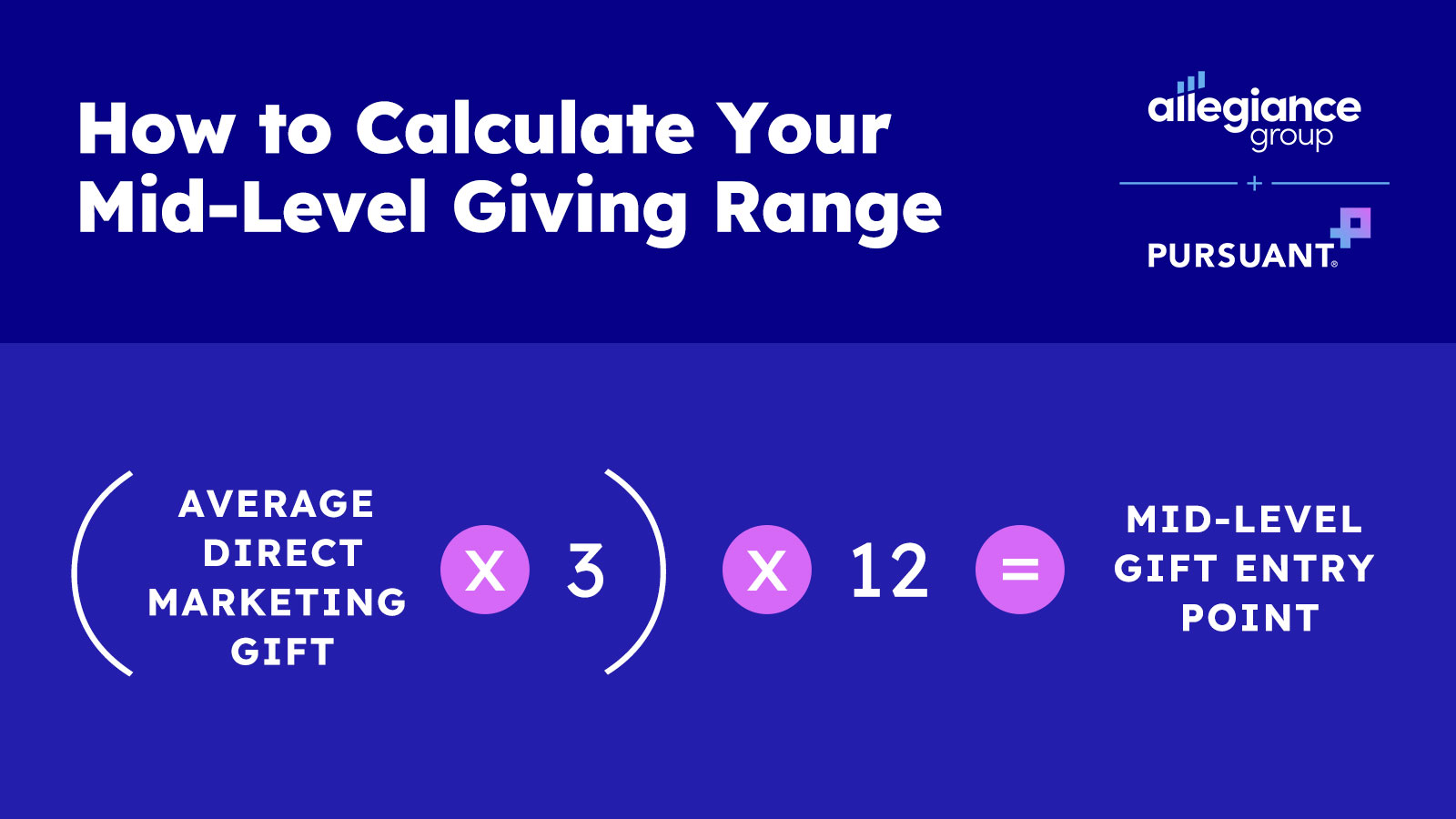
If your average direct marketing gift is $50, multiply that by three to get $150. Then, multiply that number by 12, which means the low end of your mid-level gift starts at $1,800.
Spotlight Your Mid-Level Donors
Whichever method you choose, once you have the parameters established, you’ll want to revisit your file and identify the existing mid-level donors that fit the profile. Before moving forward, evaluate whether your staff has the capacity to manage closer relationships with those donors.
If not, then narrow the parameters. For instance, if your mid-level includes 3,000 names, you and your team may not be able to effectively carry out the program, which usually requires regular personal and customized communication.
Regardless of the size of your mid-level group, you’ll want to create tiers to help you manage tasks. Enhanced email and direct mail outreach will be sufficient for the entry-level tier, which will be the majority of your mid-level donors. Above them will sit a group that you or your team can personally cultivate, and at the very top will be a much smaller number of donors that you’ll want to pass to your major gifts team.
To develop those tiers, you’ll need to collect the following data points:
- Wealth indicators — this includes net worth, income, and property ownership
- Discretionary income — the amount of money a person has after taxes to spend, save, or invest
- Other philanthropic activities/external giving — how much someone is donating to other organizations
- Giving history with your organization
- Engagement history — this includes non-monetary engagement such as volunteering or donating goods or services
- Affinity — the person supports organizations like yours
You can create this hierarchy with GivingDNA, a fundraising, wealth screening, and data analytics tool. Using this kind of tool makes it easy for organizations to discover giving patterns, donor preferences, and personalize year-end request letters.
For example, CESC, Inc., a social services organization in Florida, needed a 50% increase in revenue. By using GivingDNA, the agency discovered their constituents’ philanthropic affinities, wealth, and personal demographics and identified specific groups for targeted communications. The result? CESC exceeded its goal of bringing in 50% more revenue year over year.
Nonprofits have a lot on their plates, and this work can be time consuming and confusing without the right tools or expertise. Don’t go it alone. Contact AGP today.
Unique Benefits of Mid-Level Donor Programs
- Increased loyalty: Mid-level donors are less likely than micro or small donors to stop donating. These donors also make up a larger percentage of the average donor base than major donors.
- More likely to become major donors: Mid-level donors have more giving potential than other groups. They have demonstrated an affinity for the cause and shown they trust the organization. More likelihood of becoming major donors / more giving potential
- More cost-effective: It’s cheaper to retain and invest in upgrading existing donors than to recruit brand-new major donors. It’s like promoting from within.
- New connections: Mid-level donors offer untapped connections and have networking opportunities that can benefit the organization. They can share their trust and enthusiasm for the organization with their associates.
When it comes to mid-level donors, all these factors contribute to a more stable revenue stream and donor retention rates overall.
Overcoming Roadblocks from Leadership
As compelling as the generosity and loyalty of mid-level donors may be, you may still find roadblocks to creating a program just for them. Most budgets simply don’t consider them. Plans for the fiscal year generally (and rightfully) dedicate resources towards major gifts and direct marketing efforts, leaving little room for creating tailored communications for these donors. Organizations will need to defend their decision to do so.
Here’s how to respond to those challenges in 4 easy steps:
- Define your mid-level: Take the top 5 percent of your mass-market audience, or you can define your mid-level as a range of $500 to $1,000 or up to whatever your major gift threshold may be. Another option is the following equation:
- Calculate your potential addressable audience: Once you have that sum, go back to your file and see how many constituents fit that profile. When you have that number, you’ll be able to predict the potential return of a mid-level giving program, e.g., “By creating such a program, we can expect a return of X because our addressable audience with upgrade potential is Y.”
- Beef up your tech stack: Invest in technology (or augment your existing tech stack) to automate this work. Besides assisting your other fundraising efforts, the right software will identify which mid-level donors to target and when.
- Visualize the donor journey: To help colleagues or leadership who may be skeptical of establishing a mid-level program map the donor journey for them. This will help them see the touchpoints throughout the organization, and how there’s a role for everyone to play, which can help dissolve departmental silos and territorial teams.
Raising funds for your organization’s mission is a shared goal, and mid-level donors offer predictable, lucrative support to celebrate and honor. With the right strategies in place and an organizational mindset focused on long-term success and stewardship, mid-level giving can drive sustainable revenue, donor loyalty, and long-term engagement.
Kicking Off Your Mid-Level Donor Program
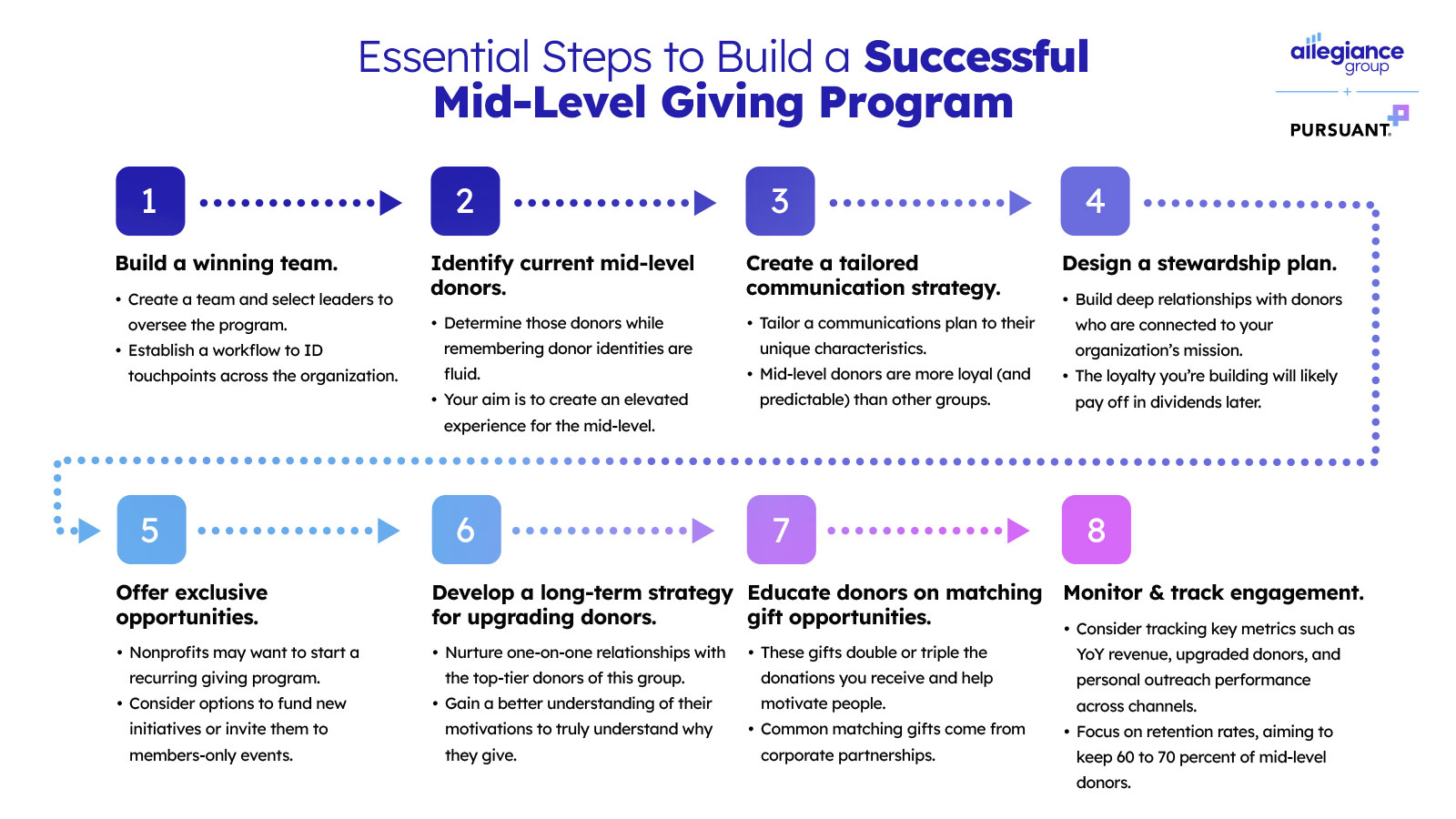
Here, we’ll cover the basic steps nonprofits will need to build a mid-level giving program.
- Build a winning team. Recommend creating a specific team and appointing managers or leaders of that team to oversee the program. This is known as relationship fundraising. Once the team is in place, establish a workflow with direct marketing and major gifts teams and map the donor journey to identify all touchpoints across the organization.
- Identify current mid-level donors. As noted earlier, determine those donors while remembering donor identities are fluid. A donor who gave a qualifying gift several years ago, and now they give you $50 a year doesn’t mean they should be on your mid-level. Your aim is to create an elevated experience for the mid-level.
- Create a tailored communication strategy. Mid-level donors are more loyal (and thus more predictable) than other groups, and they deserve a communications plan tailored to their unique characteristics through personalization, possible branding, and demonstrating impact and community.
- Design a stewardship plan. Good donor stewardship is about building deep relationships with donors who care for or are connected to your organization’s mission. Through a relational approach, the loyalty you’re building will likely pay off in dividends later.
- Offer exclusive opportunities. Nonprofits may want to consider starting an exclusive branded club or program for mid-level donors, such as a recurring giving program. You could also offer them options to fund new initiatives or invite them to members-only events.
- Develop a long-term strategy for upgrading donors. Nurture one-on-one relationships with the top-tier of this group. Prepare a list, allocate time to check in weekly, noting any feedback or special requests. Ideally, the calls aren’t just to say thanks or check-in, but fact-finding missions where you talk with donors to better understand their motivations, the role that your organization plays in their life, and other information that paints a better picture of who they are.
- Educate donors on matching gift opportunities. Matching gifts double or even triple the donations you receive and motivates people. For example, 84% of donors are more likely to give if they know a match is offered. The most common matching gifts come from corporate partnerships who match employees’ donations to nonprofits.
- Monitor and track engagement. Consider tracking key metrics such as year-over-year revenue, the number of donors who transitioned to major gifts, and personal outreach performance across different channels. Lastly, focus on retention rates, aiming to keep 60 to 70 percent of mid-level donors.
Regularly reporting on the success of your mid-level donor program is the key to maintaining momentum, leadership support, and fundraising success. It’s important to track key metrics at least monthly so you can adjust as needed and show quarterly progress.
Promoting Mid-Level Giving for Sustainable Revenue
Targeted messaging is key to expanding this donor tier. A branded program gives your mid-level donor effort a unique identity and reinforces its importance across your organization. If you already have a named monthly or major donor program, consider whether a new brand might confuse or complement your existing structure. When done well, branded programs create a sense of community and recognition that mid-level donors value.
Consider these tips for developing and managing a branded program:
- Start simple. You don’t need to overhaul your approach. Build on the communication tactics that already engage your mid-level donors.
- Tailor communications. Continue including mid-level donors in your annual fund outreach but elevate their experience. For example, send a quarterly newsletter – without a direct appeal. Adjust communication frequency or tone to reflect their level of commitment.
- Focus your efforts. If your mid-level pool is large, prioritize the top segment you can meaningfully steward and create a personalized engagement track for them.
- Evolve gradually. Incremental changes are fine — consistency and thoughtful stewardship matter more than speed.
Strategic, donor-centered marketing builds trust, deepens donor identity, and strengthens long-term loyalty. When donors feel seen and valued, they are far more likely to continue — and even increase — their support, ensuring the sustainability and growth of your mission over time.
Essential Communication Elements
While the list below isn’t exhaustive and may not apply to every message, it offers good guidelines for what key communications elements should be used when communicating to your mid-level donors.
Personalized greeting. Incorporate this beyond the salutation into the body of your communications — email, letter, postcard, or web page. The message should be tailored to the donor throughout the copy.
The hook. What will “hook” your reader in? Why are you writing? Create a communications calendar or use an existing one to help you understand, build on, or reference the current donor experience. Think, for example, of what they may have recently experienced through channels like:
- Social media. Is there a trend your organization can jump in on? Is there a social media campaign your own nonprofit is already running?
- News reference. This is an effective way to show that your organization is making waves — something like, “Did you see the [put your local TV station or other media outlet here] story about our [put your initiative or program here]?”
- Direct mail. What have your teammates in development and marketing sent recently?
- Events. Is there an upcoming event that you can call their attention to?
Tips to Effectively Promote Mid-Level Giving
Here are a few marketing tips that will help you engage more mid-level donors for the long haul:
- Use data-driven marketing strategies: Glean insights about your mid-level donors. Do they tend to live in certain types of areas — rural or urban? Have they given feedback or answered surveys about which programs interest them? This type of information can inform your communication efforts.
- Personalize appeals: Use what you know about these donors to reference their specific interests and ask for average amounts that fall within the mid-level range.
- Highlight the impact of past/potential gifts: Storytelling is powerful. Provide tangible examples of how their donations have been used to further the mission (e.g., a d might provide statistics on the impact of new technology purchased with fundraising dollars).
- Build social proof: Collect and share testimonials from other mid-level donors as well as stories about how beneficiaries’ lives were helped by the nonprofit.
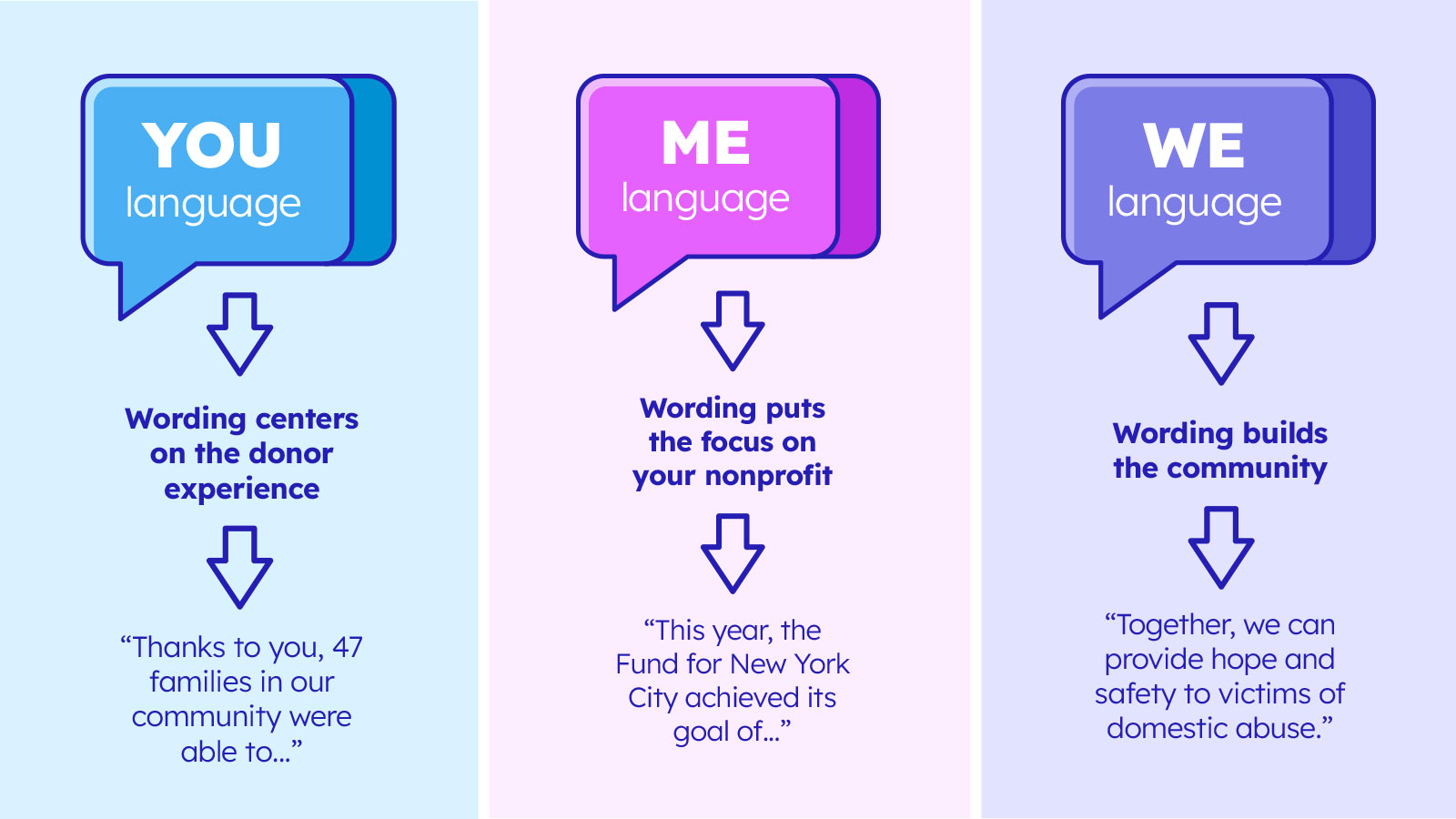
- Center donors in your storytelling: Are donors at the center of your communications? The words you use in your outreach will answer that question. One way to focus messaging on donors is by using You, Me, and We language in your promotions.
- Collect feedback: Ask donors about their experience and use that information to not only tweak your program but also improve your outreach efforts to ensure they stay engaged over time.
Stewardship vs. Maximizing Growth: How to Do Both
Investing in a strategy for mid-level donors pays off in higher donor retention rates, upgrades, and significant growth in their major donor feeder pool. However, donor stewardship doesn’t need to take a lot of extra staff time or money.
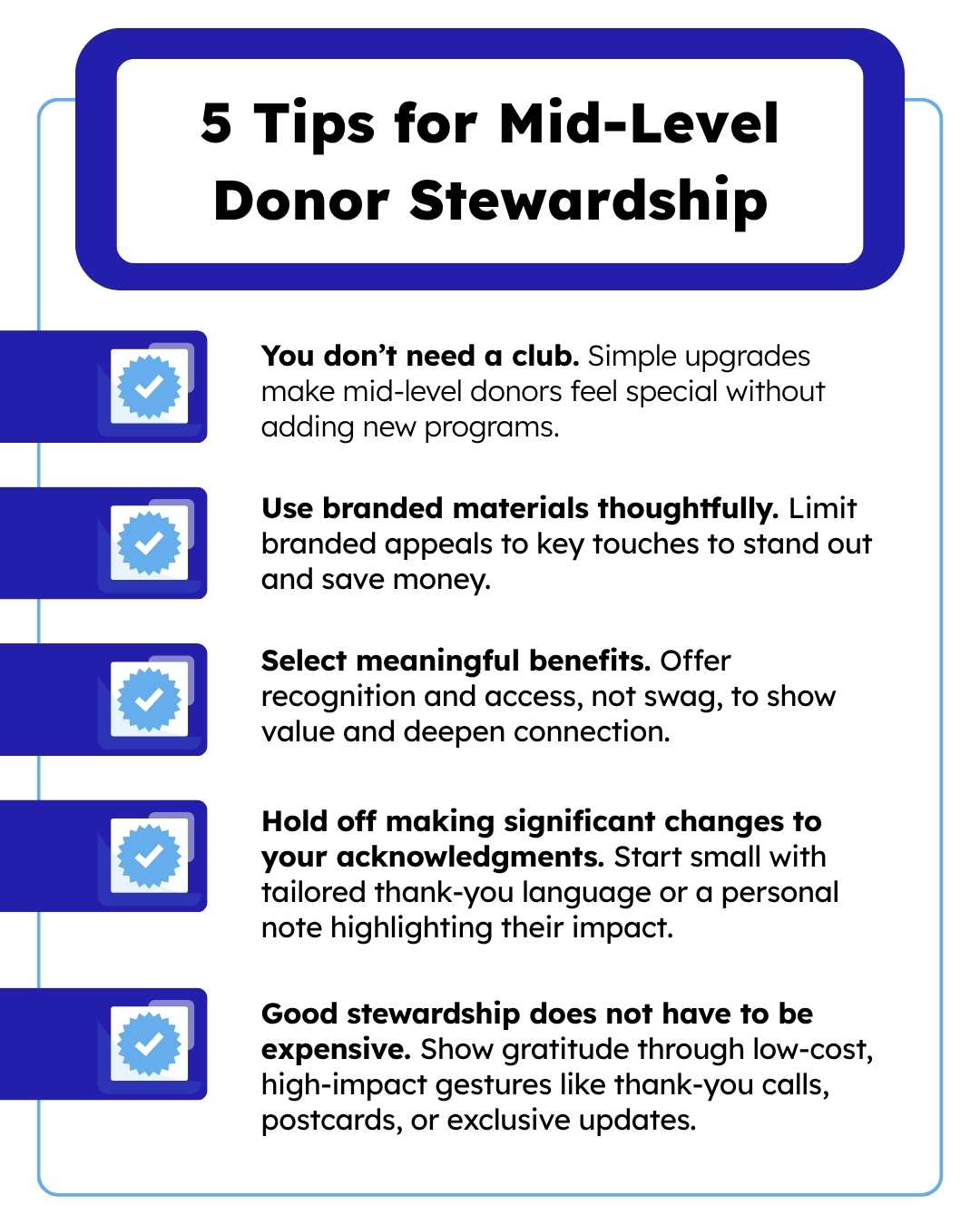
Here are five ideas you can use:
1. You don’t need a club. Update a few of your regular donor renewals with closed-faced outer envelopes, higher-quality paper, or special thank you notes. You can also send out one or two special appeals to this group highlighting a specific need.
2. Use branded materials thoughtfully. If you have a branded club, you don’t need to use branded stationery every time you communicate. Send out one or two renewal appeals using the branding. It can save you money.
3. Select meaningful benefits. Offer perks that donors will appreciate, not swag items like mugs or bags. This can include communications they were already going to receive such as newsletters, progress updates, quarterly reports or invitations to special events. Include the donor’s name in the annual report or on a special recognition page on the website.
4. Don’t make significant changes to your acknowledgments just yet. Keep mid-level donors in the regular acknowledgment program but take time to develop a unique variable paragraph that recognizes their leadership or send a special note card acknowledging their special status.
5. Good stewardship does not have to be expensive. Ask volunteers to call them once or twice a year to say thank you. Send special thank-you postcards or invite them to join conference calls to hear directly from your executive director. Mail the annual report to them.
Remember, powerful fundraising copy includes a case for support, uses a personal tone, and makes the ask early and often with urgency. Genuinely thank the donor and use “You” language, and make sure to answer these questions: Why give? Why give now? What happens if you don’t give?
Steward Mid-Level Donors for Long-Term Benefits
If you can find a few key ways to enhance your organization’s relationship with your mid-level donors, you should reap some significant rewards, such as more upgrading, higher retention rates, and a bigger pipeline for your major donor program.
Check out our Mid-Level Accelerator, a scalable donor engagement solution that helps local, regional and national nonprofits build and grow a thriving mid-level program. With flexible tiers, it gives you the tools to strengthen donor relationships while creating a steady pipeline of upgrade-ready supporters for the future. Contact us now to learn more.