
For years, fundraising strategies have centered on two priorities: acquiring new donors and cultivating major gifts. Yet between those groups lies one of the most valuable, and overlooked, segments of your donor file.
As donor acquisition becomes increasingly expensive and retention becomes more critical, organizations cannot afford to overlook the supporters they already have. Mid-level donors represent a small portion of the donor base but often generate a significant share of annual fund revenue while serving as the strongest pipeline for future major gifts.
This isn’t about making more asks. It’s about building stronger relationships through intentional stewardship, meaningful engagement, and consistent communication. When organizations do that well, increased giving becomes a natural outcome – and not the only objective.
Retention Is the New Acquisition
Rising acquisition costs make donor retention more valuable than ever, which is why organizations should rethink where growth comes from.
Revenue growth isn’t always about finding more new donors, but from identifying and investing in those donors who are already committed to your mission. Those mid-level donors in your file are among your most stable and loyal donors.
They often represent approximately 5% of donors but contribute nearly half of annual giving revenue. This segment typically has strong retention rates (65–70%) which is this critical for forecasting and long-term sustainability. That means losing these mid-level donors can have a disproportionate impact on fundraising performance
In fact, they are one of the strongest predictors of sustainable fundraising growth. Two-thirds of major donors originate from the annual fund, with over half having been mid-level donors, making this segment a strategic fundraising priority. It is the bridge between annual fund and major giving, which is why every donor portfolio should include intentional cultivation before formal major gift qualification.
More Than a Pipeline: Mid-Level Donors Are Mission Partners
Mid-level donors shouldn’t only be viewed as future major donors – they’re also some of your organization’s most committed champions. Recognize what they already represent to your organization, not simply where they will go next.
- Loyal supporters: Many have supported the organization for five, 10, or more years.
- Increasing support: For many, their giving has steadily increased over time
- Mission focused: They care deeply about your work and its sustainability
The takeaway? Organizations should help these donors make their mission one of their philanthropic priorities by consistently demonstrating the impact of their gifts and appreciation for them.
Stewardship Is the Growth Strategy
Many donors are genuinely surprised when someone calls simply to thank them rather than ask for another gift.
Why? Many mid-level donors have been giving for years, and no one has ever asked them why they give. When that happens, they can share their story.
Donors want to be heard – not just asked.
“When you say upfront, ‘I’m not asking for a gift,’ it lowers the donor’s defenses. Most people expect a nonprofit call to lead to an ask, which is perfectly fine, but making that clear quickly opens the door to a real conversation.”
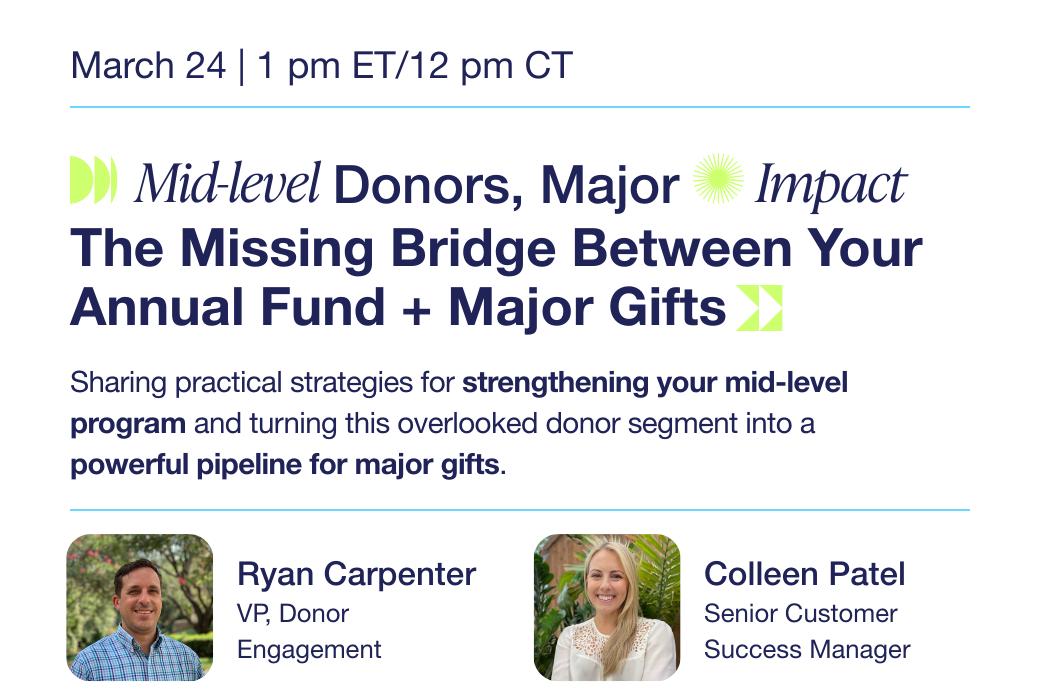
Ryan Carpenter, VP of Donor Engagement
Many organizations unintentionally treat mid-level donors transactionally. For example, treating a $1,500 donor like they are still a $50 donor risks creating donors who plateau – or eventually leave.
This is where intentional, personalized stewardship and engagement with mid-level donors – rather than episodic or transactional outreach – builds lasting relationships, deepens loyalty, and encourages increased giving
What this looks like:
- Personalized thank-you calls and notes
- Asking why donors give
- Soliciting feedback
- Sharing impact
- Building conversations – not campaigns
- Create recognition opportunities
Organizations must commit to consistency, whether using internal staff or external support, and realistically assess portfolio sizes to ensure regular, elevated engagement with mid-level donors.
This is how you turn a mission in a movement. Remember, donors don’t just want recognition – they want to belong.
Looking for practical guidance on defining your mid-level donor segment and building a scalable engagement strategy?
Explore our companion article, Mid-Level Giving FAQ: Turn Overlooked Donors into a Powerful Growth Engine, for additional best practices and implementation ideas
Technology Identifies Donors. People Inspire Them.
Development teams are expected to acquire new donors, retain existing supporters, manage events, steward major gifts, and keep campaigns moving, often with limited staff and resources.
So how can organizations deliver meaningful stewardship when they don’t have the capacity to engage every donor? That’s where technology can make a meaningful difference – and help organizations find the right balance.
Data intelligence and predictive tools like AGP’s GivingDNA help organizations identify which donors are most likely to respond to personal outreach, allowing fundraisers to focus their time where it will have the greatest impact. Instead of trying to build relationships with potentially thousands of donors at once, organizations can prioritize outreach based on giving history, engagement, timing, and philanthropic potential.
AI can further support these efforts by streamlining donor research, summarizing past interactions, and segmenting donors.
These tools make stewardship more efficient by helping fundraisers prepare for more informed personalized conversations without replacing the relationships that drive long-term, donor loyalty.
Technology can identify the right donor, at the right time, with the right context. It can’t replace trust that’s built when someone takes the time to ask why a donor gives, listen to their story, and demonstrate the impact of their support.
This approach strengthens retention, inspires greater generosity, and moves donors from supporters to lifelong advocates. As AI makes communication easier to automate, genuine person-to-person engagement is even more valuable.
Consistency Matters More Than Organization Size
One of the biggest misconceptions about mid-level giving is that it requires a large development team or a dedicated mid-level officer. In reality, successful programs aren’t defined by the size of the organization – they’re defined by consistency.
Many nonprofits face the same challenge: limited staff capacity, competing priorities, and growing expectations. Annual campaigns, major gifts, events, and stewardship all compete for the same finite resources. As a result, mid-level donors often receive attention only when time allows or after they’ve already demonstrated significant giving potential.
The organizations seeing the strongest results take a different approach. Here is where to start:
- Define your mid-level. The threshold will vary based on mission, donor base, and fundraising model
- Assign clear ownership for cultivating these relationships
- Establish realistic, manageable portfolios for everyone on your team
- Commit to regular, meaningful outreach, not just when a campaign is underway
Consistency matters whether those relationships are managed by an internal team, trained volunteers, or an external partner like AGP. What donors experience is far more important than who makes the call. Sporadic outreach creates a fragmented donor experience, while ongoing conversations build trust over time.
So, where should you begin? Start small. Setting aside just two hours each week to personally thank mid-level donors can be enough to establish a rhythm of stewardship that strengthens relationships and improves long-term retention. The goal isn’t perfection – but creating a sustainable practice that demonstrates donors are known, valued, and appreciated.
Make Your Mid-Level Donors a Year-End Priority
Your most loyal donors may already be in your file. The question is whether they’ll hear from you in a way that inspires a larger gift. See how AGP’s focused three-month program can help you strengthen mid-level engagement before year-end.
Create a Donor Experience That Reflects Their Commitment
For many organizations, mid-level giving is simply a gift range. For donors, it should feel like something much more meaningful.
As supporters deepen their commitment to an organization, their experience should evolve alongside their generosity. That doesn’t necessarily mean exclusive events or expensive benefits. More often, it means creating opportunities for donors to feel connected, recognized, and part of something larger.
Consider these options:
- Thoughtfully branded mid-level giving society
- VIP stewardship packages
- Personalized communications
- Meaningful updates about the impact of their support
- Omni-channel engagement
These touchpoints can create a stronger sense of belonging and reinforce that they are valued not simply because of how much they give, but because of the role they play in advancing the mission.
The experience should also feel cohesive across every channel. Personalized outreach is most effective when it complements – not replaces – direct mail, email, digital communications, and ongoing stewardship. Together, these touchpoints create continuity throughout the donor journey and reinforce the organization’s appreciation long after a gift is made.
Mid-level programs aren’t about creating another donor category – they’re building a community of supporters who feel connected to the mission and inspired to help it grow.
What High-Performing Mid-Level Programs Have in Common
Organizations with successful mid-level programs don’t simply ask for larger gifts – they create more meaningful relationships. Here are two case studies:
Public Media Organization
One public media organization partnered with AGP to combine data intelligence with personalized outreach. Board volunteers and a dedicated mid-level manager reached out to donors not with scripted solicitations, but with genuine conversations designed to thank supporters, learn why they gave, and share more about the organization’s work.
What they did
- Equipped board volunteers
- Personalized outreach
- Focused on conversations rather than solicitation
- Used data intelligence to prioritize outreach
The results were remarkable: 89% of participating donors made their largest gift to date, while 91% were retained.
Religious Arts Organization
Another client, a religious arts organization, experienced a different kind of transformation. A mid-level manager moved from primarily making fundraising asks to focusing on stewardship and relationship building.
As conversations became more authentic and less transactional, donors responded positively – and so did the staff. The manager found greater satisfaction in the work, and donor relationships deepened.
The results? Revenue from the program doubled in a single year, growing from approximately $1 million to more than $2 million.
While every organization’s donor base is different, the lesson is remarkably consistent: stewardship isn’t separate from fundraising – it strengthens fundraising. When donors feel seen, heard, and appreciated, stronger retention and increased giving become natural outcomes of stronger relationships.
Three Questions Every Fundraising Leader Should Ask
Building a stronger mid-level program doesn’t necessarily begin with new technology, additional staff, or a larger budget. It begins with asking the right questions.
1. Have we clearly defined who our mid-level donors are? This is the range that can constitutes up to 50% of your annual fund revenue.
2. Who is responsible for cultivating these relationships? Ownership matters. Identify who is tracking mid-level donors through the pipeline and prioritizing them in planning and resource allocation.
3. Are we communicating consistently enough to build loyalty rather than simply asking for another gift? Dedicate time each week to personally thank and recognize these donors, or a manageable subset, so they feel heard and valued.
Answering these questions won’t create a complete mid-level strategy overnight. But they provide a strong foundation for transforming overlooked donors into some of an organization’s most loyal advocates – and building a more sustainable fundraising program for the future.
Wrapping Up
Mid-level giving isn’t simply another fundraising program. It’s an investment in some of your organization’s most loyal supporters.
When donors feel heard, appreciated, and connected to your mission, stronger retention, increased giving, and healthier major gift pipelines naturally follow.
Organizations don’t need perfect systems or large teams to begin. They need intentional stewardship, consistent communication, and a commitment to treating mid-level donors like the mission partners they already are. When organizations invest in these relationships, strong fundraising results become the natural outcome – not the sole objective.
*This blog is based on a conversation from the Go Beyond Fundraising Podcast. Listen to the episode.
Ready to strengthen your mid-level giving strategy?
Download Mid-Level Giving Matters: Securing Stability When Times Are Uncertain for practical guidance on identifying mid-level donors, strengthening stewardship, improving retention, and building a more sustainable fundraising program.