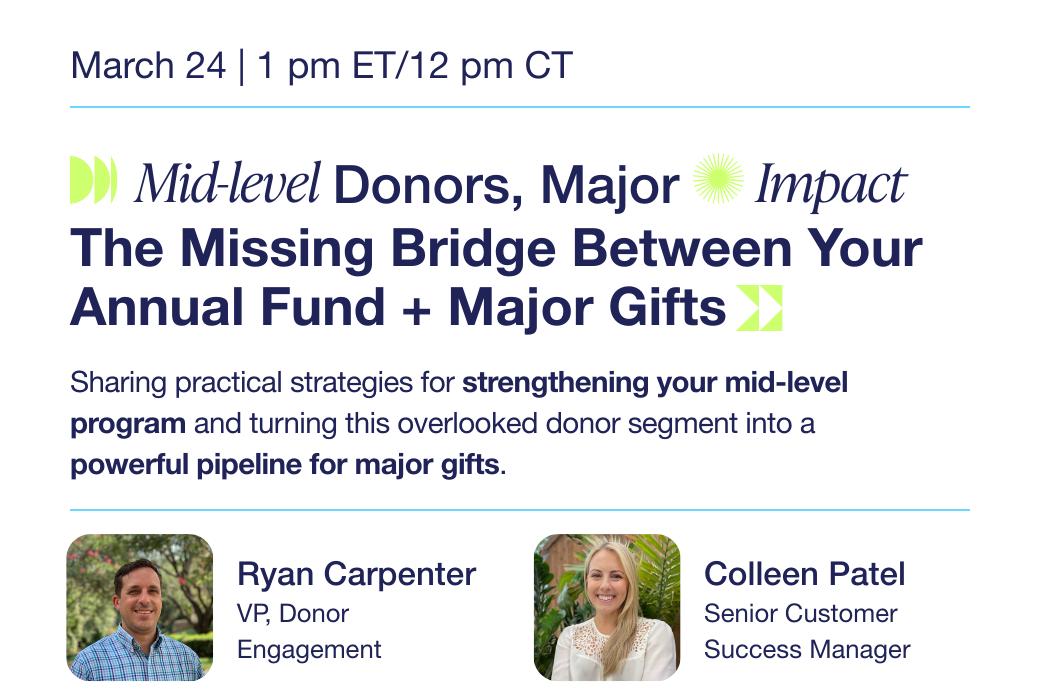
Trent Ricker: Hey everybody, I’m Trent Ricker, the Chief Executive Officer and Chief Strategy Officer at AGP, formerly Allegiance Group and Pursuant. I’m joined today by Ryan Carpenter. I’ll let Ryan introduce himself a bit. He’s the VP of Donor Engagement, but Ryan, why don’t you say hello to everybody and talk about what that role means?
Ryan Carpenter: Thanks, Trent. As the VP of Donor Engagement, I manage high-value, high-touch donor programs for our clients. Things like mid-level giving programs, planned giving programs, high-value new donor programs that really allows us to go a little bit deeper with those engagements with those donors.
Trent Ricker: I love that. And I think it’s important to note that, you know, in our legacy for Pursuant, we did quite a lot of early work in mid-level. It’s always been part of our DNA, and I was really happy to have you join. How long have you been with AGP now? How many years has it been?
Ryan Carpenter: Seven years in two weeks? Yeah.
Trent Ricker: Wow. Time flies. Oh, you even know it’s the weeks. I like it. So, you must have started August 1 around there, right? Okay, good. But you and I, when we were talking about it, you know, getting back into mid-level from an important perspective, it’s donor engagement. I love that phrase because I think it speaks to the importance of stewardship as well as cultivation and upgrade. You and I have talked a lot, and you’ve kind of helped me coin the phrase that I’ve been using a lot out there, that retention is the new acquisition. And I think as part of that stewardship and donor engagement, high touch is so critical. So, I’m really glad that you’ve got the experience that you’ve gotten from working with lots of clients, other agencies, and now bringing that expertise to AGP that you have over the last several years.
So, let’s kind of start out. I want to kind of hear your perspective on mid-level. Why mid-level and why now?
Ryan Carpenter: Yes, so why now? Well, I started my career in building mid-level donor programs. I went beyond, you know, simple versions of mail and e-mail campaigns. And so, I’ve always had a strong interest in it, not just because it’s where I’ve started. I was lucky to get started there because it’s really this brackish water of vast population of donors and not knowing who you should be spending time with, but knowing they’re all valuable, right? These are people that are giving a large part of their disposable income to your organization. And mid-level, why now? Really, because it supports your annual fund, right?
Mid-level is typically 5 percent of your annual fund, but they give 50% of the revenue year over year. You can set that like clockwork, right? They retain at the highest levels – typically 65 to 70% if you’re running a solid program. And so, it’s going to help your annual fund. You’re going to be able to budget and forecast effectively and make sure that you’re going to hit your goals.
Conversely, it also helps your major giving program. Major gift donors don’t stay at major gift donors forever, right? And so, you need to continually replenish those portfolios. And because two-thirds of your major donors start in your annual fund and over half of them at one point or another were recently in your mid-level donor program, we really want to focus on identifying who those next major gift donors are. And so really it sits there in the middle supporting both key fundraising programs that most organizations are already running or focusing on.
Trent Ricker: You know, it’s interesting because if we think about the correlation – which we like to do an awful lot in this podcast series – is where there are loyalty programs that we’re used to as consumers and how you’re treated, creating loyalty to that brand and becoming a more frequent customer, right? And in this case, I believe clearly the most generous country in the world, and people have continued to show that generosity, but they also give when and where asked, and they also have their own interests that are aligned. Part of what we do is to try to make sure we’re marrying those interests to those folks that might have the deepest affinity.
But I also find that the mid-level in and of itself is not necessarily always a sacrificial leap for someone to give that donation. When we started some of these programs back in Pursuant early days, some of those mid-levels might have been $5,000 or $6,000 multi-year pledges, for instance, for an alma mater or something of that effect.
Ryan Carpenter: Sure.
Trent Ricker: So important, but what you’re trying to do is establish is a philanthropic priority. Coming back to that kind of for-profit loyalty, talk a little bit about the ways that we treat those that we feel like are closest aligned to our mission so that we can go deeper and get more meaningful gifts and cultivate them through becoming ambassadors of the organization all the way up – hopefully to becoming larger donors and hopefully major donors at some point, if not planned givers.
Ryan Carpenter: Often when I start talking about the solutions around mid-level that we provide our clients. I have to step back and say, it’s not all about just raising more. Mid-level donors, I believe, are very important constituents for your organization. They care a lot about your mission. They should be appropriately stewarded and valued, really, at the end of the day.
Now, are they going to write a check that’s going to put a name on a building? No, very likely not. Maybe you’ll find a couple here or there that will eventually graduate to that giving level. But ultimately, if somebody is going to take their hard earned money and write a check for $1,000, $2,500, that’s meaningful. And we can do more than simply sending them back something in the mail that thanks them for it, or a gift receipt. They should be honored. And on top of that, you know, also solicit feedback from these individuals because they care a lot about your mission. Not only are they writing $1,000, $5,000 checks, which is a significant amount of most people’s disposable income, they’ve been on your file for a long time. Most mid-level donors you’ll see they’ve been on file for over five years or more. In many cases, it’s over 10 years or more. These are people that deeply care about your organization, and they’ve been incrementally upgrading. And so, we should really respect that and appreciate that. I always look at it as a win-win. One, the donor wins because we want to provide our clients, mid-level donors, with an elevated treatment that conveys how much we appreciate their support and lets them know how important they are for our clients’ missions to continue and grow. And conversely, that’s going to strengthen the relationship, but it’s also going to lead to them wanting to support at even more meaningful levels as they can.
And now, you know, there’s only going to be a small percentage of donors every year from mid-level that’ll elevate to major giving. Let’s just say 5%. It’s somewhere around there. The other 95%, we want them to continue to support us at those meaningful levels that are really driving your annual fund to continue to hit and exceed your goals. And so, it’s a little bit of what we want our clients and their fundraising efforts to succeed, but we also want to do so in a respectful way and really honor and appreciate those that make it all possible.
Trent Ricker: You know, you and I have been in this business for quite some time, and I think mid-level has always gotten recognition, but it hasn’t always been operationalized. We’re going to talk about that in a minute, because I want to hear about some of your organizational experiences. But I think to that end, the fact that you pointed out that the top 5% of annual donors in general from our studies account for 50% of annual fund revenue is very meaningful. That 5% is critical for us to cultivate. We want to become a philanthropic priority.
And in this day and age, kind of going back to my question of, you know, why mid-level and why now, we’re seeing – at least statistically – that there are fewer donors that are giving more dollars. I always beat this horse anytime we’re on a podcast. I’m not so sure I buy that because I don’t know if we’re able to track donors the way that we once were because there could be supporters and GoFundMe or other peer-to-peer aspects. But nevertheless, we need to cultivate them, and that’s why it’s more important than ever now. The why now is that pipeline generation for major donors is critical, and that comes through stewardship and cultivation from annual fund, through leadership, annual giving, or mid-level up into major gifts.
We’ve seen everything from – I’m curious as to your take on this because it depends on the market segment – I’ve seen anything from 30% to two-thirds of a file that the major donors originated from the annual fund. So, it’s not as if someone just comes in as a major donor. It does happen. It’s a good, good, good byproduct to say here for a moment that based on your market segment, what mid-level giving means to a hospital might mean something very different than to a ministry or a food bank. We kind of consider mid-level – Ryan, why don’t you talk about that? It’s usually between $1, 000 and $5,000 or $1,000 and $10,000 but some of our hospitals are between $10,000 and $100, 000 – talk about that framing first of all, and then we’ll come back to kind of that cultivation into major gifts.
Ryan Carpenter: Sector certainly plays a part as to what you define your mid-level as. That said, you have a mid-level – whatever it may be – and that is an inflection point where you as an organization have to recognize, okay, these are people that are important to our mission, they’ve been giving consistently, and they’re going to be our next major donors one day. And oh, by the way, they’re also helping to continue to have our annual fund goals hit time and time again. Now that all said, yes, if you are a public media organization or you are a university, your mid-level is going to be drastically different. And in some of those opposite sides of the spectrum, there are different, these are different donors.
Certainly, if you write a check for $1,000 versus 95,000, there’s different potential, there’s different expectations. But at the end of the day, mid-level is where your annual fund stops and major giving begins. And so, for all organizations, whatever that giving level is, that’s where you should really take time to understand the opportunity and understand where you should be spending time because you want those people to continue to give at those levels and also identify the next ones that can make even more of a transformational gift.
Trent Ricker: That’s excellent. You know, I think it’s interesting to me that when we work with a lot of organizations on their annual fund, we think about acquisition, retention, upgrade, and stewardship. But of those three buckets where we’re talking about actual cultivating of dollars – acquisition, retention, and upgrade – it strikes me that most organizations spend a lot of time on acquisition. Why is that? Because they have some natural churn, and churn isn’t necessarily unhealthy at some levels. There’s people who give episodically for a variety of reasons, but there are those that are closely aligned with the mission of the organization.
We look, and we even work with our own clients that the kind of legacy programs that they work in or acquisition and then focusing on retention so as to kind of close the gap – the coverage ratio. Is your donor file growing? And not enough time spent on this upgrade. I don’t love that word upgrade, but let’s talk about it in the terms of cultivation. I’ve used a phrase for a long time – kind of tongue in cheek – that for most organizations it represents a donor sombrero because the reality is we have a lot on the bottom of that base, and then we have a little tip top where it’s collapsed down for major giving, and we’re not doing enough to kind of make that a true pyramid. Talk to us a little bit because you’ve been in this business of mid-level giving for quite some time, dating prior to Pursuant, but it feels like most organizations are kind of squeezed between acquisition and renewal and major gifts, but mid-level kind of gets the leftover attention. They talk a big game, but they don’t always walk that big game.
Ryan Carpenter: Yeah, that’s true. And ultimately, I don’t think it’s because they disregard what mid-level giving programs can be and what they should – how they should be. But ultimately, budgets are a reality. Historically speaking, you’re going to go lean towards, look, I need to acquire, I need to renew that annual fund. And then obviously, major giving has you know, longstanding strong programs that run and that’s where the majority of your individual giving comes annually. And so mid-level does get squeezed. But what happens is it’s an overlooked opportunity.
I’ve been doing this for almost 15 years. Every day, you are having these rich conversations and identifying people that want to support you at a much greater level. All they need is to be heard and talk to about it. And if you don’t do that, here’s the reality of it. If you are going to continue to treat your mid-level donors like when they first made that $50 check, eventually they’re going to plateau and you’re going to lose them because they’re giving and their support and their interest for your mission has been growing steadily over the last five, 10 years. And what comes with that is they want to be a greater part of it, too. They’re telling you that simply by the amount of giving – the amount of support they’re giving you. And if they’re not being reciprocated with, it’s going to feel like you don’t appreciate that and don’t value it. And so, what’s going to happen is they’re going to go to another organization that potentially will fulfill them because all donors want to be fulfilled, right?
Trent Ricker: Right. That’s a critical differentiation. I mean, one of our taglines is turning missions into movements at AGP. And to your point, I think those that are engaged with a mission and that have supported that mission, they want to feel like they’re part of a movement. And part of how we do that is actually having higher touch, which is both a stewardship play. And we hope that pays off with loyalty, higher lifetime value, and then upgrade as well. I want to pivot on that for a little bit there for a quick second then because I think thinking back to what Pursuant did 15 to 20 years ago, we had an offering called Charitable Partners Program. And it was primarily for hospitals and higher education to support full-time, mid-level gift officers. We would recruit, hire, train, place, manage, make sure that they’re adhering to a certain benchmark of the number of visits.
And there were physical visits, they were face-to-face visits, some phone calls, and then, you know, a couple of folks that then were in some level of kind of portfolio management and little friendly competition. That became somewhat of an expensive model because, again, it’s outsourcing full labor. You have some experience and you’ve brought to us this kind of concierge concept that we’re evolving here at AGP where it’s higher touch. It’s both stewardship and upgrade. But talk to me a little bit about that because I still think in this day and age, we’re going to hit on this. The human touch is more important than ever, right, Ryan?
Ryan Carpenter: Absolutely. And, you know, we have a couple different solutions so that we work with your own internal team to help support you and make sure you’re speaking to the right people at the right time with the right message. But also, we understand nonprofits have to run lean. Your donors want to see that 90 to 95 cents on the dollar is going towards program. What does that mean? You have to have a lean team. That doesn’t maybe allow you to have all the boots on the ground for every program you should be doing. And so that’s where we help take it on for you. We’re not only going to identify the donors among your vast mid-level that should be getting that elevated one-to-one communication and cultivation and stewardship, but we’re going to do it for you.
We have a team of donor engagement specialists that will actually serve on behalf of your organization to develop and build those relationships. And, you know, I can’t tell you how many times I’ve heard the conversations that have been had. They’re really meaningful. The people that we have executing that, and I’ve had execute that really enjoy their work. The donors really appreciate that, and they respond. Again, win-win. I’m not doing it solely because I want you to give more, but we want you to know that we are aware of you. We appreciate you. And then if the outcome of that is that you want to double your support on any given year, well, that’s a great byproduct because you also want to see that mission continue to grow and exceed.
Trent Ricker: Which is great because a lot of organizations will leverage volunteers to do some follow up phone calls. It’s not uncommon, but it does seem like an afterthought. And I think that’s part of what we believe in kind of taking that function and setting it aside. Some folks might think it doesn’t seem natural for us to kind of outsource that aspect.
Ryan Carpenter: Yes.
Trent Ricker: We want to have those folks engaged in your mission who already have the personal belief in your mission to begin with, that will be excellent ambassadors of your organization. And to your point, talking and connecting with supporters that we’ve pre-qualified as those that might be able to and potentially showing a proclivity to possibly give a larger gift in the mid-level range. It’s not a hard sell in that, but I think it’s so important in this day and age.
I want to kind of shift because there’s a really important data component to this, and I want you to share that with the audience. Technology can tell us who to talk to, when to talk to them, and perhaps some interest as to what to talk about. I think preparation is – I don’t want to say easier than ever because that’s not a fair thing to say as there’s a lot of information to gather – but balance that. Talk about our prospect identification, but just as much how, whether you’re using a concierge with AGP or your internal gift officers can best prepare in this day and age of this kind of AI tech angle versus the augmented human touch.
Ryan Carpenter: As an aside, I think I look back when I first started doing this back in the early teens and we were writing handwritten notes so people would respond to them more than a voicemail because it was tactile. People like to see it. And then they thought, wow, somebody actually spent the time to write this to me. I am going to call them back and just thank them or let them know what I think. And now I feel like due to the proliferation and ease of scale with things that are digital – AI included – that authentic human, one-to-one is really valued. Not because the other things aren’t good. We should be doing that. Those are tools that help our organizations, donors respond to. But I feel like that human touch is more important than ever because it’s less likely that you’re going to receive it.
Trent Ricker: I agree.
Ryan Carpenter: Again, we work with clients where if you have a team that’s ready to take the strategic guidance and the prioritization that we have through our tools like GivingDNA, where you have a mid-level file of 5,000 donors and you only have time to really build relationships with 500 of them. We can help you identify them and then provide – through years of experience – what’s that engagement look like? What’s the outreach strategy? So, we can help our clients do that. But if you really want to pick up your mid-level program and don’t have a person on staff now, we can also take that next step with the outreach.
We spend a lot of time getting to understand your organization. Just like when you onboard a new employee, we want to onboard our team, so they are acting as a representative of your organization. We’re not going to know everything – just like I don’t know everything about AGP. Somebody may call me, a client may ask a question, and I have to go to one of our colleagues. But we are going to sincerely want to understand your organization. So when my team of people are reaching out to build relationships with your donors, we can proudly say they are an extension of your mission and they’re going to help you to connect, strengthen that relationship with your supporters.
Trent Ricker: You know, it’s such a good point because my experience with many organizations, particularly mission-based organizations – all of our organizations are mission-based – but what I mean are those that might be in human services like the food banks or the rescue missions, ministries, and then expanding maybe out to animal welfare and the like as opposed to hospitals, arts and culture, higher education, where there’s kind of a stream of a customer or a patron or a student in their orbit they obviously can be a next generation supporter and mid-level donor. But back to the mission-based organization, you know, I was with a food bank recently and what struck me is their mid-level program is starting to gain some momentum. And that’s a function of them actually identifying a person who has strong affinity with the food bank and loves to talk about the mission impact. So that’s very natural for them to be on the phone.
Part of the problem that we find is that that’s – in this particular case – a part-time job because that individual also, when it’s time to do the gala or the other event, or they need some extra hands in a different area, that person’s kind of floating a bit. So, we’re missing opportunity for the timeliness to have the appropriate conversations that are necessary to truly make this go beyond just, hey, Ryan, here’s a list of folks you should call and thank when you get a chance versus, hey, Ryan, here are some folks that we think might actually be good candidates to give a larger gift, who’ve given a recent gift, who should be thanked and could also be talked to more about who we are, why we’re important, and thanking them for their gift – the impact their gift made – and making an offer, when appropriate, to extend their reach. What do you think about the internal versus external? Because some organizations clearly have some mid-level gift officers, but…
Ryan Carpenter: I think the biggest thing is you have to commit to consistency because the start and stop that’s a disjointed experience for your donors, let alone what you’re dealing with internally. Whenever we start a mid-level engagement with our clients, we determine, do you have staff to do something or do you need us to put hands on keyboards, or on the phone. When that’s determined, we also then want to understand, do have staff internally. Let’s be realistic about what kind of portfolio you can manage because we want you to consistently reach out to these people. This is not telemarketing where you’re picking up and calling and, you know, speaking to them one time. It’s really building a relationship with these people. And that requires ongoing conversation. It also means the consistency of the conversation. Again, we’re not telemarketing, we’re not reading from a script. We’d certainly have strategic guidance and those types of resources, but we want you to be able to have a conversation with somebody tomorrow. And then five months from now, when you realize, oh, I got to reach out to, you know, Sue or John again, you can see what you spoke to them about before. What is it they cared about? What were their interests? What were the questions they had? And then build off it. Because again, we’re building relationships, which the client, the donor, excuse me, deserves and the client benefits from.
Trent Ricker: Excellent. And to kind of put a wrap on that before I want to go on the next topic, that human element is critical. What we’ve talked about in this segment is all about how the person who has a deep connection to the organization from the inside – whether they are on staff, a volunteer, or an ambassador that might be one of our concierges – that is a human element. And that human element is more important than ever, as you said at the top. I think it’s important that everybody understand there’s a lot floating out there about virtual engagement officers and cultivation from stewardship. I think it’s too early to actually determine what’s going to be effective there. But I will say it will not replace the human touch that’s necessary. We can use AI and technology for prospect identification, certainly we use some sophisticated models in order to identify prospects that would be more likely to give at that level. At points where the real mid-level opportunity is, I think that AI and other tools can help you show up more relevant in your conversation, better prepared but it’s not a replacement for the conversation. It’s what gets you ready for it.
So, we talked about a lot of things in there, whether it’s your resources or our resources or equipping some volunteers from a stewardship perspective. Let’s make sure, as Ryan said, that we’re talking to the right people at the right time and the old Seth Godin-ism, right? Personalized, relevant, and timely touch. And to your point, it’s not just a one-time touch.
Ryan, talk to me about where we’ve seen some success, you know, both through AGP partnerships, but as you’ve observed, we’re in the industry where we’re observing some great success in mid-level, but still an awful lot that leaves to be desired. Share with everyone some of the successes we’ve seen when they have that discipline, and they apply themselves to mid-level program.
Ryan Carpenter: Last Q4 giving season, we began working with one of our public media clients. You’d mentioned it, so it just kind of popped in my head, volunteers. We worked with the team at this public media organization, and they said we have one individual that can consistently perform outreach. We also have board members that are volunteers that we want them to reach out to their constituents in their various counties that they represent for our organization. So, we provided them with the approach – here’s how you want to speak to these people, here’s what you want to ask them and learn about. And then, here’s some of the resources you can share with them if they do want to learn more about one of the programs or some of the work you do.
We worked with them from September through the end of the year. And I mean, it was phenomenal – 90% of those donors, 89% actually, but I’ll round up to 9-0 – they made their largest gift ever to the organization. And remember, they’re not unlike other organizations. Most of these supporters have been on file for five or more years, many over 10 years. The largest gift they ever made was when we executed this program for their mid-level manager and for a handful of board volunteers to begin reaching out to them and not simply reading off a script and saying, hey, I want to thank you for your last gift. Thanks so much. Make sure to give again.
Trent Ricker: Right.
Ryan Carpenter: No, we wanted to really strengthen that relationship and elevate that. And it showed through. 91% actually retained, which that’s a really high number. I’d love it if it was 100%, but at the end of the day, 91% of these people – 89% made the largest gift – 91 retained. That’s a significant outcome just in a short period of time.
Oh, by the way, they’re continuing to work with this after just seeing the success of what a short period of time could come through.
Trent Ricker: And I want to make sure I heard that right. In that case, we were empowering and equipping their team with the right lists of who to talk to, and then the full picture of how to cultivate those larger gifts. Is that correct?
Ryan Carpenter: Yes. There’s really a couple different facets to this. The program is using data intelligence and machine learning to identify who you should be spending the most time with, right? Because again, mid-level is vast. Unfortunately, we can’t personally touch everybody to build these relationships. We do incorporate some timing-based segmentation. So, if somebody does make a gift and maybe they’re not in that priority segment, you’re still going to reach out to them. But that’s one part of it.
In addition, we want to work with your team because in some cases I work with organizations where they have a gift officer who has a light portfolio, maybe they’re new to the organization. They understand how to build relationships with individuals. Or it’s a new person who’s not that experienced and they need a lot of heavy coaching. What we’re sharing with them is what the approach is. Let’s put it this way, very simply, what’s the opening? Well, I tell you what, it’s very simple, five words. I’m not calling to ask for something, ask for a gift. I think that’s five, might be a couple more. But it’s something as simple as that. And by saying, look, you want to open, introduce yourself, ask to speak to that person, and then say, I’m not asking for a gift. Why is that important? Well, because most times when a nonprofit calls you, you anticipate they’re going to ask for a gift, which is perfectly fine. But we want them to lower their defense mechanism. And that allows us to very quickly have a conversation.
We’re going to provide that ongoing support. We’re going to provide resources that we feel their donors care about. Because again, once you get to that mid-level, you certainly want to continue to get the annual fund and the, you know, the mailings and emails that get you where you are. But if you’re writing a check for $1,500, you may want to hear a little bit more about what your dollar is going towards.
We work with them on a variety of different things — segmentation, what the communication strategy should be, and then what are some of the resources that will help you and also be beneficial to your donors.
Trent Ricker: That’s really solid. I think that one of the most important things we try to get across it’s a people-to-people thing. If you ask somebody, why did you support our organization? Everybody has a story, particularly those that we’re going to tee up for potential mid-level, because it’s probably not because their niece asked them to make a donation. It’s probably because they have a personal story, either close to them or someone in their family that either loves the arts or loves animals or, you know, themselves had suffered with food insecurity when they were younger and they want to give back. But sharing those stories, I’ve also found that the people that work for these wonderful organizations that we’ve been so blessed to work with many of those people inside work there because they have their own stories. So, connecting those two stories, and to your point, then being able to open up more about the work that we do, why it’s important, how you’ve already helped, and how your support continues to make an impact is a natural transition rather than its kind of being salesy.
Ryan Carpenter: A couple things I have to share. These donors haven’t had a chance to tell anybody what it means.
Trent Ricker: That’s exactly right.
Ryan Carpenter: I mean, they open up, and it’s like such a wonder to them. Like, wow – I’ve heard it so many times – I can’t believe you’re calling me just to like thank me and ask for, ask what I, why I support you. It’s like, almost like a breath of fresh air. A release of some sort where they can share it with somebody finally. And we, you know, you want to do it sincerely. And that shows through. And then on the staff, we work one of our longest time clients, a religious arts and culture type organization. They had a mid-level manager who was soliciting. And this individua it was a tough sledding every day, you know, and I could see the weight bearing on his shoulders. And we said, a few years back, let’s try this approach. It’s all about stewardship cultivation. I can’t tell you how his demeanor changed, how much he loved the work he did, and how successfully he was actually speaking to donors.
Whereas before it was like a quick preamble and ask for another $2,000 gift. Now it was just all about getting to know them and thank them. And he loved the conversations he had. He looked forward to picking up the phone and having those conversations, sending those emails. And here’s the kicker, by the way, doubled revenue in first year from $1 million to just over $2 million.
Trent Ricker: That’s awesome. That’s amazing. And to your point, what we’re doing is connecting somebody’s passion as to why they worked at that organization and just saying a big part of your job, maybe the most important part of your job is to have conversations with people who are like you that share the same passion. And they also happen to be longer term loyal donors that likely have capacity to give a bit more. And when that time arises, and granted, there’s a discipline to it. Let’s not kid ourselves that if we’re not actually working towards an ask, it won’t, people don’t give if they aren’t asked. But to your point, it’s not all about a transactional element in this day and age, it’s more important than ever.
Ryan Carpenter: Sure.
Trent Ricker: Talking about some other programs because I think it’s important to note that you could do a mid-level program standalone. They usually work best if, regardless of whom your agency might be working on with annual fund. We’ve worked with organizations in partnership with that other agency. And if you’re in annual fund, the omni-channel approach to have that continuity related to personal outreach paired with elevated direct response. Talk a little bit about how we can prime the pump with a direct response mechanism – particularly in the mail – that is a higher level touch, maybe that VIP type touch through the mail that kind of cultivates before we have those conversations.
Ryan Carpenter: We actually have a webinar coming out early on August on the health space, where the work that my team does with the identification and the personal one-to-one outreach that certainly played a big part in it. But there was also this greater strategy where, one, they rebranded their mid-level giving society, and why that’s important. It’s very important.
One thing I love when I work with clients that have mid-level giving societies is it’s not just some internal mechanism to talk about a donor group that gives between $1,000 and $10K, right? You’re creating a community that you can use to bring together. And it’s also a way to let them know how important they are to your mission, right? And that creates that greater community. They rebranded it. They spoke about it. We did our job with the personal outreach and the coaching for two mid-level managers that had portfolios. But then we also began to elevate the communications. They still received the direct marketing that they were always receiving. But we incorporated some higher level stewardship packages. We also were implementing some timing based stewardship and cultivation, for a lack of a better word, for donors that were about to lapse. We were really trying to be intentional about communicating with these people on a one-to-one, but then also what they were receiving through mail and digital better aligned with how they felt about the organization, their giving levels, what was important to them. And so, it’s been wildly successful. I’m super excited to talk about it in a few weeks. And it just brings together everything. It’s not only about the work that my team and I do. It’s about the work that we all do – myself, my team, and our colleagues that manage direct response programs – we want it to be very cohesive to create that experience that is consistent and appropriate.
Trent Ricker: You named a few things in there that I think are key to recap, too. What you call your mid-level giving society is important. You want people to feel part of community. That’s more important than ever. We can draw from some for-profit examples in direct response. Many of you on the call might actually have a premium credit card, for instance, which allows for travel benefits or admission into membership into the airline club or whatever else it might be. I had an Apple card. The presentation when they deliver that card in the packaging is significantly different. You feel like you’re part of a special group, if you will. You feel like you’re part of a tribe. We think it’s really important. That’s a natural extension with mission. If we’re trying to turn mission into movement and actually align mission with capacity to give and support, that’s something that we have in common with those folks that are supporting us. So, it’s a natural extension. And it isn’t just the one-to-one. I’m eager for that webinar because I do think all those various touchpoints both in the thank you, the stewardship, what’s happening on digital, what’s happening in mail, to prime the pump for that conversation, but to keep them in that category so that it isn’t just an episodic one-time gift at the end of the year of $1,000, $2,000, or $3,000. And now suddenly we call them a mid-level donor. We might assign them into somebody’s new portfolio that just graduated into mid-level, certainly doesn’t want to feel like they’re the nuisance in the major gift portfolio’s attention. It’s got to be intentional in there, right, Ryan?
Ryan Carpenter: I won’t go as far to say is it’s like a bespoke experience, but we have to meet our most loyal supporters where they are and really just recognize how they feel about our organization, and we want to like reciprocate that. You have to have this. Just like when you start an annual fund, you’re getting your typical, monthly solicitation. Well, when you’re in a major gift, you’re not seeing anything that’s mass produced. You have a major gift officer that is individualizing and personalizing every communication, right? That’s at almost every organization. We’re blending that in mid-level, and that means we have to kind of make some shifts and make some intersperse some stewardship with those monthly appeals that they continue to get. We have to be cognizant of where this donor is with their relationship and their journey with our organization. Because again, if you don’t do that, they’re going to plateau and eventually you’re going to lose them.
Trent Ricker: I love that. Well, as we wrap there’s a couple of things that I’d like to share with the audience. We always like to end our podcast with things that we feel like you can do picking up on Monday. One of the things that I’d like to challenge the audience, and I want you to pick up on this, Ryan, and maybe add to it. Do you know how many donors in your organization sit between your average gift and your major gift threshold? There’s two key points there. You can get your average gift, and you know where you right now are assigning folks into major gift portfolios. For those that are in between, I challenge our audience to get that number. And then just as important, do you know who’s moving them? Who’s responsible for moving them through?
I want to throw that back to you because you’re a big believer that the mid-level doesn’t necessarily need to be a transient bridge between annual fund and major giving. It can be more than that because sometimes that is the destination for some of our supporters. But what other tips would you either add to that or support irrespective of the type of program so that our audience understands the opportunities in front of them and that they prioritize it as they’re doing their planning.
Ryan Carpenter: You hit it. First, let’s recognize what your mid-level donor program is, and it’s very simply as seeing where is 50% of our revenue coming from, $500 to $5,000, $100 to 1000, or it could be $250 to $1,000. That’s for you to determine whatever is below major giving.
And then from there, I really think you should make an effort to personally steward these people. This isn’t about creating a portfolio yet, just making sure that – and a lot of organizations are good at this – assigning somebody, whether it’s donor relations, your annual fund manager – to two hours every week to pick up the phone and call everybody that made a gift over $500. That discipline, the consistency, I can’t tell you that was like day one for me. We need to be consistent about it. So, start to call and simply thank those people because that’s really the first step. You want to make sure these people feel heard and valued because otherwise, they’re not going to continue to give it that level, unfortunately. Make sure you’re making some effort where you can personally thank. And look, it doesn’t have to be everybody. I always start by telling our clients that.
Let’s be realistic about who and how much time you can be put towards that because any little effort is going to help. And so maybe it’s everybody is giving at mid-level. Maybe it’s only donors. It’s only 100 donors that you can manage throughout the year, right? You can make three calls a week or two calls a week but start there. I promise you, start there.
Trent Ricker: I love it. Yeah, define what it is. Know who’s responsible for moving it. If you need some help, engage someone like AGP or any other fine agencies out there that have programs. I think it’s important that everybody here today hears that it’s not just here’s the list of who to call. The mid-level program goes far beyond that. It goes the full picture of what to send and when, and our connection with that very important part of our donor file that is cultivating the next generation of major donors, really important.
Well, Ryan, I know that one more teaser for that webinar coming out here probably in I think about a month or less, depending on when people are listening to this, around early August of 2026, that you’re going to have a great webinar that talked about that program. And anything else that you’d like to say as we close for the day?
Ryan Carpenter: I’m going to get real altruistic. I just personally feel like these supporters, they deserve this, right? I said it earlier, right? They’re not going to write, in many cases, a seven-figure check and see their name on a wall or a building. But if I’m writing a check for $1,000 or $5,000, that’s meaningful. I don’t care who you are. That’s a significant amount of money. and they should be appreciated and valued. And so, it all starts there for me. There’s a lot of positive outcomes from that, but that to me, it’s important that these people are recognized and heard.
Trent Ricker: Thank you, Ryan. I know you’re passionate about mid-level. I love that your passion infiltrates everyone here at AGP, and AGP stands for mid-level. So, if you’re interested in talking to Ryan, please reach out, and he’s happy to help. And thank you everybody for tuning in today.
Ryan Carpenter: Thanks, guys.