

According to our Giving Outlook report, donations hit a record $617 billion last year – a 5.7% increase over the previous year. For the fifth straight year, the number of donors decreased, down 3.6% in 2025.
Despite record giving, the donor base is shrinking. Before we ask how to get more donors, we should ask whether we’re giving the ones we have a reason to stay.
Here’s my challenge: Have everyone on your fundraising team make a $25 gift to your own organization. Don’t change the process, Then, for 90 days, pay attention to what happens. At the end, bring everyone back together and compare experiences.
Ask yourselves: Did you feel valued? When did you feel unheard? Was it easy to give? And, most importantly, did the experience make you want to stay connected?
I guarantee you’ll learn something. When you put yourself in the donor’s shoes, you start seeing friction you might otherwise miss. How we treat that first-time giver is critically important, and those first 90 days are pivotal.
This exercise can reveal more than any dashboard or performance report.
Stop Thinking of a Donor Journey as a Series of Touchpoints
Donors don’t experience a communications calendar. They experience a relationship.
“We need to make sure that we are treating everybody that is giving to us, regardless of level, as a community member and making sure that they feel part of the organization with continued impact updates rather than just continual requests for more donations,” says Liz Lowe, VP of Client Relations.
Those first 90 days matter. Your organization is still top of mind, and you have an opportunity to show someone why they should stay connected.
The Challenge: Put Yourself in the Donor’s Shoes
Day 1: How easy is it to give?
Have team members make a small gift and document what happens:
- How did you find the donation page?
- How many clicks did it take?
- Could you easily give using your preferred payment method?
- Did the donation form work well on mobile?
- Was there anything confusing or difficult?
Being able to accept a gift isn’t the same as making it easy to give. If someone is ready to support you, don’t give them a reason to abandon the process.
The First 24 Hours: What happens after the gift?
Now is your first major stewardship checkpoint. Ask your “mystery donors” the following:
- How quickly did you receive a thank-you message?
- Was it simply a tax receipt?
- Did the message mention the impact of your gift?
- Did it make you feel part of the mission?
A receipt is important, but a receipt isn’t stewardship. If all I hear after giving is “here’s your receipt,” the experience is transactional. Thank me. Show me what my gift is doing. Help me understand what people like me are making possible. Make me feel like I’m part of the mission.
Days 2-30: Do you make your donors feel valued?
Now you can assess stewardship gaps by looking at everything the donor receives during the first month:
- Is there an immediate second ask?
- How much mission or impact content do they receive?
- Are they introduced to the organization in a meaningful way?
Stewardship is often treated as something to do when time and budget permit. Sarah Hartke, SVP of Client Growth and Strategic Markets, thinks it’s just the opposite: Stewardship must be foundational and woven throughout the donor journey.
Days 31-90: What relationship are you building?
This is where you start to see whether you’re building a relationship that can create real loyalty.
Ask the following:
- What did the organization teach me about its work?
- Have I seen impact?
- Do I feel connected to the mission?
- Did the communications I received reflect why I gave?
- Did the organization give me reasons to stay engaged?
Stop Pigeonholing First-Time Donors
We tend to label first-time donors by how they came to us: event donor, Giving Tuesday donor, disaster relief donor. The problem is that doesn’t tell us much about why they gave. So, start asking better questions:
- Why did this person give?
- What motivated them?
- What do we know about them?
When retention improves, acquisition can create momentum rather than simply replacing donors who leave. And that’s when your fundraising program can start to compound.
Your 90-Day Audit Template
Use a template to create your organization’s 90-day audit.
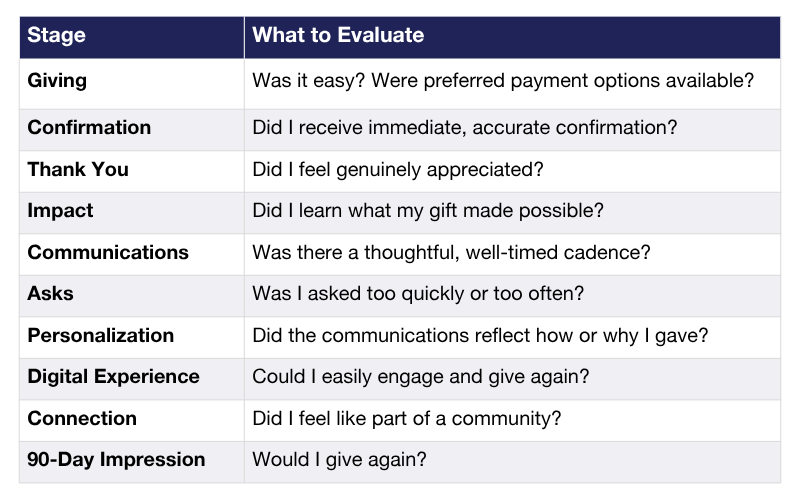
What Your Employees Notice May Surprise You
When you come back together after 90 days, get curious. Don’t defend the process or explain why something happened. Listen for where the experience didn’t match what you intended.
Instead:
- Listen for patterns.
- Listen for moments when the experience doesn’t match their expectation
- Pay attention to moments when they felt ignored, confused or treated transactionally.
- Compare their experience with your intended donor journey.
Before we ask how to get more donors, it’s worth asking whether we’d want to be one of our own.
The Goal is an Improved Donor Journey – Not a Perfect One
At the end of 90 days, you won’t just have another dashboard to review. You’ll have experienced your own donor journey. Find the biggest points of friction and start there.
Stewardship can become a competitive advantage because it builds loyalty. That means reducing friction, improving the acknowledgment experience, communicating impact and, most importantly, understanding what motivates people to give.
If there are fewer donors, we can’t afford to treat the people who do give as transactions. The first 90 days are our opportunity to start building a relationship worth keeping.
This blog is based on an episode of the Go Beyond Fundraising Podcast. Listen here.
See the forces reshaping fundraising
Download the 2026–2027 Giving Outlook for AGP’s complete findings and a clearer view of where nonprofit giving is headed.