

What if the best way to grow your donor base wasn’t to find more donors, but to keep more of the donors you already have?
Nonprofits shouldn’t stop looking for new donors. But they do need to think differently about what happens after someone gives to their organization for the first time. A first gift is an important beginning, but what you do next is just as important for the donor relationship.
As AGP’s CEO Trent Ricker put it in a recent podcast episode, “Retention is the new acquisition.”
When organizations invest in the donor experience, communicate impact, and give people meaningful reasons to stay connected, retention becomes more than a metric. It becomes a growth strategy.
It’s the Donor Experience — Not Acquisition
For many organizations, the challenge isn’t simply acquiring donors. It’s creating a donor experience that gives them a reason to stay. Nonprofits work hard to get that first gift. But then what?
- Has the donor been thanked promptly?
- Do they understand what their gift made possible?
- Are they welcomed into the organization?
- Do your communications reinforce why they gave, or simply ask for another gift?
The first 90 days are critical. Stewardship needs to be built into every layer of the donor experience.
Stewardship is Part of Your Revenue Strategy
After that first gift, there are very real administrative tasks — sending the receipt, a thank-you and other communications. But the strategy behind those tasks is where the growth opportunity lies in building trust, demonstrating impact and strengthening the connection between the donor and the mission. The goal is to understand donor motivations and create opportunities for deeper engagement that can lead to the next gift.
A layered stewardship program can be a competitive advantage when fewer donors are available. It’s what can set you apart and help build lasting loyalty.
Stewardship isn’t what happens after fundraising. Stewardship is an essential part of fundraising.
What Transactional Fundraising Looks Like
A gift is made, and a receipt is sent. While important, the receipt alone is transactional, not a relationship. A meaningful thank-you acknowledges the donor, demonstrates impact and connects them to the mission.
Organizations may deliver multiple communications, but the donor may experience them as disconnected messages. A sequence isn’t automatically a journey from the donor’s perspective.
Look at your communications through a donor’s eyes. Does the first-time donor receive a thank you? Impact reports and insider information? A meaningful introduction to the organization? Or do they just receive another solicitation?
Beyond 90 Days: The First Year is Where Loyalty Takes Shape
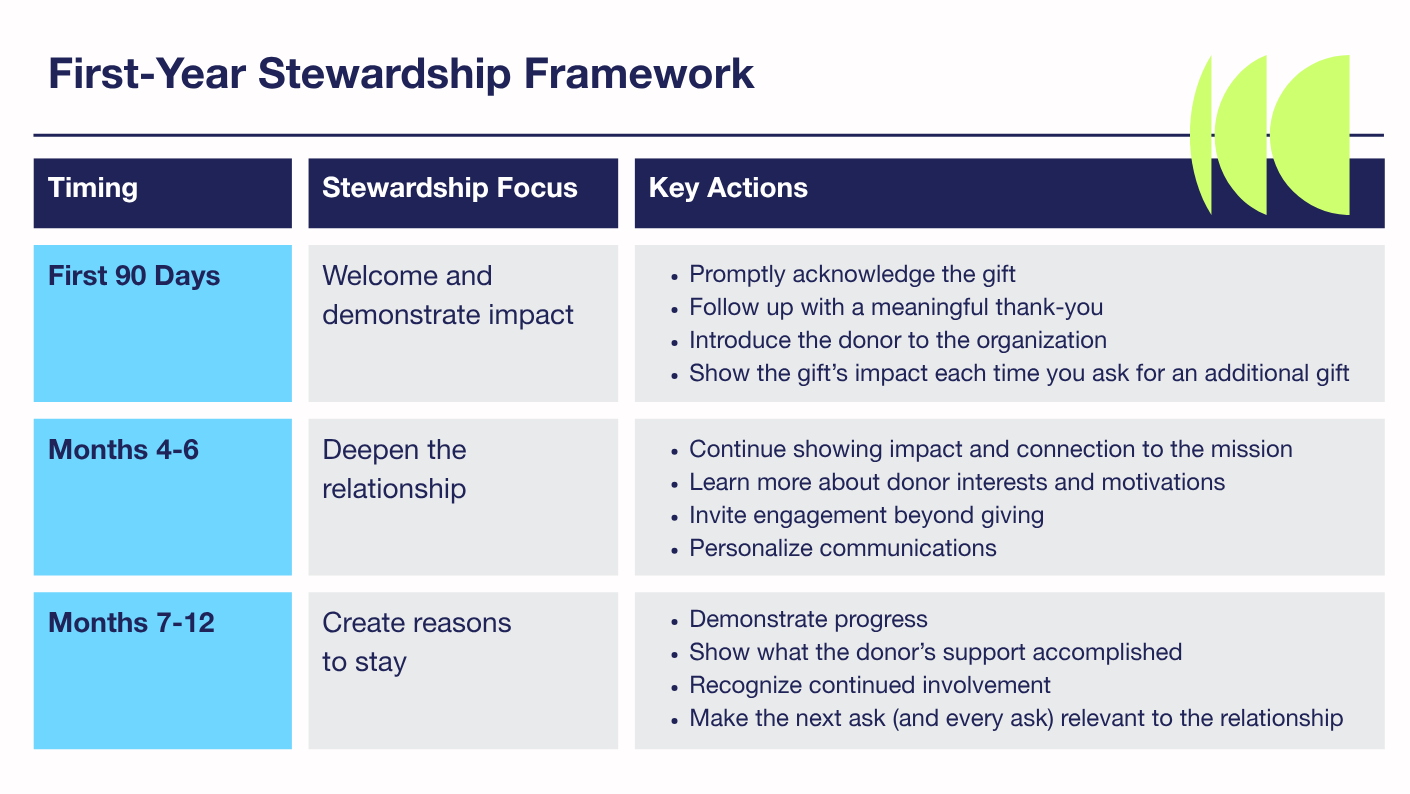
The first gift is an event. Retention is what happens when that event grows into a relationship. A first-year stewardship plan doesn’t have to be complicated. Start by thinking in three stages:
Crisis Donors Are Donors, Too
Food banks offer a useful example. During periods of crisis, from COVID to more recent SNAP-related challenges, many saw an influx of new donors, often through online giving.
The mistake some organizations made was treating these donors as one-time or crisis donors, then dropping them into a normal communications stream.
These donors had already demonstrated that they cared about the mission, and they gave for an emotional reason. The opportunity is to build on that connection. Show them how their support is helping their neighbors. Invite them to volunteer, visit the food bank or learn more about the work.
An intentional stewardship track for crisis-driven donors can acknowledge what prompted the gift, demonstrate impact and create a path toward a second gift and a longer-term relationship.
Investing more heavily in stewardship for episodic donors can improve retention and build greater lifetime value.
The Donor Experience Is Bigger Than the Donation
Healthcare organizations don’t assume that attracting a patient is the end of the experience. Why should nonprofits assume attracting a donor is?
Look at the donor experience from the donor’s point of view. How easy was it to give? Was the process intuitive? Was the gift acknowledged promptly? Did the donor understand what happened next? Did the organization deliver on the promise that inspired the gift?
The donor experience is an organizational responsibility, not just a development team responsibility.
If donors are leaving because of friction or weak stewardship, continually acquiring more donors doesn’t solve the underlying problem. Review the experience for:
- Difficult donation forms or limited payment options
- Poor mobile experience
- Generic messaging
- Immediate repeat solicitations
- Lack of impact communication
- Disconnected communications
- No connection to mission or impact
Before increasing the size of the funnel, give people a reason to stay in it.
Are You Measuring What You Say Matters?
Organizations say they want deeper donor relationships, but their metrics often focus heavily on new names and donor count. If that’s all you measure, you may miss whether the relationships you already have are actually growing in value.
This is an opportunity to ask the following questions:
- Is donor retention measured?
- Is revenue retention measured?
- Are you looking at donor value over multiple years?
- Are stewardship activities funded?
- Does the board hear about retention as often as acquisition?
As Trent Ricker says, “We know retention matters, but acquisition is what gets funded.”
You don’t need a bigger list. You need a scorecard that counts what you say you value.
Make Stewardship Part of the Plan (And Someone’s Job)
Stewardship is a necessity, not a nice-to-have. But for smaller organizations especially, it can easily become something that happens when there is time. The answer isn’t to build a more complicated program. It’s to make stewardship intentional, assign ownership and build it into the way you already work.
Start with three questions:
1. What happens immediately after someone gives?
Do they receive more than a receipt? Is the thank-you timely and meaningful?
2. What reason do we give them to stay connected?
Are we demonstrating impact, reinforcing their connection to the mission and helping them feel part of the organization?
3. Are we measuring what we say matters?
If retention matters, does it show up in the dashboard, budget and board conversations?
From there, build stewardship into the fundraising calendar. Automate repeatable communications and reminders where it makes sense. Reserve staff time for human moments — personal thank-you notes, phone calls, conversations and meaningful follow-up.
The goal isn’t to create a perfect stewardship program overnight. It’s to take manageable steps toward meaningful progress and make stewardship intentional.
Retention Turns Acquisition Into Growth
Stewardship isn’t about doing more for the sake of doing more. It’s about being intentional with the relationships you’ve already worked hard to build.
Acquisition still matters. But when retention is weak, too much of that acquisition simply replaces the donors you’ve lost. When retention is strong, acquisition becomes momentum.
That’s the opportunity. A first gift becomes a second gift. A second gift becomes an ongoing relationship. Over time, those relationships can deepen into monthly, mid-level, major or planned giving.
Before asking how to find more donors, ask what you’re doing to keep the ones you’ve already earned.
This blog is based on an episode of the Go Beyond Fundraising Podcast. Listen here.
Want to turn retention into sustainable growth?
Explore the 2026–2027 Giving Outlook for data-backed insights, practical tools and strategies to help your organization strengthen retention and build a fundraising program that compounds over time.